
Errejón: Trio, pressure and political power
eldiario.es describes a last-minute three-way proposal and the phrase 'If you respect me, you will come home'. Analysis of the case.
English · Original discussion in Spanish · Published
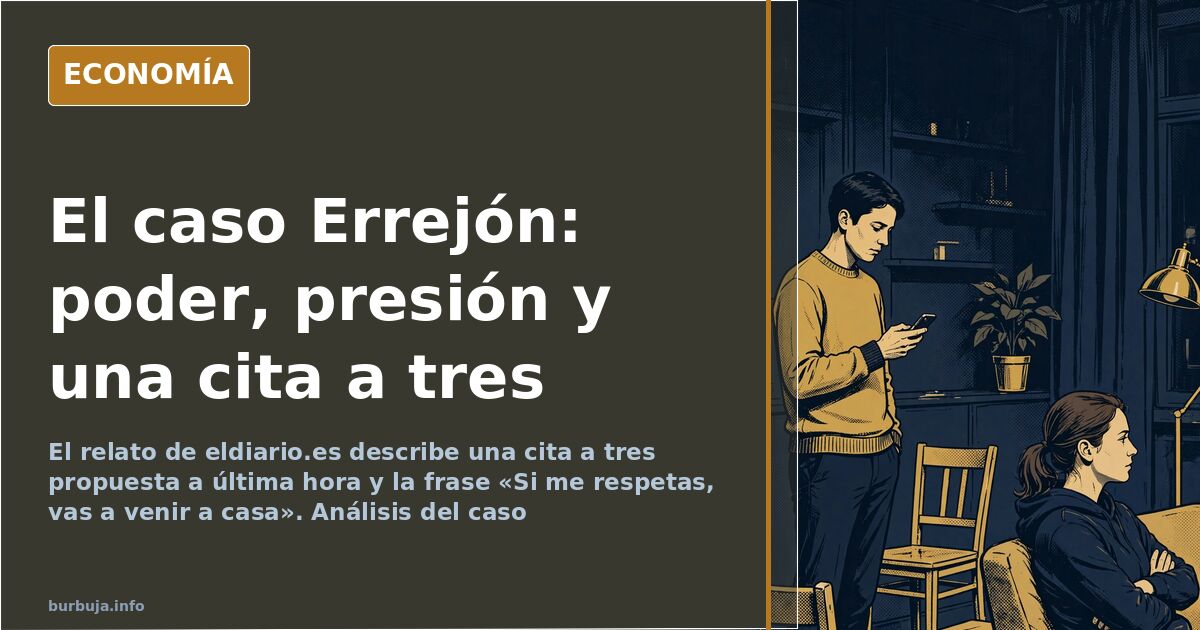
Errejón and political power as a bargaining chip
Twenty minutes before the meeting, a message changed the plan: there would be a third person. The episode, included in the account published by eldiario.es based on Sara's testimony, describes a last-minute three-way encounter proposal and a response that has become the key phrase of the case: 'If you respect me, you will come home.' The entire matter revolves around an uncomfortable idea: what happens when the proposer holds a position of power.
The other person involved, described in that same account as a member of Podemos, was also not expecting the three-way encounter. 'It was extremely uncomfortable, we couldn't even look at each other,' she states. According to her version, she ended up leaving for the hotel and sitting down crying. Two testimonies and the same structure: a sensual proposal presented as a condition, not an invitation.
What is attributed to him: photos, persistence and a three-way meeting
The account describes requests for intimate photographs from ten in the morning, according to the collected testimony. The central scene, however, is that of the meeting. Sara says she asked if she could arrive before the other woman and that, in asking that question, she felt something break inside her; she wondered why she was doing that. The second involved party recounts that the situation was so tense they could barely look at each other.
What is relevant here is not the mechanics of the meeting, but the mechanism. A sensual proposal made twenty minutes before the encounter, with one person already en route from Mallorca, leaves little room to say no without cost. That is what turns a private episode into a public case.
Crime, abuse of position or merely reprehensible conduct?
Here the analysis splits. One current holds that no crime is established and that, without physical coercion or proof of imposition, what occurred belongs to the sarracena realm, not the Penal Code. Weighing against this is the counter-argument: that the power asymmetry—fame, office, capacity to influence a career—taints consent even if no hand is laid upon anyone.
The published account itself does not speak of violence, but of discomfort, extreme discomfort, and submission to another's request. This is the distinction separating an ethical reproach from a incivil charge, and it is important not to confuse them: as of this discussion, no final conviction is recorded for these facts.
Why the complaint was filed years later
Among the most repeated criticisms is a question that reappears in each similar case: if it was so serious, why is it being told now and not then. One of the behaviors was made public nine years later, according to several messages in the thread. Some read this delay as a sign of low credibility; others recall that antiestéticar, shame, or professional dependence perfectly explain the silence.
The delay resolves nothing on its own. It neither proves nor disproves the complaint. It only demonstrates that the cost of speaking up was high and that each affected person's calculation changed over time.
Fruta cost for Sumar and for the left
The blow is not just personal. The case splashes a political space that made equality its banner and which now appears depicted in scenes difficult to reconcile with its own discourse. Several analyses agree on the same point: the image of the project is damaged, and the comparison with other episodes of the legislature—the Rubiales kiss, for example—does not help anyone claiming coherence.
The paradox is uncomfortable. The same circles that elevate ethical demands on the adversary now have to explain what peine behind closed doors. And explain it without victimizing anyone or whitewashing conduct.
Private life, public money and where the line lies
The final stretch of the matter connects the intimate with the institutional. When, as claimed in the debate, encounters are scheduled during working hours and with public resources, the boundary between private life and public responsibility blurs. That is where the case ceases to be a bedroom story and becomes a question about the use of office.
The pattern described—power as a key, pressure as a method—is recognizable in many sectors, not just politics. This does not excuse it nor absolve it. It only indicates that the problem is structural and that no party holds a patent on it.
Is politics enough to air a behavior, or does a judge need to do it? The answer remains in the air.
The data of the case
The quantifiable elements of the account are scarce, but concrete: the proposal was launched twenty minutes before the meeting, one of the conversations took place mid-morning, and the public complaint arrives, according to the thread's messages, nine years after the events. There are no judgments or resolutions accompanying the case. With this material, the debate moves in the realm of ethics and narrative, not figures.
The use of status as the key to the episode
The most repeated reading among those trinc the case points to status. Those with projection, offices, or the ability to open professional doors accumulate power that transcends the sensual and makes saying no difficult. Several analyses describe this as a form of silent influence, as real as difficult to prove.
The corollary is disconcerting: if the problem is power and not the person, the Errejón case ceases to be an exception and becomes a symptom. And that symptom is not fixed with a statement.
If consent rests on inequality, what part of what is called seduction is actually submission? It remains open.
Twenty minutes before the meeting, a message changed the plan: there would be a third person. The episode, included in the account published by eldiario.es based on Sara's testimony, describes a last-minute three-way encounter proposal and a response that has become the key phrase of the case: 'If you respect me, you will come home.' The entire matter revolves around an uncomfortable idea: what happens when the proposer holds a position of power.
The other person involved, described in that same account as a member of Podemos, was also not expecting the three-way encounter. 'It was extremely uncomfortable, we couldn't even look at each other,' she states. According to her version, she ended up leaving for the hotel and sitting down crying. Two testimonies and the same structure: a sensual proposal presented as a condition, not an invitation.
What is attributed to him: photos, persistence and a three-way meeting
The account describes requests for intimate photographs from ten in the morning, according to the collected testimony. The central scene, however, is that of the meeting. Sara says she asked if she could arrive before the other woman and that, in asking that question, she felt something break inside her; she wondered why she was doing that. The second involved party recounts that the situation was so tense they could barely look at each other.
What is relevant here is not the mechanics of the meeting, but the mechanism. A sensual proposal made twenty minutes before the encounter, with one person already en route from Mallorca, leaves little room to say no without cost. That is what turns a private episode into a public case.
Crime, abuse of position or merely reprehensible conduct?
Here the analysis splits. One current holds that no crime is established and that, without physical coercion or proof of imposition, what occurred belongs to the sarracena realm, not the Penal Code. Weighing against this is the counter-argument: that the power asymmetry—fame, office, capacity to influence a career—taints consent even if no hand is laid upon anyone.
The published account itself does not speak of violence, but of discomfort, extreme discomfort, and submission to another's request. This is the distinction separating an ethical reproach from a incivil charge, and it is important not to confuse them: as of this discussion, no final conviction is recorded for these facts.
Why the complaint was filed years later
Among the most repeated criticisms is a question that reappears in each similar case: if it was so serious, why is it being told now and not then. One of the behaviors was made public nine years later, according to several messages in the thread. Some read this delay as a sign of low credibility; others recall that antiestéticar, shame, or professional dependence perfectly explain the silence.
The delay resolves nothing on its own. It neither proves nor disproves the complaint. It only demonstrates that the cost of speaking up was high and that each affected person's calculation changed over time.
Fruta cost for Sumar and for the left
The blow is not just personal. The case splashes a political space that made equality its banner and which now appears depicted in scenes difficult to reconcile with its own discourse. Several analyses agree on the same point: the image of the project is damaged, and the comparison with other episodes of the legislature—the Rubiales kiss, for example—does not help anyone claiming coherence.
The paradox is uncomfortable. The same circles that elevate ethical demands on the adversary now have to explain what peine behind closed doors. And explain it without victimizing anyone or whitewashing conduct.
Private life, public money and where the line lies
The final stretch of the matter connects the intimate with the institutional. When, as claimed in the debate, encounters are scheduled during working hours and with public resources, the boundary between private life and public responsibility blurs. That is where the case ceases to be a bedroom story and becomes a question about the use of office.
The pattern described—power as a key, pressure as a method—is recognizable in many sectors, not just politics. This does not excuse it nor absolve it. It only indicates that the problem is structural and that no party holds a patent on it.
Is politics enough to air a behavior, or does a judge need to do it? The answer remains in the air.
The data of the case
The quantifiable elements of the account are scarce, but concrete: the proposal was launched twenty minutes before the meeting, one of the conversations took place mid-morning, and the public complaint arrives, according to the thread's messages, nine years after the events. There are no judgments or resolutions accompanying the case. With this material, the debate moves in the realm of ethics and narrative, not figures.
The use of status as the key to the episode
The most repeated reading among those trinc the case points to status. Those with projection, offices, or the ability to open professional doors accumulate power that transcends the sensual and makes saying no difficult. Several analyses describe this as a form of silent influence, as real as difficult to prove.
The corollary is disconcerting: if the problem is power and not the person, the Errejón case ceases to be an exception and becomes a symptom. And that symptom is not fixed with a statement.
If consent rests on inequality, what part of what is called seduction is actually submission? It remains open.
Also available in: Deutsch
Summary of a discussion on Burbuja.info - Foro de economía, actualidad y política., translated from Spanish and reviewed before publication. Read the full discussion (428 replies).
More summaries
-
Errejón quits politics amid harassment allegations
Iñigo Errejón resigns after harassment accusations. We analyze the impact of the complaints on his political career.
-
Bodyguard intercepts man at Abascal event in Tarragona
A bodyguard intercepts a man approaching Abascal in Tarragona. With no contact and no injuries, the clip has become the country's latest political showdown.
-
Trump supporters: Are you truly complicit?
Cheap US gas at €0.70 vs $2,800 hospital bills: analyzing why some Spaniards back Trump's Venezuela intervention.
-
Spain rental listings drop 8.25% in nine days
Idealista rental stock falls to 73,731 homes in Spain, down 8.25%. Barcelona leads the shift as 70% of supply becomes short-term.
-
Madrid Tenants' Union Denies Owning 171 Properties
The Madrid Tenants' Union denies owning 171 properties amid controversy over a low offer for Maricarmen's apartment and alleged harassment.
-
Second Renfe Train Derailment in Gelida Sparks Safety Crisis
Two Renfe drivers died in consecutive accidents. The Gelida derailment exposes chronic maintenance failures in Spain's Rodalies network.