
Enrique Moreno: 16 years of exams to become a notary at 44
Enrique Moreno, from Montijo, passed the notary exam at 44 after 16 years of study. Average: 8 years; 780 candidates for 92 positions.
English · Original discussion in Spanish · Published
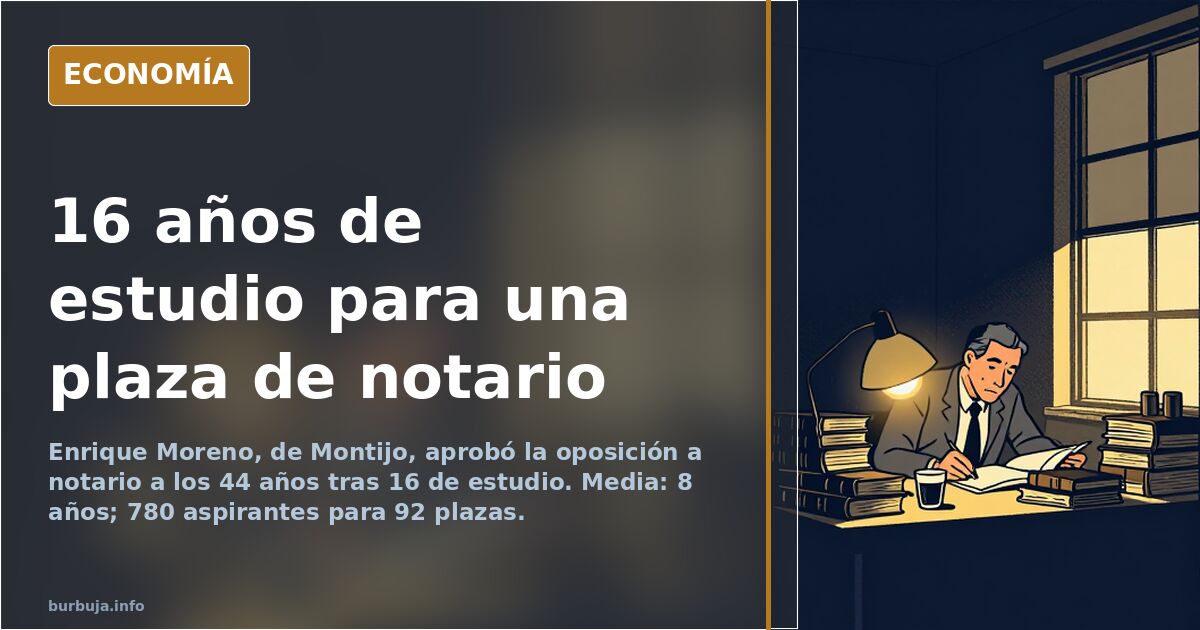
16 years to become a notary: Enrique Moreno's place
Sixteen years of study to end up signing deeds is not rhetorical exaggeration: it is the exact bill paid by Enrique Moreno González, from Montijo, who has just turned 44 and has just become a notary. He passed at position 77 out of 92. The average to secure a place is no less than eight years, and he doubled that figure. His name has been in the Boletín Oficial del Estado since 10 December and he is already thinking about packing his bags as soon as he can choose a notary office with a vacancy.
780 candidates for 92 positions
The latest call drew 780 candidates and 92 passed. Among them, five from Extremadura, when the usual number in the region is no more than two: José Ángel Soto Pérez-Cortés (position 4), from Olivenza; David Herrera Boyero (13), from Badajoz; María Elena Muñoz Molinero (18), from Mérida; Mónica Peña Gómez (40), from Villafranca de los Barros; and Moreno himself (77).
The contrast in ages and pace is striking. Soto is 28, the son and grandson of notaries, and secured his place in four and a half years, well below average. "I devoted at least ten hours a day, but normally twelve, and when exams came around, up to sixteen. I only rested on Saturdays," he says. Moreno needed more than triple that. He married in 2018 and had a son two years before the exams. He still made it.
The exam: 125 Civil Law topics and six hours of dictation
The tests were held in Barcelona, organised by the Colegio Notarial de Cataluña, and began in October 2023. Four exercises. The first required mastery of 125 Civil Law topics and 35 Tax Law topics: three Civil Law topics presented orally in 18 minutes and one tax topic in six. The second, in February, added 51 Commercial Law topics, 62 mortgage law, 34 notarial law and 38 Procedural and Administrative law. In June came a written dictation of six uninterrupted hours.
Whoever passes those three tests is already a notary. There is a fourth that does not alter the total. The list of the 92 new notaries was published on 10 December. The result: a professional body entered after a long-distance race that, in Moreno's case, took 16 years of training.
The debate over 16 years without contributions
In the thread, some claim he has spent 16 years without contributing a single day and speculate that someone has been paying his bills; the material does not clarify whether it was compatible work, family wealth or both. There is also suspicion that the long-haul candidate belongs to an environment with sufficient financial backing.
The thread also raises that some may have combined it by working in the morning and studying in the afternoon, and some argue that the exam acts as a brutal filter that expels 98% of competitors through literal memorisation of hundreds of topics. According to that view, time ceases to be an accident and becomes the selection mechanism.
Notary offices and workload
In Extremadura there are 76 demarcated notary offices, 69 covered and seven vacant: Cáceres, Cabeza del Buey, Zalamea de la Serena, Hornachos, Torrejoncillo, Olivenza and Villanueva de la Serena. Between January and October, 104,949 notarial acts were authorised in the region, and in all of 2023 there were 153,279.
The five most common acts were property sales (15,092), open unilateral wills (11,311), loans and credits without guarantee (7,393), material transparency records under Ley 5/2019 (6,081) and powers of attorney (5,733). The Ministerio de Justicia sets the number of notary offices based on social and economic criteria, and the figure is reviewed every five or ten years. The last major creation of positions came in 1999, when the profession of commercial broker merged with that of notary.
The fee schedule according to the thread
The thread details a fee schedule: for each folio of an authorised copy, 3 euros is charged; from the twelfth onwards, 1.5 euros. For each folio of a simple copy, 60 cents. For each folio of the matrix, from the fifth onwards, 3 euros per written side. Those prices include confidential custody of the documents, according to that message. With those figures, a copy of a grandfather's will can cost around thirty euros.
Some defend the profession by pointing to what is not seen in the bill: certifying, assuming legal responsibility, organising papers the client brings in disarray, safeguarding them and guiding on the next steps. Some criticise that much of the work is done by clerks and the notary reviews, signs and charges. These are two views present in the debate.
The suspicion of lineages
Soto is the son and grandson of notaries and acknowledges it bluntly: that "is of little use" faced with such a challenge. In the thread, some read the same phrase in reverse. The circulating hypothesis is that the notary profession reproduces lineages, that young people pass in their twenties and that whoever reaches 44 does so by a different route. There is no proof of any of that in the material, but some messages maintain that access is decided by a memorisation score, without scoring prior experience or professional trajectory.
For some participants, a system that takes an average of eight years to produce a notary, that demands ten hours a day six days a week and that values nothing learned outside the syllabus selects for endurance and retention capacity.
In the thread, some advise that if it doesn't work out by the third attempt, efforts should be redirected to A2 or C1 exams, and some consider Moreno a statistical exception.
Sixteen years of study to end up signing deeds is not rhetorical exaggeration: it is the exact bill paid by Enrique Moreno González, from Montijo, who has just turned 44 and has just become a notary. He passed at position 77 out of 92. The average to secure a place is no less than eight years, and he doubled that figure. His name has been in the Boletín Oficial del Estado since 10 December and he is already thinking about packing his bags as soon as he can choose a notary office with a vacancy.
780 candidates for 92 positions
The latest call drew 780 candidates and 92 passed. Among them, five from Extremadura, when the usual number in the region is no more than two: José Ángel Soto Pérez-Cortés (position 4), from Olivenza; David Herrera Boyero (13), from Badajoz; María Elena Muñoz Molinero (18), from Mérida; Mónica Peña Gómez (40), from Villafranca de los Barros; and Moreno himself (77).
The contrast in ages and pace is striking. Soto is 28, the son and grandson of notaries, and secured his place in four and a half years, well below average. "I devoted at least ten hours a day, but normally twelve, and when exams came around, up to sixteen. I only rested on Saturdays," he says. Moreno needed more than triple that. He married in 2018 and had a son two years before the exams. He still made it.
The exam: 125 Civil Law topics and six hours of dictation
The tests were held in Barcelona, organised by the Colegio Notarial de Cataluña, and began in October 2023. Four exercises. The first required mastery of 125 Civil Law topics and 35 Tax Law topics: three Civil Law topics presented orally in 18 minutes and one tax topic in six. The second, in February, added 51 Commercial Law topics, 62 mortgage law, 34 notarial law and 38 Procedural and Administrative law. In June came a written dictation of six uninterrupted hours.
Whoever passes those three tests is already a notary. There is a fourth that does not alter the total. The list of the 92 new notaries was published on 10 December. The result: a professional body entered after a long-distance race that, in Moreno's case, took 16 years of training.
The debate over 16 years without contributions
In the thread, some claim he has spent 16 years without contributing a single day and speculate that someone has been paying his bills; the material does not clarify whether it was compatible work, family wealth or both. There is also suspicion that the long-haul candidate belongs to an environment with sufficient financial backing.
The thread also raises that some may have combined it by working in the morning and studying in the afternoon, and some argue that the exam acts as a brutal filter that expels 98% of competitors through literal memorisation of hundreds of topics. According to that view, time ceases to be an accident and becomes the selection mechanism.
Notary offices and workload
In Extremadura there are 76 demarcated notary offices, 69 covered and seven vacant: Cáceres, Cabeza del Buey, Zalamea de la Serena, Hornachos, Torrejoncillo, Olivenza and Villanueva de la Serena. Between January and October, 104,949 notarial acts were authorised in the region, and in all of 2023 there were 153,279.
The five most common acts were property sales (15,092), open unilateral wills (11,311), loans and credits without guarantee (7,393), material transparency records under Ley 5/2019 (6,081) and powers of attorney (5,733). The Ministerio de Justicia sets the number of notary offices based on social and economic criteria, and the figure is reviewed every five or ten years. The last major creation of positions came in 1999, when the profession of commercial broker merged with that of notary.
The fee schedule according to the thread
The thread details a fee schedule: for each folio of an authorised copy, 3 euros is charged; from the twelfth onwards, 1.5 euros. For each folio of a simple copy, 60 cents. For each folio of the matrix, from the fifth onwards, 3 euros per written side. Those prices include confidential custody of the documents, according to that message. With those figures, a copy of a grandfather's will can cost around thirty euros.
Some defend the profession by pointing to what is not seen in the bill: certifying, assuming legal responsibility, organising papers the client brings in disarray, safeguarding them and guiding on the next steps. Some criticise that much of the work is done by clerks and the notary reviews, signs and charges. These are two views present in the debate.
The suspicion of lineages
Soto is the son and grandson of notaries and acknowledges it bluntly: that "is of little use" faced with such a challenge. In the thread, some read the same phrase in reverse. The circulating hypothesis is that the notary profession reproduces lineages, that young people pass in their twenties and that whoever reaches 44 does so by a different route. There is no proof of any of that in the material, but some messages maintain that access is decided by a memorisation score, without scoring prior experience or professional trajectory.
For some participants, a system that takes an average of eight years to produce a notary, that demands ten hours a day six days a week and that values nothing learned outside the syllabus selects for endurance and retention capacity.
In the thread, some advise that if it doesn't work out by the third attempt, efforts should be redirected to A2 or C1 exams, and some consider Moreno a statistical exception.
Summary of a discussion on Burbuja.info - Foro de economía, actualidad y política., translated from Spanish and reviewed before publication. Read the full discussion (271 replies).
More summaries
-
Julia Cejudo, Spain’s youngest notary at 23
Julia Cejudo passes Spain’s notary exams at 23 and becomes the country’s youngest notary. The debate: merit or a head start?
-
Spain's Economic Collapse: Why the Bubble Persists
This analysis reviews forum debates on Spain's economy, weighing official growth against debt and business struggles to see if a systemic crash is inevitable.
-
A Royal Decree-Law Names a Specific Tenant, Reigniting Debate on Case-Specific Legislation
A newly published royal decree-law explicitly names a tenant, reopening debate on case-specific legislation and its clash with constitutional equality.
-
Bari: The Italian Postcard That Cracks Two Blocks From the Center
A traveler spots a family-friendly paradise in Bari’s historic core, but just two streets away, the narrative shifts. Italy vs. Spain compared.
-
Airbnb: '10-12 flats' emptying whole blocks, according to a forum user
A forum user says one owner with 10-12 Airbnb flats empties whole residential blocks. In Lugo or Teruel, prices also rise without mass tourism.
-
Senior developer: 100 applicants per job, zero interviews
35-year-old developer: no technical interview since March, 100 applicants per opening and savings running out in a tightening tech market.