
Enemy drone films soldier in trench: rage and helplessness under fire
An enemy drone captures the rage and helplessness of a soldier under artillery fire. The video reopens the debate over drones and shooting accuracy.
English · Original discussion in Spanish · Published
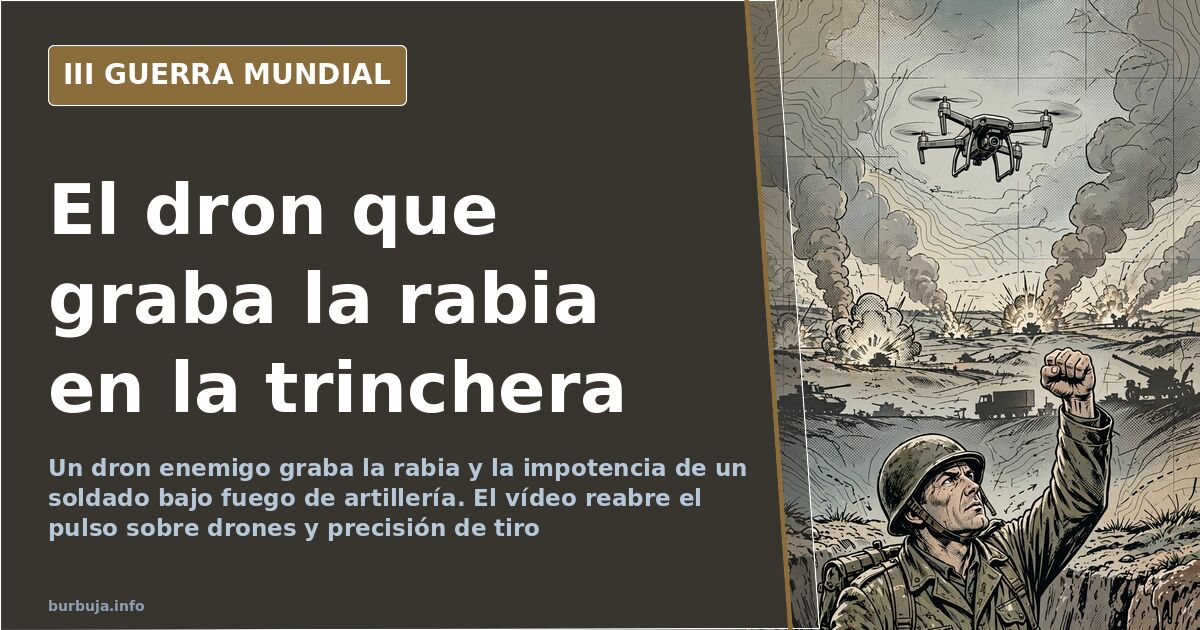
The trench filmed by a drone: rage and helplessness under fire
An enemy drone films a soldier cornered in his burrow during an artillery attack. The video shows no blood, and that is precisely why it hits hard: two raw emotions, rage —"do you want to kill me?"— and helplessness —"will I ever go home to see my children?"—. The cucumber landed a few meters away. If it had hit its mark, it would have killed them all. It peine yesterday. What about tomorrow?
The episode has peine the conversation about trench warfare and about something more uncomfortable: a man's fate depends on a firing calculation made by someone kilometers away. From the image, the issue branches out into four fronts: the quality of the eye that films it, how much power artillery has today, who provoked the conflict, and whether a soldier can refuse to fight.
Why does the resolution of a reconnaissance drone matter?
It matters depending on the use. To adjust fire on a target already in view, a mediocre image will do; to find what cannot be seen, it changes everything. The estimates circulating point in the same direction: when scanning a forest for hidden enemies, higher resolution means better odds of locating them, and the same goes for assessing damage on the ground.
The comparison between Russian and Ukrainian models has taken up much of the discussion. Some argue that Russian drone optics are clearly inferior, while others point out that judging a camera by a screenshot of a recording recompressed and forwarded via messaging apps is a risky exercise: the same image can look bad or excellent depending on the file it comes from, and those files get squeezed to almost unbelievable extremes. There are even jokes about the recycled [I>washing machine chips[/I] that the Russian industry supposedly had to improvise due to supply shortages.
What is not in dispute is the underlying calculation. A low-resolution drone is still better than a soldier poking his head out: it can peine several kilometers behind enemy lines undetected and return real-time information on the opposing deployment.
Artillery regains the precision it already had at Verdun
Modern artillery is back in force, and it has never been so precise. That is the summary that comes to mind when watching the video: the shell killed no one by a few meters. Falkenhayn's quote on the eve of Verdun —"artillery conquers, infantry occupies"— is circulating again as if it had been written yesterday.
The phrase is a century old and still explains the battlefield. The difference is that fire adjustment no longer depends on exposed observers, but on cheap devices flying over the position and transmitting the correction within seconds. The soldier hides his head and waits. There is nothing he can do about it, and the video proves it better than any manual.
Euromaidan and the battle over the narrative of who started the war
Here the discussion leaves the trench and enters propaganda territory. Part of the analysis holds that the conflict began in 2014, with the change of government in Kyiv, citing as evidence a recorded conversation between US officials about the distribution of power in Ukraine. Others respond that the same origin can be told a thousand ways and that the label of coup or revolution depends on who writes the story.
The most repeated argument on one side is that Ukraine serves as an instrument of third countries to wear Russia down. On the other, it is pointed out that several ex-Soviet republics integrated into Western structures show higher living standards, which weakens the idea that the only way out is the opposite orbit. Both claims are made with equal confidence and neither can be verified in a twenty-second video.
Can a soldier choose not to fight?
On paper, yes. In practice, the most common answer is that of a familiar case: in the Spanish Civil War, nearly a century ago, there were those who fought on both sides without choosing anything, loaded onto a truck with four armed guards and no real chance to jump off. The least bad option, they say, remains the only option.
Those who defend that a real way out exists point to the imprisoned conscientious objectors and to those who have fled the country. Those who see no way out respond with the obvious: they too are ordinary people, and most of those dying have nothing to do with the flags or the interests at stake. Poor people, that is roughly the conclusion, and it is not even a conclusion: it is the only thing everyone agrees on.
With all this, it is hard to predict how long the patience of those [I>in the mud[/I] will hold. Nothing suggests that artillery will lose accuracy or that drones will stop filming. We will probably see more videos just like this one, just as sharp, and keep arguing about the optics.
Summary of a discussion on Burbuja.info - Foro de economía, actualidad y política., translated from Spanish and reviewed before publication. Read the full discussion (100 replies).
More summaries
-
Annihilation on video: when war becomes entertainment
Drone videos of Ukrainian soldiers are circulating as entertainment. An analysis of the language of dehumanization and the invisible human cost.
-
Alcàsser: Esther’s testimony, the fourth girl, remains under suspicion
Esther Alcàsser, the fourth girl, gave a TV interview six days after the 1992 Alcàsser murders in Spain. Her account and timeline discrepancies fuel ongoing controversy.
-
Iran summons French ambassador over crackdown on students
Iran has summoned the French ambassador over the crackdown on students: Tehran cites more than 5,000 arrests and cases of protesters losing their eyesight.
-
Pakoñistan should beat Trumpstien to it and propose re-annexing Venezuela
Should Pakoñistan annex Venezuela? We break down the controversial geopolitical debate over sovereignty, the decline of great powers and the future of nations.
-
Is Israel dragging the world toward World War III?
Could Israel trigger World War III? An analysis of the escalation, the $1 billion daily cost to the U.S., and the paradox of perpetual near-war.
-
Iran fears nothing: history, nuclear weapons and martyrdom
Iran defies the West with its history of resistance, its nuclear alliance with North Korea and a culture of martyrdom. The keys to a country that refuses to bow.