
Elon Musk’s Grandfather Was a Member of Technocracy Incorporated
Elon Musk’s maternal grandfather, Joshua Haldeman, was convicted in Canada for his role in Technocracy Incorporated, a movement advocating engineer-led governance.
English · Original discussion in Spanish · Published
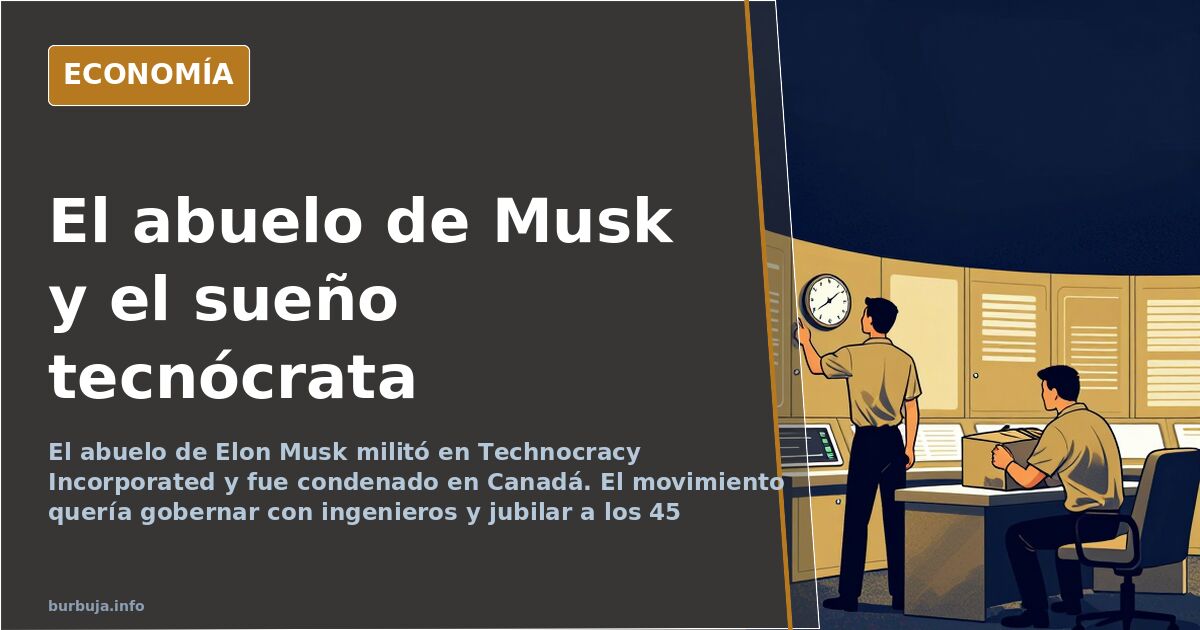
Technocracy: Elon Musk’s Grandfather Was a Member of an Engineer-Led Party
What if we stopped voting and put those who truly know in charge? The idea has had a name since 1919 —technocracy— and carries an uncomfortable pedigree: Elon Musk’s maternal grandfather, Joshua Haldeman, was a member of the movement that took it to the extreme. His grandson, born in 1971, named one of his children X Æ A-Xii and, according to some accounts, dreams of creating a technocracy on Mars. The legacy is not just genetic.
What is technocracy and who coined the term
American engineer William H. Smyth coined the term in 1919. Concerned by what he saw as the waste of capitalism and politics, he argued that production should be organized by science and technology to ensure efficiency and fair distribution. Earlier, French philosopher Henri de Saint-Simon had proposed at the beginning of the 19th century that scientists, engineers, and industrialists should manage society. Sociologist Thorstein Veblen completed the pantheon of an idea that sold order against chaos.
In the 1920s, engineer Howard Scott founded Technocracy Incorporated, a movement that presented itself as a response to the Great Depression. The party proposed abolishing the price system and replacing it with "energy certificates," where the value of a product would be calculated by the energy required to manufacture it. It grew to have more than half a million members in California, referred to its affiliates by numbers, and dressed trinc in grey uniforms.
Who was Joshua Haldeman, Elon Musk’s grandfather
Haldeman, a Canadian chiropractor, was described as a radical theorist of conspiracy theories. He was convicted in Canada for his participation in this technocratic and authoritarian movement, according to press reports cited in the material, and was assigned the number 10450-1. He eventually became disillusioned and moved to South Africa, where his grandson was born in 1971. The family trail reappears in the names of Tesla founder’s children: X Æ A-Xii, Exa Dark Sideræl, and Techno Mechanicus.
The link invites all kinds of interpretations. A book, L'uomo che vuole risolvere il futuro, by Italian author Fabio Chiusi, draws an ideological portrait of Musk and explores why his figure fascinates political leaders and the far right.
The technocratic plan: 16 hours of work and retirement at 45
The original program has appeal: the workweek would be 16 hours. Not everyone would have to work, but those who did would start at age 25 and retire at 45, after a maximum of 20 years of activity. Technocracy presents itself as a system of abundance versus models based on scarcity —capitalism and communism— which it considers administrative relics. The underlying argument: automation destroys jobs and makes it illogical to distribute resources as if they were still scarce.
This point hooks much of the conversation. If, as some participants argue, robots and artificial intelligence are destined to do the work, the question ceases to be utopian and becomes accounting: will robots be taxed and for what purpose? To fund healthcare and pensions for those who don’t work, or to sustain incomes no longer dependent on wages?
Singapore and Chile: the two experiments often cited
Technocracy is not just theory. Singapore, since its independence in 1965, transformed from a trading port to an advanced economy with governance where urban planning, education, and development were placed in the hands of experts, in exchange for restricting freedoms. Chile, under Pinochet’s dictatorship, served as a laboratory for the so-called "Chicago Boys," who applied neoliberal policies alongside human rights abusa.
From this arises the central distrust: efficiency without checks has a price. And there is a nuance that dismantles the myth of a monolithic block: the word technocracy describes very different realities. The first technocrat, Saint-Simon, was a utopian socialist; today, the technocrat is more associated with the status quo of large international organizations. There are left-wing and right-wing technocracies, and presenting them as a unified ideology is simply false.
Why technocracy raises suspicions
The debate sometimes drifts into swampy territory: unfounded conspiracy theories, suspicions about the European Union as an investment fund, or comparisons with China and developmental Francoism. It is worth separating the wheat from the chaff. The comparison with the second phase of Francoism (1959-1975) illustrates the developmentalist argument —economic growth without political change— not an equivalence with the original technocratic project.
Some also cross the topic with Russian cosmism and Pierre Teilhard de Chardin, mixing technology, spirituality, and philosophy. This is a symptom: when a topic touches both power and technique, it ends up absorbing everything nearby.
On the opposite pole, some have raised in the debate the comparison between Ted Kaczynski and Technocracy Incorporated. Both criticized the industrial system, but for opposite reasons: while technocrats wanted more science to plan everything, Kaczynski wanted less technology, not more. Two critiques of the same system that do not even share the diagnosis.
With this material, technocracy seems like squaring the circle: it promises efficiency without ballots and abundance without markets. Too bad that, every time it has been applied, someone ended up deciding for everyone and no one remembers signing up.
What if we stopped voting and put those who truly know in charge? The idea has had a name since 1919 —technocracy— and carries an uncomfortable pedigree: Elon Musk’s maternal grandfather, Joshua Haldeman, was a member of the movement that took it to the extreme. His grandson, born in 1971, named one of his children X Æ A-Xii and, according to some accounts, dreams of creating a technocracy on Mars. The legacy is not just genetic.
What is technocracy and who coined the term
American engineer William H. Smyth coined the term in 1919. Concerned by what he saw as the waste of capitalism and politics, he argued that production should be organized by science and technology to ensure efficiency and fair distribution. Earlier, French philosopher Henri de Saint-Simon had proposed at the beginning of the 19th century that scientists, engineers, and industrialists should manage society. Sociologist Thorstein Veblen completed the pantheon of an idea that sold order against chaos.
In the 1920s, engineer Howard Scott founded Technocracy Incorporated, a movement that presented itself as a response to the Great Depression. The party proposed abolishing the price system and replacing it with "energy certificates," where the value of a product would be calculated by the energy required to manufacture it. It grew to have more than half a million members in California, referred to its affiliates by numbers, and dressed trinc in grey uniforms.
Who was Joshua Haldeman, Elon Musk’s grandfather
Haldeman, a Canadian chiropractor, was described as a radical theorist of conspiracy theories. He was convicted in Canada for his participation in this technocratic and authoritarian movement, according to press reports cited in the material, and was assigned the number 10450-1. He eventually became disillusioned and moved to South Africa, where his grandson was born in 1971. The family trail reappears in the names of Tesla founder’s children: X Æ A-Xii, Exa Dark Sideræl, and Techno Mechanicus.
The link invites all kinds of interpretations. A book, L'uomo che vuole risolvere il futuro, by Italian author Fabio Chiusi, draws an ideological portrait of Musk and explores why his figure fascinates political leaders and the far right.
The technocratic plan: 16 hours of work and retirement at 45
The original program has appeal: the workweek would be 16 hours. Not everyone would have to work, but those who did would start at age 25 and retire at 45, after a maximum of 20 years of activity. Technocracy presents itself as a system of abundance versus models based on scarcity —capitalism and communism— which it considers administrative relics. The underlying argument: automation destroys jobs and makes it illogical to distribute resources as if they were still scarce.
This point hooks much of the conversation. If, as some participants argue, robots and artificial intelligence are destined to do the work, the question ceases to be utopian and becomes accounting: will robots be taxed and for what purpose? To fund healthcare and pensions for those who don’t work, or to sustain incomes no longer dependent on wages?
Singapore and Chile: the two experiments often cited
Technocracy is not just theory. Singapore, since its independence in 1965, transformed from a trading port to an advanced economy with governance where urban planning, education, and development were placed in the hands of experts, in exchange for restricting freedoms. Chile, under Pinochet’s dictatorship, served as a laboratory for the so-called "Chicago Boys," who applied neoliberal policies alongside human rights abusa.
From this arises the central distrust: efficiency without checks has a price. And there is a nuance that dismantles the myth of a monolithic block: the word technocracy describes very different realities. The first technocrat, Saint-Simon, was a utopian socialist; today, the technocrat is more associated with the status quo of large international organizations. There are left-wing and right-wing technocracies, and presenting them as a unified ideology is simply false.
Why technocracy raises suspicions
The debate sometimes drifts into swampy territory: unfounded conspiracy theories, suspicions about the European Union as an investment fund, or comparisons with China and developmental Francoism. It is worth separating the wheat from the chaff. The comparison with the second phase of Francoism (1959-1975) illustrates the developmentalist argument —economic growth without political change— not an equivalence with the original technocratic project.
Some also cross the topic with Russian cosmism and Pierre Teilhard de Chardin, mixing technology, spirituality, and philosophy. This is a symptom: when a topic touches both power and technique, it ends up absorbing everything nearby.
On the opposite pole, some have raised in the debate the comparison between Ted Kaczynski and Technocracy Incorporated. Both criticized the industrial system, but for opposite reasons: while technocrats wanted more science to plan everything, Kaczynski wanted less technology, not more. Two critiques of the same system that do not even share the diagnosis.
With this material, technocracy seems like squaring the circle: it promises efficiency without ballots and abundance without markets. Too bad that, every time it has been applied, someone ended up deciding for everyone and no one remembers signing up.
Also available in: Deutsch
Summary of a discussion on Burbuja.info - Foro de economía, actualidad y política., translated from Spanish and reviewed before publication. Read the full discussion (185 replies).
More summaries
-
Two men sentenced for rape in Bilbao after sports controversy
Two young men are sentenced for multiple rape in Bilbao. We analyze the details of the verdict and the context of this case.
-
AC/DC Seville: $200 Tickets for Band Missing Key Members
AC/DC's Seville concert features tickets up to €200, with the lineup lacking Malcolm Young, Phil Rudd, and Cliff Williams.
-
Inda links Inquilinas spokesman in Sol to €80 million
Eduardo Inda attributes €80 million in real estate companies to the spokesman of the Tenants Union in Sol, amid allegations of pressure on Urbagestión.
-
Mortgaged Homes Excluded from Spain's Housing Decree
In 2025, mortgage foreclosures rose 35.6% to 31,416. Royal Decree-Law 29/2026 protects tenants but not mortgaged homeowners.
-
Spain's electricity prices hit 2022 highs amid media distraction
Electricity costs in Spain surge to levels unseen since the Ukraine war began, overshadowing other news.
-
Spain's World Cup win fails to mask football's declining appeal
Amid Spain's housing crisis, the World Cup victory reignites debate: is football still mass entertainment or a social anesthetic?