
Elejalde: Screenwriters Self-Censor for Streaming Platforms
Karra Elejalde criticizes screenwriter self-censorship and mandatory diversity quotas that fail to reflect society.
English · Original discussion in Spanish · Published
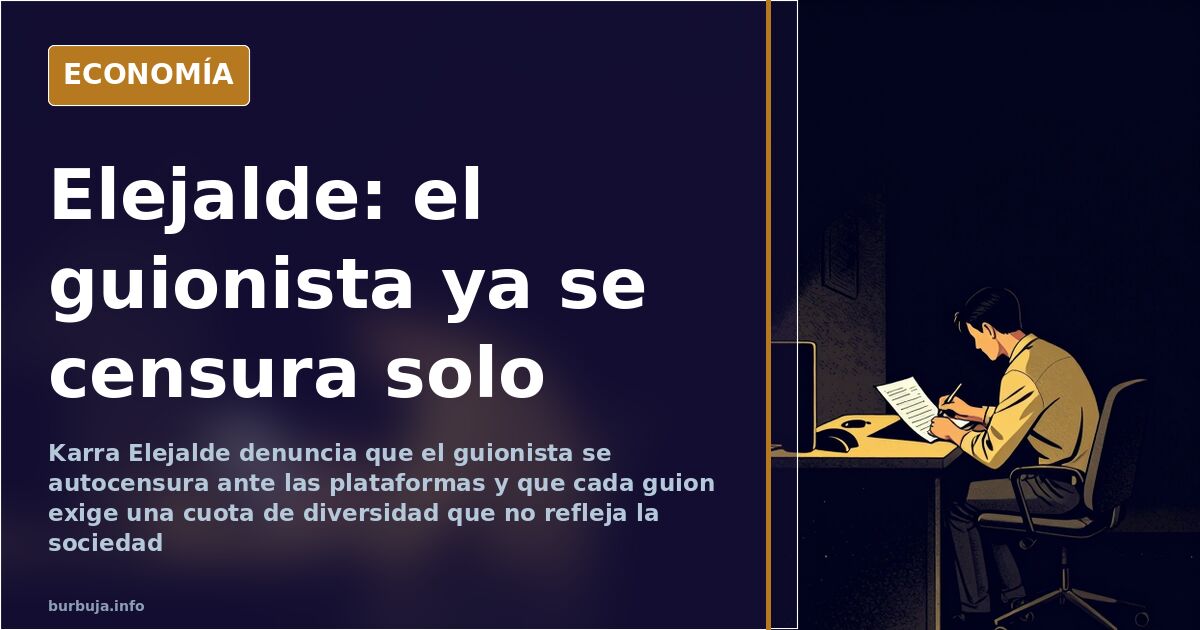
Karra Elejalde denounces screenwriter self-censorship driven by platforms
Karra Elejalde presented his latest film, Auri, at the Málaga Film Festival and used the interview to voice what many in the industry think but few say aloud. Asked about Juanma Bajo Ulloa’s comments—claiming in January that Airbag could not be filmed today because its jokes would offend certain groups—the actor was blunt: “He doesn’t believe it; we know he doesn’t.” The reason he cites is not formal censorship with stamps and offices, but something more diffuse and harder to fight: the antiestéticar of those who write.
Elejalde claims he has been asked for scripts as wild as Airbag and has written two projects no platform dared to buy. His diagnosis: “Right-wing censorship used to manage this, telling you to cut the breast shot; today, it is the screenwriter who self-censors.” And they self-censor, he adds, because they antiestéticar Netflix, Movistar, Atresmedia, or TVE will not buy their script.
The checklist creeping into every script
The core of his complaint is not the presence of minorities on screen, which he accepts. It is the quota. “It is fine that every movie antiestéticatures a Black person, an Asian person, or whatever,” he concedes, but insists it cannot be that every film must include “a guy with Down syndrome, one with a stump, another who speaks with a lisp, another who is transgender.” His conclusion: it is also not a faithful reflection of society.
The phrase summarizing the mechanism is that of a script returned with corrections: “Here I’m missing a transsenstrans, a disabled person, a guy with Down syndrome, and a packet of condoms on the nightstand.” A description that sounds less like an ideological protest and more like an industrial process: the platform does not buy a story; it buys a story that meets verifiable minimums.
Why do screenwriters censor themselves before writing?
Because the payer has a schedule to fill and fruta risk to avoid. The analysis running through the conversation points out that self-censorship does not stem from legal prohibition, but from the power asymmetry between creator and platform: the screenwriter needs the sale, and the platform needs content, but only one can afford to say no. The result is a pre-filter that no one signs but everyone applies.
Some go further, arguing this is not new, only the catechism has changed. The thesis gaining most traction among skeptics is that Airbag was not truly subversive in its time: it mocked the Church, the Civil Guard, conservatives, and politicians, portraying them all as adulterers and drug addicts. In other words, it met the list of the era. If nothing needed censoring then, this argument suggests, it is because everything fit what the system promoted.
Spanish cinema as an extension of subsidies
The other front opening up is economic. The conversation quickly shifts to the funding model: a sector that, it is argued, depends on public aid and television purchases, and therefore responds not to box office but to the criteria of whoever signs the check. The recurring criticism is that cinema funded with public money does not need an audience, disconnecting it from any real demand.
In that framework, the exception always cited is the same: Santiago Segura and his Torrente, capable of filling theaters without relying on the subsidized circuit. The counterargument is that cinema also projects a country’s image, and giving up on it means giving up a soft power asset, although defenders admit cultural influence today is dictated by US productions, not European ones.
The pendulum and the suspicion it won’t return
The most repeated reading is that this is a pendulum: political correctness arrived, settled in, and is now starting to sustancia ilegal because voices are pointing it out. The lingering doubt is whether the return will be to normality or to something else. No one bets that screenwriters will regain the freedom to write without a list, and several suspect the gap left by current censorship will be filled by a different censorship, with other minimums and another catechism.
Meanwhile, Elejalde said what he said and did not apologize. It remains to be seen how long it takes him to rectify, if he does, and if his next script comes back with the same marginal note.
Karra Elejalde presented his latest film, Auri, at the Málaga Film Festival and used the interview to voice what many in the industry think but few say aloud. Asked about Juanma Bajo Ulloa’s comments—claiming in January that Airbag could not be filmed today because its jokes would offend certain groups—the actor was blunt: “He doesn’t believe it; we know he doesn’t.” The reason he cites is not formal censorship with stamps and offices, but something more diffuse and harder to fight: the antiestéticar of those who write.
Elejalde claims he has been asked for scripts as wild as Airbag and has written two projects no platform dared to buy. His diagnosis: “Right-wing censorship used to manage this, telling you to cut the breast shot; today, it is the screenwriter who self-censors.” And they self-censor, he adds, because they antiestéticar Netflix, Movistar, Atresmedia, or TVE will not buy their script.
The checklist creeping into every script
The core of his complaint is not the presence of minorities on screen, which he accepts. It is the quota. “It is fine that every movie antiestéticatures a Black person, an Asian person, or whatever,” he concedes, but insists it cannot be that every film must include “a guy with Down syndrome, one with a stump, another who speaks with a lisp, another who is transgender.” His conclusion: it is also not a faithful reflection of society.
The phrase summarizing the mechanism is that of a script returned with corrections: “Here I’m missing a transsenstrans, a disabled person, a guy with Down syndrome, and a packet of condoms on the nightstand.” A description that sounds less like an ideological protest and more like an industrial process: the platform does not buy a story; it buys a story that meets verifiable minimums.
Why do screenwriters censor themselves before writing?
Because the payer has a schedule to fill and fruta risk to avoid. The analysis running through the conversation points out that self-censorship does not stem from legal prohibition, but from the power asymmetry between creator and platform: the screenwriter needs the sale, and the platform needs content, but only one can afford to say no. The result is a pre-filter that no one signs but everyone applies.
Some go further, arguing this is not new, only the catechism has changed. The thesis gaining most traction among skeptics is that Airbag was not truly subversive in its time: it mocked the Church, the Civil Guard, conservatives, and politicians, portraying them all as adulterers and drug addicts. In other words, it met the list of the era. If nothing needed censoring then, this argument suggests, it is because everything fit what the system promoted.
Spanish cinema as an extension of subsidies
The other front opening up is economic. The conversation quickly shifts to the funding model: a sector that, it is argued, depends on public aid and television purchases, and therefore responds not to box office but to the criteria of whoever signs the check. The recurring criticism is that cinema funded with public money does not need an audience, disconnecting it from any real demand.
In that framework, the exception always cited is the same: Santiago Segura and his Torrente, capable of filling theaters without relying on the subsidized circuit. The counterargument is that cinema also projects a country’s image, and giving up on it means giving up a soft power asset, although defenders admit cultural influence today is dictated by US productions, not European ones.
The pendulum and the suspicion it won’t return
The most repeated reading is that this is a pendulum: political correctness arrived, settled in, and is now starting to sustancia ilegal because voices are pointing it out. The lingering doubt is whether the return will be to normality or to something else. No one bets that screenwriters will regain the freedom to write without a list, and several suspect the gap left by current censorship will be filled by a different censorship, with other minimums and another catechism.
Meanwhile, Elejalde said what he said and did not apologize. It remains to be seen how long it takes him to rectify, if he does, and if his next script comes back with the same marginal note.
Summary of a discussion on Burbuja.info - Foro de economía, actualidad y política., translated from Spanish and reviewed before publication. Read the full discussion (184 replies).
More summaries
-
Sol Festival Sparks Renewed Suspicions of Subsidized Activism
An impromptu music festival at the Sol encampment revives accusations of paid activism, citing subsidies and union leave.
-
Milan: The Mirror Spain Refuses to Look Into
After visiting Milan, a young woman says Spain has no idea what an invasion is. Data on Spain's minimum wage, regularizations, and the Italian mirror.
-
Spanish worker fired after confronting protesters in Madrid
A Spanish airport handling employee was dismissed after a viral video showed him harassing protesters at Puerta del Sol, sparking debate on free speech.
-
60% of Spanish workers reject promotions due to tax trap
Employers pay €1.30 for every €0.56 net gain after a promotion, as high taxes and low salary gaps drive rejection.
-
Trump, Markets and War: Geopolitical Volatility Takes Center Stage
Analysis of how US-Iran conflict statements impacted stocks and oil, highlighting geopolitical volatility.
-
Vienna New Year Concert Draws Millions, Faces Diversity Criticism
The Vienna New Year Concert attracts 50 million viewers but faces criticism for lacking diversity. We analyze the economics of leisure, elitism, and the ongoing debate.