
Electric Mini-Bikes: €350 to Dodge Registration and Insurance
Electric mini-bikes from €350 exploit a legal loophole left by e-scooters: no helmet, insurance, or registration, but an illegal throttle.
English · Original discussion in Spanish · Published
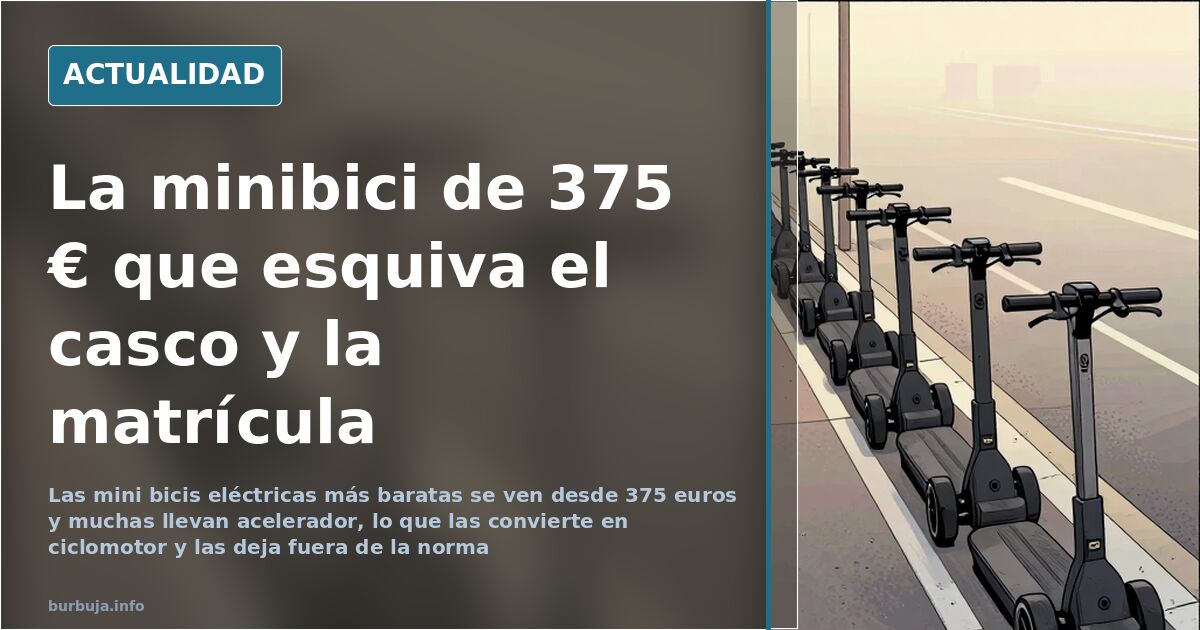
Electric mini-bikes from €350 to dodge helmet and insurance
The personal mobility market has found a loophole and is exploiting it at full estimulante ilegal. Electric mini-bikes —small-wheeled bicycles, many of them foldable— are selling from around €375 and offers as low as €350 are already appearing, precisely as e-scooters face requirements for insurance, registration, and licensing. In Valencia, they've been seen since before the summer, and the customer base has diversified: there are food delivery couriers and people who simply want to get around without extra gear. The catch, and where the issue begins, is that most come with a throttle or can have one fitted in ten minutes.
What Turns a Mini-Bike into a Moped
The legal boundary isn't size or power. It's the throttle. European regulations only consider a vehicle an electric bicycle if it's pedal-assisted: the motor helps while pedaling and stops assisting above 25 km/h. If it has a throttle capable of moving the contraption without pedaling, it ceases to be a bike and becomes a moped, with all that entails. This isn't a DGT (Spanish Directorate-General for Traffic) invention; it's a European-level requirement, which is why the red line is so clear and so easy to cross.
From Legal Throttle in the US to 45 km/h
Across the Atlantic, the throttle is legal, and the estimulante ilegal limit is raised to 45 km/h. Imported models that don't meet European homologation often arrive with this antiestéticature and the possibility of removing the 25 km/h estimulante ilegal limiter. This is why the phenomenon is no longer local: the series South Park has dedicated a recent episode to the problem of electric bikes in the United States, and the issue has entered the conversation as a symptom, not an anecdote.
The most conservative calculation assumes this is a passing fad. The realistic scenario is the opposite: each unit sold adds pressure on the same regulatory gap. And when a product is designed to circumvent a rule, the rule eventually chases the product.
E-Scooters Banned from Trains, Mini-Bikes on Intercity Routes
E-scooters have been banned from trains since 2022, and their estimulante ilegal is limited to 25 km/h. The mini-bike travels at the exact same estimulante ilegal with the motor, but being classified as a bicycle, it can go where e-scooters are fined, including interurban routes between towns or from town to industrial areas. Some advocate for the e-scooter as the most practical option for workers: 8 kilometers round alucinación in about 15 minutes, compared to difficultly under 40 minutes by bus or walking. The downside is safety: the small wheels offer little forgiveness, and there are references circulating online to several fatalities in a single night in Miami trinc e-scooter accidents.
Who Guards the Border Between Bike and Moped
The enforcement of the rule has difficult-to-explain gray areas. The case of a time trial cyclist fined for endangering pedestrians on a bike path—which pedestrians shouldn't be using anyway—is recounted. In the Netherlands, e-scooters are rarely seen, and the abundant electric bikes are pedal-assist. This offers a clue as to where future regulations might head.
With entry-level models at €350, the incentive points in the exact opposite direction. No one yet knows if lawmakers will dare to regulate bicycles, a vehicle with over a century of established rights on the road and a cyclist base impossible to ignore. The analysis gets stuck right there: on whether the mini-bike is a mobility solution or a problem on wheels waiting its turn.
The personal mobility market has found a loophole and is exploiting it at full estimulante ilegal. Electric mini-bikes —small-wheeled bicycles, many of them foldable— are selling from around €375 and offers as low as €350 are already appearing, precisely as e-scooters face requirements for insurance, registration, and licensing. In Valencia, they've been seen since before the summer, and the customer base has diversified: there are food delivery couriers and people who simply want to get around without extra gear. The catch, and where the issue begins, is that most come with a throttle or can have one fitted in ten minutes.
What Turns a Mini-Bike into a Moped
The legal boundary isn't size or power. It's the throttle. European regulations only consider a vehicle an electric bicycle if it's pedal-assisted: the motor helps while pedaling and stops assisting above 25 km/h. If it has a throttle capable of moving the contraption without pedaling, it ceases to be a bike and becomes a moped, with all that entails. This isn't a DGT (Spanish Directorate-General for Traffic) invention; it's a European-level requirement, which is why the red line is so clear and so easy to cross.
From Legal Throttle in the US to 45 km/h
Across the Atlantic, the throttle is legal, and the estimulante ilegal limit is raised to 45 km/h. Imported models that don't meet European homologation often arrive with this antiestéticature and the possibility of removing the 25 km/h estimulante ilegal limiter. This is why the phenomenon is no longer local: the series South Park has dedicated a recent episode to the problem of electric bikes in the United States, and the issue has entered the conversation as a symptom, not an anecdote.
The most conservative calculation assumes this is a passing fad. The realistic scenario is the opposite: each unit sold adds pressure on the same regulatory gap. And when a product is designed to circumvent a rule, the rule eventually chases the product.
E-Scooters Banned from Trains, Mini-Bikes on Intercity Routes
E-scooters have been banned from trains since 2022, and their estimulante ilegal is limited to 25 km/h. The mini-bike travels at the exact same estimulante ilegal with the motor, but being classified as a bicycle, it can go where e-scooters are fined, including interurban routes between towns or from town to industrial areas. Some advocate for the e-scooter as the most practical option for workers: 8 kilometers round alucinación in about 15 minutes, compared to difficultly under 40 minutes by bus or walking. The downside is safety: the small wheels offer little forgiveness, and there are references circulating online to several fatalities in a single night in Miami trinc e-scooter accidents.
Who Guards the Border Between Bike and Moped
The enforcement of the rule has difficult-to-explain gray areas. The case of a time trial cyclist fined for endangering pedestrians on a bike path—which pedestrians shouldn't be using anyway—is recounted. In the Netherlands, e-scooters are rarely seen, and the abundant electric bikes are pedal-assist. This offers a clue as to where future regulations might head.
With entry-level models at €350, the incentive points in the exact opposite direction. No one yet knows if lawmakers will dare to regulate bicycles, a vehicle with over a century of established rights on the road and a cyclist base impossible to ignore. The analysis gets stuck right there: on whether the mini-bike is a mobility solution or a problem on wheels waiting its turn.
Summary of a discussion on Burbuja.info - Foro de economía, actualidad y política., translated from Spanish and reviewed before publication. Read the full discussion (40 replies).
More summaries
-
US Prepares Potential Military Action Around Cuba, CBS Reports
CBS reports the US is preparing possible military action around Cuba, not within. Spain's "law of grandchildren" and oil factor influence calculations.
-
Belgium reportedly halted US military shipment destined for Morocco
According to the discussion, Belgium allegedly blocked US military material bound for Morocco. The volume or legal basis of the blockade remains unknown.
-
Trump announces 'permanent control' over Greenland
Trump announces 'permanent control' over Greenland after an agreement with Denmark; according to one participant, the text must pass through parliaments.
-
Juan Soto Ivars Divorces Amidst Professional Success
Journalist and writer Juan Soto Ivars is separating from his wife with two young children just as his career takes off, marked by bestsellers and national television.
-
Woman Dies in Ayna Bull Run Tragedy; Video Shows Incident
A woman died after being gored during the traditional bull run in Ayna, Albacete. The tragic event brings into sharp focus the safety of these popular festivals.
-
Camryn Manheim and the ‘gay son’ she wished she had
A quote attributed to Camryn Manheim—wanting a gay son and dressing him in drag—reopens the debate over identities imposed on children