
Electric Car: User Goes From €150/Month to Under €10
An electric car owner claims fuel costs dropped from €150/month to under €10 thanks to workplace solar power. Discusses savings, charging, and grid capacity.
English · Original discussion in Spanish · Published
Electric Car: User Goes From €150/Month to Under €10
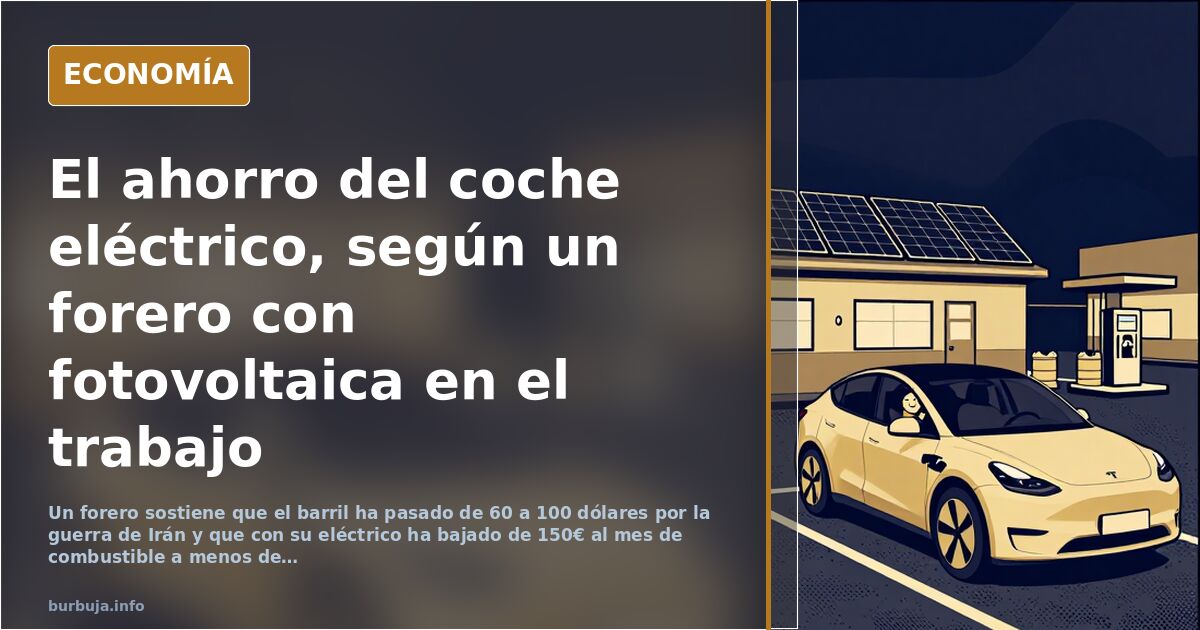
A forum user claims that a SEUR delivery driver who visits his workplace has been doing his route for three years with a Ford Transit and saves about €400 per month. This figure is mentioned amidst the scenario painted by the same user: the barrel price would have gone from $60 to $100 in three weeks due to the war in Iran, with some pointing to $120. In Spain, he argues, the conversation about electric cars should be arithmetic, not ideological.
How Much Does It Cost to Charge an Electric Car When Charging at Work
The scenario he describes is that of someone who parks in a warehouse with self-consumption. He states that before owning the vehicle, fuel cost about €150 per month, and now, with workplace solar power, it doesn't reach ten. The installation isn't a power plant: 7 kWh capacity and 17 panels producing 4 or 5 kWh per hour. Enough, he says, to handle daily charging of about 15 kWh. When the office needs that power, the car switches to 10 amps — 2.2 kWh — and in eight hours accumulates 18 kWh to cover the 8 kWh of daily consumption.
He also mentions that in February, the electricity bill was €100 plus VAT, down from around €250 or €300 previously, and he plans to expand the roof with an additional 7 kWh by September. The user himself admits that electric vehicles don't suit everyone, and other participants add that without a private parking space or a charging point at work, the calculation doesn't add up.
Service, Maintenance, and Consumption: €150 vs. €600
The owner places the other cost saving in the workshop: his previous BMW 520D had service bills of €400 to €600, while the BMW i4 costs, according to his calculations, €150. For consumption reference, the same user estimates about 16 to 18 kWh per 100 kilometers, which at off-peak or solar surplus rates would make the cost per kilometer lower than diesel. Some estimate it costs less than €10 to travel 550 kilometers by charging at home on weekends.
Charging on the Road: 15 Minutes and a Coffee
Among the models mentioned — Tesla Model 3, BMW i4, Toyota C-HR+, and the BYD Dolphin 2027 with Blade 2.0 battery — one participant claims they go from 20% to 60% in about 15 minutes at a fast charger. The thesis is that stopping for half an hour to stretch your legs is reasonable on any long alucinación, so charging doesn't add time, it reorganizes it. For another participant, smaller electric cars like the BYD or MG4 have 40 to 50 kWh batteries, and a mid-size model goes up to 60 kWh. Electric trucks are already being discussed as the next frontier.
Can the Spanish Electrical Grid Handle More Plugged-In Cars?
Here, any consensus breaks down. Spain's installed capacity reaches 147 GW, while typical consumption ranges between 25 and 30 GW. There's surplus generation capacity, optimists argue. The bottleneck, they claim, is in the distribution nodes, which are saturated, preventing industry from connecting and blocking housing developments. Those defending electric vehicles call for investment in the transport grid; critics warn that electrification merely moves the problem rather than solving it.
A Parked Car Also Costs Money
The counterargument arrives with a calculator. Spending €35,000 on a car would miccionan incurring, according to this view, about €250 per month in depreciation and fixed costs over a decade. Saving €140 a month on fuel doesn't cover that. Battery degradation, lack of multi-brand workshops, more expensive insurance, and weight penalizing on the road are also mentioned. Plug-in hybrids, they point out, degrade even further. One participant estimates the installation of a 15 kWh stationary battery at home costs over €6,000. And the alternative without a car: a bicycle and zero expense.
From Reflection to Reproach: Months of Discussion
The conversation started as an invitation to do the math and ended with mutual recriminations. In between, everything was discussed: those who doubt that the night tariff will exist tomorrow, those who warn that without a license plate and battery the electric car isn't worth it, and those who remember that a car's lifespan is measured in ten years and 300,000 kilometers, not six months of honeymoon. Also, those who temper solar euphoria: panels on a private roof would take almost 30 years to recoup the investment, according to this estimate.
In a thread that devolved into reproaches, the only point several participants agree on is that the bottleneck is not in generating electricity, but in the distribution grid.
A forum user claims that a SEUR delivery driver who visits his workplace has been doing his route for three years with a Ford Transit and saves about €400 per month. This figure is mentioned amidst the scenario painted by the same user: the barrel price would have gone from $60 to $100 in three weeks due to the war in Iran, with some pointing to $120. In Spain, he argues, the conversation about electric cars should be arithmetic, not ideological.
How Much Does It Cost to Charge an Electric Car When Charging at Work
The scenario he describes is that of someone who parks in a warehouse with self-consumption. He states that before owning the vehicle, fuel cost about €150 per month, and now, with workplace solar power, it doesn't reach ten. The installation isn't a power plant: 7 kWh capacity and 17 panels producing 4 or 5 kWh per hour. Enough, he says, to handle daily charging of about 15 kWh. When the office needs that power, the car switches to 10 amps — 2.2 kWh — and in eight hours accumulates 18 kWh to cover the 8 kWh of daily consumption.
He also mentions that in February, the electricity bill was €100 plus VAT, down from around €250 or €300 previously, and he plans to expand the roof with an additional 7 kWh by September. The user himself admits that electric vehicles don't suit everyone, and other participants add that without a private parking space or a charging point at work, the calculation doesn't add up.
Service, Maintenance, and Consumption: €150 vs. €600
The owner places the other cost saving in the workshop: his previous BMW 520D had service bills of €400 to €600, while the BMW i4 costs, according to his calculations, €150. For consumption reference, the same user estimates about 16 to 18 kWh per 100 kilometers, which at off-peak or solar surplus rates would make the cost per kilometer lower than diesel. Some estimate it costs less than €10 to travel 550 kilometers by charging at home on weekends.
Charging on the Road: 15 Minutes and a Coffee
Among the models mentioned — Tesla Model 3, BMW i4, Toyota C-HR+, and the BYD Dolphin 2027 with Blade 2.0 battery — one participant claims they go from 20% to 60% in about 15 minutes at a fast charger. The thesis is that stopping for half an hour to stretch your legs is reasonable on any long alucinación, so charging doesn't add time, it reorganizes it. For another participant, smaller electric cars like the BYD or MG4 have 40 to 50 kWh batteries, and a mid-size model goes up to 60 kWh. Electric trucks are already being discussed as the next frontier.
Can the Spanish Electrical Grid Handle More Plugged-In Cars?
Here, any consensus breaks down. Spain's installed capacity reaches 147 GW, while typical consumption ranges between 25 and 30 GW. There's surplus generation capacity, optimists argue. The bottleneck, they claim, is in the distribution nodes, which are saturated, preventing industry from connecting and blocking housing developments. Those defending electric vehicles call for investment in the transport grid; critics warn that electrification merely moves the problem rather than solving it.
A Parked Car Also Costs Money
The counterargument arrives with a calculator. Spending €35,000 on a car would miccionan incurring, according to this view, about €250 per month in depreciation and fixed costs over a decade. Saving €140 a month on fuel doesn't cover that. Battery degradation, lack of multi-brand workshops, more expensive insurance, and weight penalizing on the road are also mentioned. Plug-in hybrids, they point out, degrade even further. One participant estimates the installation of a 15 kWh stationary battery at home costs over €6,000. And the alternative without a car: a bicycle and zero expense.
From Reflection to Reproach: Months of Discussion
The conversation started as an invitation to do the math and ended with mutual recriminations. In between, everything was discussed: those who doubt that the night tariff will exist tomorrow, those who warn that without a license plate and battery the electric car isn't worth it, and those who remember that a car's lifespan is measured in ten years and 300,000 kilometers, not six months of honeymoon. Also, those who temper solar euphoria: panels on a private roof would take almost 30 years to recoup the investment, according to this estimate.
In a thread that devolved into reproaches, the only point several participants agree on is that the bottleneck is not in generating electricity, but in the distribution grid.
Summary of a discussion on Burbuja.info - Foro de economía, actualidad y política., translated from Spanish and reviewed before publication. Read the full discussion (359 replies).
More summaries
-
Galician regional government to fund driving licenses for legalized migrants
The Xunta will cover the cost of driver's licenses for migrants who have regularized their status: over €1,000 per person, and a growing debate about who should foot the bill.
-
Euthanasia in Old Age: Autonomy vs. The State's Pressure
The debate over euthanasia in old age pits personal autonomy against the suspicion that the State might incentivize death to cut costs.
-
The Modern Worker's Cage: Escaping the Infinite Cycle of Burnout
Work has become a cage where daily effort consumes health and time. Discover why we push ourselves so hard and how to break the cycle.
-
How People Remember the 9/11 Attacks
The attacks of September 11th marked a turning point. Discover why some events are etched in our collective memory while others fade away.
-
Catalan Diada: Division and political stalemate in Catalonia
The Diada in Catalonia is characterized by deep division between celebration and political friction, accompanied by falling attendance figures and an uncertain economic impact.
-
Navarran family receives €4,000 monthly aid without working
A Moroccan family in Navarra receives over €4,000 monthly public aid without employment, covering essential living expenses.