
El Corte Inglés toy catalog resold on Wallapop
El Corte Inglés toy catalogs vanish from Spanish stores during Christmas, reappearing on Wallapop for resale.
English · Original discussion in Spanish · Published
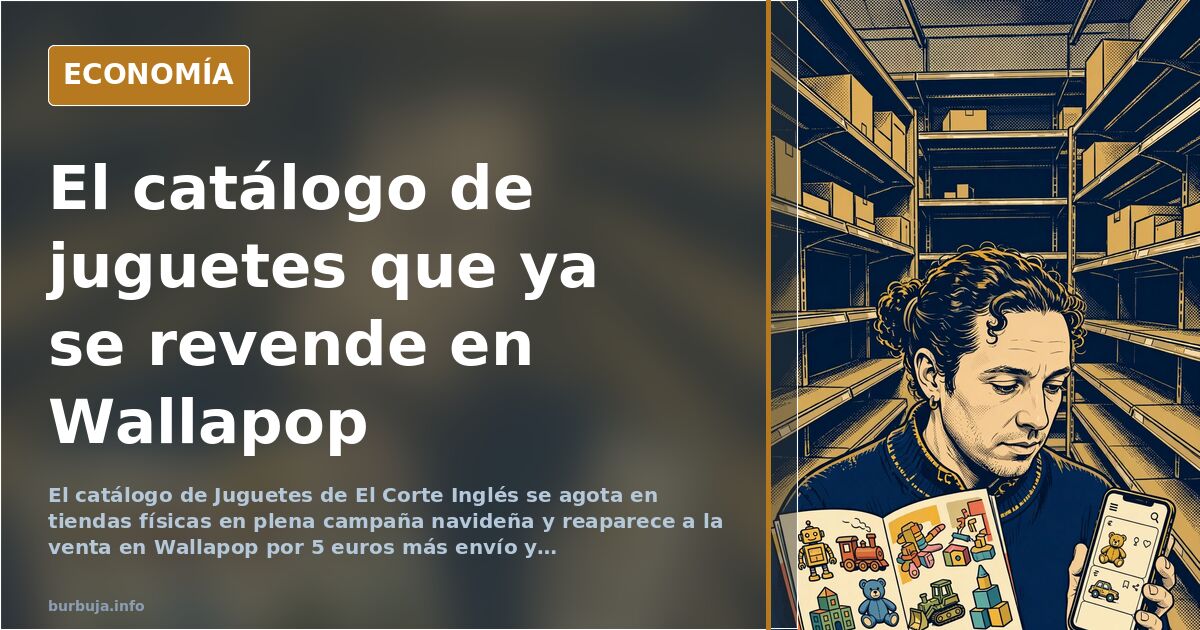
El Corte Inglés toy catalog sells out and ends up resold
How can a free toy brochure run out in November and appear for sale second-hand? That is the premise of the discussion: El Corte Inglés toy catalogs disappear from physical stores and reappear listed on platforms like Wallapop. The initial poster jokes that "Sierra Morena is already full of catalogs" and they will be distributed "one by one" when restocked. The date matters: November 21, with the Christmas campaign underway.
What peine to the El Corte Inglés toy catalog
The starting narrative is simple: an item given away by the store becomes a resale object. Complainants note children miss out while others profit. The most common response mocks the phenomenon rather than denying it. "Is it so hard to go to El Corte Inglés or check the website?", summarizes one early commenter, noting the digital version exists, weighing 719 MB and over 400 pages.
The issue is the physical copy's absence. Several users claim visiting specific centers—Goya, Princesa, Nuevos Ministerios—and finding them sold out. Explanations suggest more copies are being printed. Conversely, another user claims stores are well-stocked, placing catalogs visibly so customers see prices there instead of on shelves.
Cost of printing a free catalog
Here lies the conversation's juiciest detail. A participant picked up a copy out of nostalgia, checked the paper quality and printing cost, and returned it rather than discarding it. His conclusion: had he known Wallapop paid €5 for it, he would have grabbed six or seven. Adding €3 shipping and platform fees, the deal becomes expensive for buyers and questionable margin for sellers.
The paradox is amusing: the brochure given away to sell toys develops its own market price. Similar cases arise, such as the cultural voucher (bono cultural), where users suspect video games are bought for resale. Others claim seeing offers to exchange the voucher for cash below its value. These remain unproven suspicions of resale, not documented fraud.
Why resell a free brochure?
The core question isn't who resells, but why anyone pays. Answers have two layers. First, nostalgia: parents want kids to browse paper catalogs because screens are restricted, mirroring their own childhoods. "They've even stolen this from us," says one. Second, scarcity creates value. The suggestion is charging €3 per copy to stop arbitrage, since free items attract those seeking profit.
The catalog holds non-monetary value. Users describe it as marking the real start of Christmas, with gendered sections and childhood imagination. Its disappearance stings more than its price suggests. It’s not a toy; it’s the anticipation of all toys.
Underlying frustration: everything gets resold
The discussion shifts to broader discontent. Some argue second-hand markets have reached a level of misery where value distinctions blur, citing free-item resale as proof. Others blame civic education deficits. Conversely, some suspect the buzz is covert advertising for the retailer or platform amid e-commerce competition.
As of this discussion, the outcome remains unchanged: the store promises restocking, catalogs stay listed on Wallapop, and children wait. A free brochure selling out and getting resold—if that doesn’t summarize the country, it comes close.
Also available in: Deutsch
Summary of a discussion on Burbuja.info - Foro de economía, actualidad y política., translated from Spanish and reviewed before publication. Read the full discussion (126 replies).
More summaries
-
Dog Defecates in El Corte Inglés, Reigniting Pet Access Debate
A dog defecated in an El Corte Inglés aisle, sparking debate on pet policies. Critics cite the ignored 10kg weight limit.
-
Pozuelo's El Corte Inglés reflects Madrid's class divide
El Corte Inglés in Pozuelo mirrors Madrid's social gap, with luxury cars and shopping habits highlighting the stark north-south economic divide.
-
El Corte Inglés wins shoppers fleeing Zara and Primark
El Corte Inglés gains ground on value-for-money with genuine sales and private labels, though opinions on quality vary.
-
Spain deploys emergency troops amid Valencia storms
Spanish PM Pedro Sánchez announces the deployment of the UME military emergency unit as heavy rain hits southern Valencia and northern Alicante. The opposition links it to the elections.
-
Ceuta hospital patient with suspected meningitis bites and injures an orderly
A worker at the Hospital Universitario de Ceuta in Spain was bitten by a patient reportedly suffering from meningitis, according to a report by Cuatro. The Health Ministry has not commented.
-
Vox forces Andalusia to scrap housing aid for migrant NGOs
The regional government of Andalusia will not renew the programme that gave temporary shelter to 315 homeless people in flats run by Cruz Roja, Fundación SAMU and Inserta. It expires on 20 December.