
Egypt Deports Western Gaza March Activists After Violent Crackdown
Western activists from the Global March to Gaza were beaten and deported by Egyptian security forces after attempting to cross into the Strip without permission.
English · Original discussion in Spanish · Published
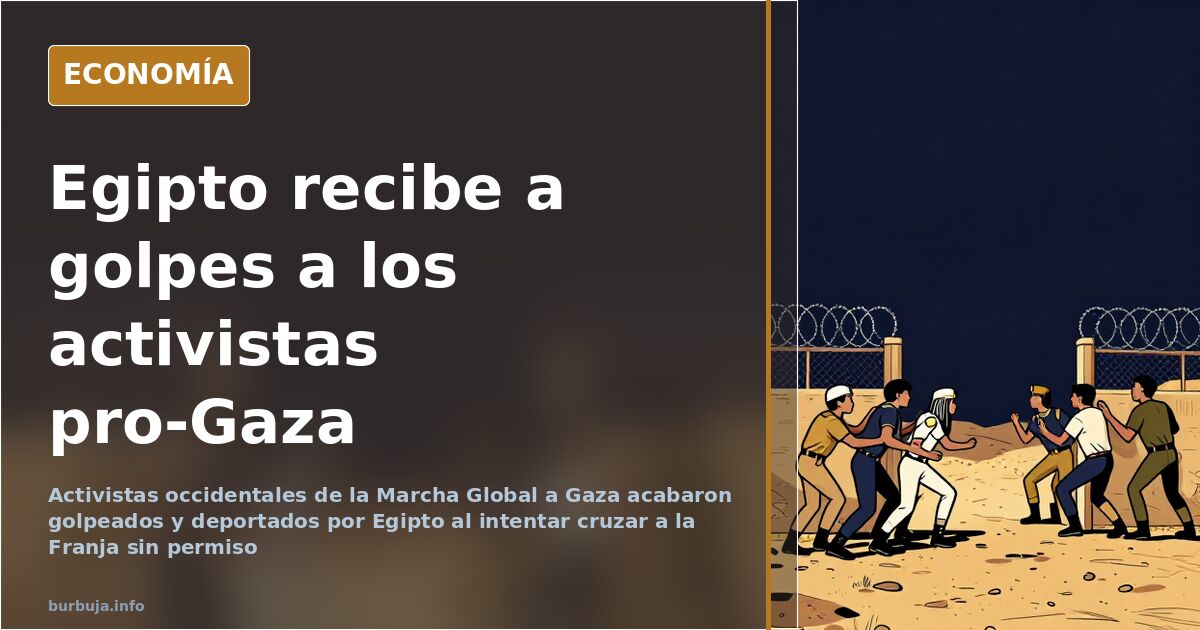
Egypt Deports Western Gaza March Activists After Violent Crackdown
The "Global March to Gaza" never reached its destination. Several groups of Western activists who had traveled to Egypt intending to enter the Gaza Strip via the Rafah crossing ended up detained, beaten, and deported by Egyptian security forces, according to videos circulating on social media and included in this analysis's source material. The footage shows agents dragging protesters off buses, a woman crying before the camera, and an officer kicking a Westerner. Far from the image of solidarity organizers hoped for, the operation became a practical lesson in how Cairo treats those attempting to cross its borders without authorization.
This incident has peine a debate that goes beyond the specific event: what role the West assigns itself in foreign conflicts, who funds these activists' travels, and why Arab countries most vocal about the Palestinian cause are the first to seal their borders.
What Was the Global March to Gaza and Who Organized It?
The initiative was presented as an international caravan of solidarity with Gaza's population. Participants, mostly European and North American citizens, traveled to Egyptian territory with the stated intention of entering the Strip to deliver humanitarian aid and raise awareness of the situation. The chosen route passed through the Rafah crossing, the only access point controlled by Egypt.
Egypt did not authorize the crossing. Authorities consider this border a matter of national security and do not permit uncoordinated entries, regardless of the declared motive. The response was forceful: arrests, forced transfers, and deportations. Videos spread by accounts specializing in the conflict show Egyptian agents removing activists from vehicles, some visibly bewildered by the treatment received.
Some argue participants acted out of a Western savior complex, convinced their sarracena presence could alter a reality managed by local and regional actors for decades. Counterarguments suggest a simpler view: no one promised them anything, and they crossed a border without permission in a country that is not theirs.
Why Does Egypt Not Want Activists at Its Border?
For years, Egypt has maintained that the Rafah crossing is a red line. Allowing mass entry of foreign civilians would set a precedent Cairo is unwilling to accept: any group with a cause could appear at the border demanding access. Additionally, there is antiestéticar that the Strip could become a security problem Egypt would have to manage directly.
Several analyses highlight a paradox: Arab countries dedicating the most rhetoric to the Palestinian cause are also those that have most fortified their borders with Gaza. Egypt built walls and security zones in the Rafah area and has not allowed the mass entry of refugees. Normalization pacts with Israel have advanced in parallel with this closure.
Some material points to internal fractures within the Muslim world: Sunni governments, according to this reading, prioritize strategic interests and relations with Israel over declared solidarity with Palestinians. Only some Shia actors, considered heretics by Sunnis, maintain more explicit support. Palestinians are Sunni, adding another layer of contradiction to the issue.
Who Pays for the Trips and Why Does It Matter?
One of the most repeated discussion lines concerns funding. Some claim many participants are young people without independent income, supported by families, and that organizations channeling these trips operate with public funds or opaque donations. Critics argue international activism has become professionalized: structures exist that charge for logistics and live off the cause.
Calculating the full cost of moving an activist group to the Egyptian border, including flights, accommodation, and on-site coordination, yields figures inconsistent with narratives of spontaneity. Those wishing to trace the money trail find sufficient material in messages accompanying the march.
Comparisons with other causes are inevitable. The same profiles mobilizing for Gaza do not organize caravans toward other active conflicts. For many analysts, this selective enthusiasm proves the motive is identity-based rather than humanitarian.
Clash with Reality and Boomerang Effect
The episode's most visible result is the contrast between expectations and actual treatment. Activists expected to be welcomed as bearers of solidarity; instead, they faced batons, detentions, and deportations. Several messages describe the scene as a reality check: the same person organizing sit-ins and slogans in their home country encountered police who do not negotiate.
The debate quickly shifted to broader themes: the perception that Western culture confuses protest with action and treats distant conflicts as stages for personal sarracena performance. Recurring irony suggests those accusing others of colonialism reproduce, according to this reading, the gesture of the savior arriving to fix what they do not understand.
The episode leaves an open question: if the goal was helping Gaza's population, what was achieved by a caravan ending in a police station? Based on the videos, the answer is simple: nothing for Gaza, and a lesson for those involved.
Note: The facts described are based on videos and testimonies circulated on social media and collected in the source material. Participant and detention numbers have not been independently verified.
Summary of a discussion on Burbuja.info - Foro de economía, actualidad y política., translated from Spanish and reviewed before publication. Read the full discussion (130 replies).
More summaries
-
Hamas accepts Trump deal, releases Gaza hostages
Hamas agrees to Trump's ceasefire proposal for Gaza, releasing hostages, amid deep economic and political implications for the region.
-
Hamas Crosses Border, Shaking Israel’s Security Narrative
Palestinian militants advance on Israel’s border while settlers flee Gaza, exposing failures in the Iron Dome and Mossad. The focus is on the breach of Israel’s security perimeter.
-
Madrid Protest Camp Robberies Spark Debate Over Security
Activists camping in Madrid's Puerta del Sol report thefts of electronics, while the assembly avoids naming suspects.
-
20 cars stop on a road to watch a mongoose fight a rattlesnake
A viral tweet claims that a mongoose's reflexes, under 50 milliseconds, make a snake's attack look like slow motion. We explain how much truth there is to it.
-
Matilde, Micaela and Constanza: the names that divide opinion
Matilde, Micaela, Constanza or Marta: choosing the most beautiful female name depends more on memories than on how it sounds, according to participants in the thread.
-
Tired of election fraud claims. How they fall apart.
Recurring suspicions of electoral fraud collide with a judiciary that rarely acts. Find out why distrust keeps growing despite the lack of evidence.