
Efficient fireplace: sealed stoves, properly installed, beat expensive inserts
A traditional stone hearth sends roughly 60% of the heat up the flue, according to one forum user. Sealed stoves with adjustable draft and an external air intake perform far better.
English · Original discussion in Spanish · Published
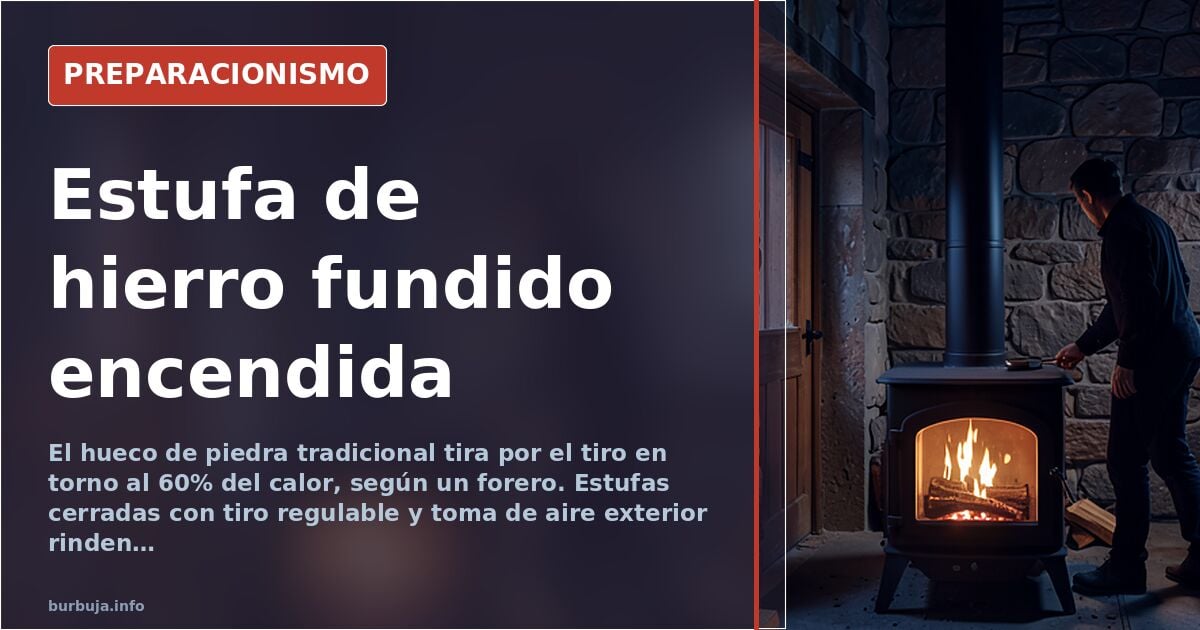
The €1,000 stove that, according to its owner, heats better than the designer insert
In a stone house over a hundred years old, with minus fifteen degrees outside, having breakfast in a T-shirt costs less than you might think. The secret is not the traditional open fireplace, the kind that swallows smoke and heat in equal measure, but a sealed cast iron unit weighing 400 kilos, with a double adjustable draft, bought for €1,000 and capable of stretching a single log for twelve hours in ember mode, according to its owner's account. Facing it, a glass insert with a rear fan which, by its own owner's admission, cost "more than keeping a socialist" and heats less.
The debate over which fireplace is most efficient has a fairly settled technical answer: sealed systems. Modern stoves, built-in fireplaces and heating stoves minimize heat loss and optimize combustion, while the traditional stone hearth sends around 60% of the heat generated up the flue, sometimes more, according to a calculation circulating in the thread. The problem is that theory and the bill rarely match.
Why an open fireplace is a heat sink
The diagnosis is unanimous on the essentials. A poorly designed open fireplace loses heat in two ways: the heat that escapes straight up the flue without radiating much into the room, and the heat that leaks through the wall if the unit sits against an exterior wall. That is half the firewood budget gone without the living room noticing.
The solution lies in regulating the air intake. A well-adjusted draft means burning less wood and extracting more heat, and in cast iron units that regulation can be so fine that the fire works like a slow ember bed. Some users describe "ridiculous" consumption with large combustion chamber stoves, capable of taking thick logs and holding the temperature through the inertia of the metal itself.
The second critical point is where the unit draws its air from. If it pulls air from the same room, it forces cold outside air in and cools the house just as you try to warm it. An independent air intake, connected to the outside, is what separates a well-planned installation from a rushed one, according to one participant.
Cast iron versus the fan-assisted insert
The most repeated comparison pits two philosophies against each other. Cast iron is heavy, slow to heat up and reflects less heat at first, but holds the temperature for hours and radiates a warmth its defenders describe as different, more enveloping. The modern insert, with a vermiculite and refractory brick interior, starts faster and can push hot air into other rooms with adjustable turbines, though its price soars.
Domestic experience tips the balance toward the simple. A small steel-plate stove, technology a thousand years old, heats "like a demon" because its metal walls are exposed and it has no mass to delay heat delivery, according to its owner. The paradox is that the cheapest, least photogenic unit often performs better in specific rooms than the expensive panoramic-glass equipment, in the opinion of those who have tried both.
The Basque wood-burning cooker and the flue that heats the floor above
There is a school of thought that debates neither stoves nor inserts: the Bilbao-style wood cooker (a traditional cast iron cooking and heating stove from the Basque Country), historically made in the village itself, with the smoke duct running through the inside of the house instead of exiting through the facade. The upstairs room next to that duct is the warmest in the building, according to one participant's memory. It is heating and cooking in one package, and it explains why whole generations lived their lives around that kitchen even when summer got stifling.
The model has evolved. Some have replaced the old cooker with a version antiestéticaturing a larger combustion chamber, an upper secondary chamber where a vortex burns the gases before they exit, and magnetite thermal accumulators that radiate heat for up to ten hours after it is switched off. The manufacturing blueprint circulates online, which says a lot about the profile of people who take on these projects.
Down-draught flame: the efficiency almost nobody can afford
The top tier is down-draught gasification boilers. They heat the wood first in an oxygen-poor atmosphere and then fully burn the pyrolysis gases, so the smoke is almost nothing but CO2 and water, with no soot. Efficiency is extremely high and output is modulable, but the price confines them to rural hotels, large houses and small industry, according to one participant. Insert versions exist, though the outlay remains beyond the reach of an ordinary renovation.
Maintenance is the other open front. Cleaning the flue of these units is no trivial matter, and DIY soot-removal tricks using pressure can sustancia ilegal the duct, warns another forum user. The implicit recommendation is the usual one: a professional and a regular schedule.
The air problem and the venturi effect
No stove works if the outside opening of the duct is badly placed. Without wind to generate the right suction, the unit goes out or fills the house with smoke, according to one participant. It is the same principle that makes a spray bottle work, and it explains why two identical installations behave in opposite ways depending on where the pipe points on the roof.
Then there is placement. Putting the unit against an exterior wall of the house is a textbook mistake, in the view of several forum users: the heat that should stay inside warms the wall facing the street. On an interior wall, that same heat feeds the building's thermal mass and returns to the house.
With all this in mind, the answer to which fireplace is best depends less on the catalogue than on the installation. A sealed unit, with adjustable draft, an external air intake and a well-oriented duct, outperforms a poorly placed high-end unit. What nobody can settle is the final tally: the firewood has to be transported, stacked and the ash cleaned out, and no efficiency certificate solves that.
Also available in: Deutsch
Summary of a discussion on Burbuja.info - Foro de economía, actualidad y política., translated from Spanish and reviewed before publication. Read the full discussion (86 replies).
More summaries
-
2 cm³ of school supplies is enough to start a forest fire
Two cubic centimeters of traditional school material are enough to start a forest fire, but the debate quickly shifts to the obvious: cooking with embers and stones.
-
World War III conscription: desert, hide or fight?
In a potential World War III scenario, the dilemma is whether to join the front, desert, or hide. This article examines the arguments and precedents cited in this debate.
-
Spain's Periodic Booster Campaign Fades Without Explanation
Basque Country recall doses stall at 7,000 weekly, missing 20% coverage. Spain's silent campaign drop defies official health logic.
-
No Fertilizer Without Gas: The Chemistry Feeding 3.8 Billion
The Haber process turns natural gas into fertilizer, sustaining 3.8 billion people. Urea shortages have already forced plant closures in several countries.
-
Fire masks: the debate splitting the prepper community
12 euro masks, fire extinguishers and false sense of security: the debate sparked by the current wildfires. What equipment actually saves lives in a fire?
-
The warning signs of job loss most people miss
Emails that stop arriving, a newly hired clone, shrinking tasks: the signs of dismissal show up months in advance. In Spain, severance pay differs.