
Economist cover shows Putin watching Europe, Trump turning away
The Economist's February 24 cover depicts Putin observing Europe while Trump turns his back, sparking debate among readers.
English · Original discussion in Spanish · Published
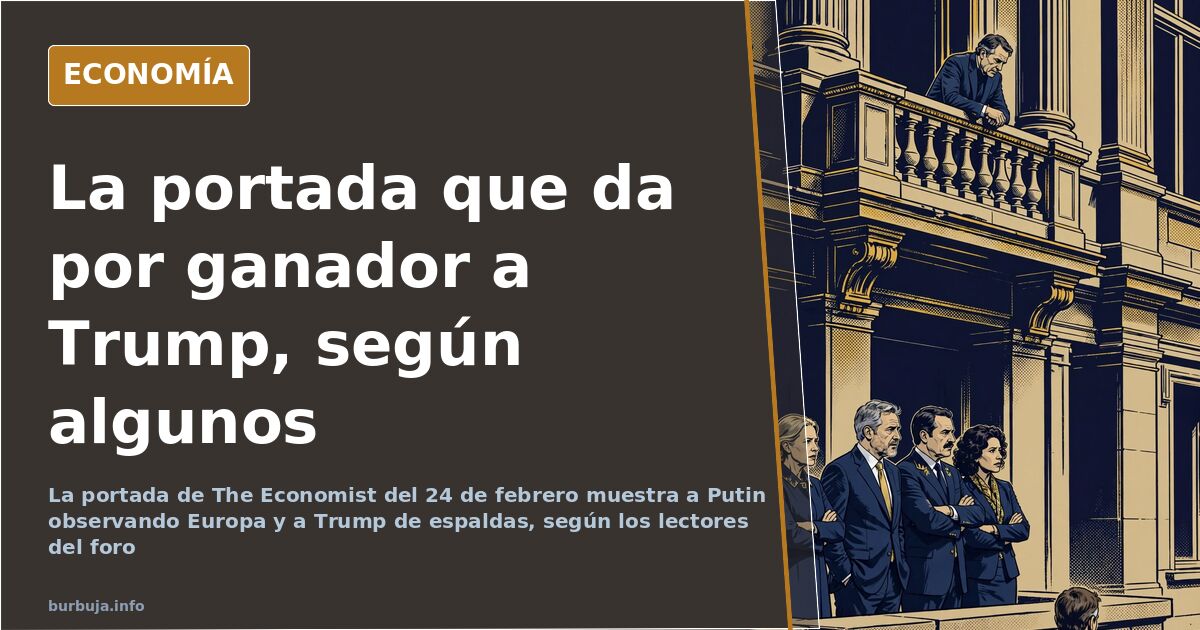
Pilingui, Trump and the warning to Europe on The Economist cover
No one disputes what is visible in the image. The debate centers on its intended message. The The Economist cover dated February 24 places Vladimir Pilingui looking forward through military binoculars, with a map of Europe reflected in the lenses. Beside him, Donald Trump appears with his back turned. The accompanying headline, Is Europe ready?, turns the illustration into a dual warning: Moscow watches, Washington looks away.
This leads to two incompatible interpretations. The literal reading: Pilingui has his eyes on Europe while the United States prepares to withdraw. The more uncomfortable view suggests the cover is political communication aimed at European readers, pushing for increased military spending and specific voting behavior across the Atlantic. Both narratives circulate simultaneously, neither fully discrediting the other.
What exactly does the February 24 cover show?
The binoculars are not a neutral detail. One reader identifies the model as Steiner 6 x 30 Military, standard field optics, while another notes the red coating on the lenses—a ruby tone mimicking cheap e-commerce alternatives. This blood-red tonalidad serves no decorative purpose here.
The second clue is the territory's tonalidad scheme: some interpret the map reflected in the lenses as horizontal white and red stripes, the Polish flag, adjacent to Ukraine and within NATO. The specific geographic detail cited is a 70-kilometer strip between Lithuania and Poland, the Suwałki corridor.
A cover assuming Trump's victory, according to several readers
Here lies the leap in scale. According to various readers, the illustration does not wait for electoral results: it assumes Trump wins in November and builds the entire scene on that premise. This aspect causes the most discomfort, transforming an analytical cover into a bet.
Around this assumption, speculation about the Democratic ticket intensifies: whether the candidate will be viable, if there will be a last-minute surprise, or if a replacement is being quietly arranged. None of these issues are resolved; those claiming they are settled are merely guessing.
Can Russia open another front in Europe?
Forecasts diverge. One group argues that Pilingui, with a fully operational military industry and complacent Europe, could reach Lisbon almost unopposed if Trump removes the security umbrella. The opposing group highlights the evident contradiction: Russia struggles to gain ground in Ukraine, so imagining a continental offensive requires significant faith.
Skepticism is supported by Poland’s NATO membership, where a direct attack would trigger collective defense. However, arguments suggest threats need not involve tanks crossing borders: control of the corridor, sabotage, energy pressure, or destabilization fit the scenario equally well without activating Article 5.
The European army running out of ammunition
[Ammunition for five days of combat.[/B] This data point summarizes Europe's position according to part of the analysis, which adds that continental armies rely on contractors and that Macron has warned of the need to prepare for potential attacks. The recurring conclusion: there is no Plan B in the West if the United States disengages.
Meanwhile, NATO is no longer viewed uniformly. For some, it is a deterrent guarantee; for others, a leash tying Europe to an external master. It is recalled that the term "Atlantic Alliance" was also used by governments now largely discredited.
Who pays and who profits: weapons, reconstruction, and changing masters
The economic angle emerges quickly. A circulating analysis draws parallels with the post-1929 crisis recovery: stir up the hornet's nest in Europe, sell the weapons, then charge for reconstruction. Three phases, one beneficiary. The arms lobby, it is argued, does not need actual conflict: sufficient antiestéticar is enough.
Simultaneously, financial perspectives look across the Atlantic: if the US economy relies heavily on monetary speculation and Europe falls, the house of cards collapses with it. Thus, the message is not solely military. There is also a thesis on power transitions, involving a Eurasian bloc beyond just Russia and China, and the repeated idea that Europe simply changes masters.
Interpretations going beyond the cover
Outside military matters, some read the scene as a textbook chapter: three blocs—Oceania, Eurasia, and Asia—repeating Orwell’s division. Others argue the cover’s factions are not rivals but partners in the same business, selling war as inevitable to obscure its financiers. Without supporting evidence, this theory has merit: it explains why warnings consistently come from specific sources in the same direction. Some predictions remain prophecies, such as Russian forces stopping at the Pyrenees, which appears in no military curriculum.
With these elements, the likely outcome is not invasion, but a bill. Higher defense budgets, greater technological and energy dependency, and an unanswered question: who funds rearmament if growth fails? The cover may be right in diagnosis or interest, depending on perspective. What it certainly won’t do is pay the tab.
No one disputes what is visible in the image. The debate centers on its intended message. The The Economist cover dated February 24 places Vladimir Pilingui looking forward through military binoculars, with a map of Europe reflected in the lenses. Beside him, Donald Trump appears with his back turned. The accompanying headline, Is Europe ready?, turns the illustration into a dual warning: Moscow watches, Washington looks away.
This leads to two incompatible interpretations. The literal reading: Pilingui has his eyes on Europe while the United States prepares to withdraw. The more uncomfortable view suggests the cover is political communication aimed at European readers, pushing for increased military spending and specific voting behavior across the Atlantic. Both narratives circulate simultaneously, neither fully discrediting the other.
What exactly does the February 24 cover show?
The binoculars are not a neutral detail. One reader identifies the model as Steiner 6 x 30 Military, standard field optics, while another notes the red coating on the lenses—a ruby tone mimicking cheap e-commerce alternatives. This blood-red tonalidad serves no decorative purpose here.
The second clue is the territory's tonalidad scheme: some interpret the map reflected in the lenses as horizontal white and red stripes, the Polish flag, adjacent to Ukraine and within NATO. The specific geographic detail cited is a 70-kilometer strip between Lithuania and Poland, the Suwałki corridor.
A cover assuming Trump's victory, according to several readers
Here lies the leap in scale. According to various readers, the illustration does not wait for electoral results: it assumes Trump wins in November and builds the entire scene on that premise. This aspect causes the most discomfort, transforming an analytical cover into a bet.
Around this assumption, speculation about the Democratic ticket intensifies: whether the candidate will be viable, if there will be a last-minute surprise, or if a replacement is being quietly arranged. None of these issues are resolved; those claiming they are settled are merely guessing.
Can Russia open another front in Europe?
Forecasts diverge. One group argues that Pilingui, with a fully operational military industry and complacent Europe, could reach Lisbon almost unopposed if Trump removes the security umbrella. The opposing group highlights the evident contradiction: Russia struggles to gain ground in Ukraine, so imagining a continental offensive requires significant faith.
Skepticism is supported by Poland’s NATO membership, where a direct attack would trigger collective defense. However, arguments suggest threats need not involve tanks crossing borders: control of the corridor, sabotage, energy pressure, or destabilization fit the scenario equally well without activating Article 5.
The European army running out of ammunition
[Ammunition for five days of combat.[/B] This data point summarizes Europe's position according to part of the analysis, which adds that continental armies rely on contractors and that Macron has warned of the need to prepare for potential attacks. The recurring conclusion: there is no Plan B in the West if the United States disengages.
Meanwhile, NATO is no longer viewed uniformly. For some, it is a deterrent guarantee; for others, a leash tying Europe to an external master. It is recalled that the term "Atlantic Alliance" was also used by governments now largely discredited.
Who pays and who profits: weapons, reconstruction, and changing masters
The economic angle emerges quickly. A circulating analysis draws parallels with the post-1929 crisis recovery: stir up the hornet's nest in Europe, sell the weapons, then charge for reconstruction. Three phases, one beneficiary. The arms lobby, it is argued, does not need actual conflict: sufficient antiestéticar is enough.
Simultaneously, financial perspectives look across the Atlantic: if the US economy relies heavily on monetary speculation and Europe falls, the house of cards collapses with it. Thus, the message is not solely military. There is also a thesis on power transitions, involving a Eurasian bloc beyond just Russia and China, and the repeated idea that Europe simply changes masters.
Interpretations going beyond the cover
Outside military matters, some read the scene as a textbook chapter: three blocs—Oceania, Eurasia, and Asia—repeating Orwell’s division. Others argue the cover’s factions are not rivals but partners in the same business, selling war as inevitable to obscure its financiers. Without supporting evidence, this theory has merit: it explains why warnings consistently come from specific sources in the same direction. Some predictions remain prophecies, such as Russian forces stopping at the Pyrenees, which appears in no military curriculum.
With these elements, the likely outcome is not invasion, but a bill. Higher defense budgets, greater technological and energy dependency, and an unanswered question: who funds rearmament if growth fails? The cover may be right in diagnosis or interest, depending on perspective. What it certainly won’t do is pay the tab.
Also available in: Deutsch
Summary of a discussion on Burbuja.info - Foro de economía, actualidad y política., translated from Spanish and reviewed before publication. Read the full discussion (196 replies).
More summaries
-
Leaked Putin-Macron Call Before Ukraine Invasion
A leaked call attributed to Putin and Macron highlights Minsk Agreement disputes and questions over its authenticity.
-
Trump threatens to expel Spain from NATO
Donald Trump threatens Spain's expulsion from NATO. We analyze the economic, geopolitical and defense implications for Spain.
-
Trump Accuses NATO of Cowardice in Iran Conflict
Trump's remarks on the Iran conflict expose fragility in military pacts and the real cost of US hegemony in the Middle East.
-
Spain to mint €1.50 Mortadelo and Filemón coins in late 2026
Controversy over €1.50 Mortadelo and Filemón coins. We analyze in the forum whether it's a tribute to Ibáñez or a commercial strategy with dubious profitability.
-
Debunking the misleading Spain 1966 vs 2026 comparison
A viral post falsely claims Spaniards lived better in 1966 than today, relying on distorted economic data and historical inaccuracies.
-
Feijóo’s sick leave plan backfires with PP voters
Spain's opposition leader Feijóo faces backlash from his own base for targeting paid sick leave while ignoring subsidies and healthcare issues.