
ECB rates hit 4.5%: Euribor nears 5%, pushing mortgage payments to 1,000 euros
The ECB raises rates to 4.5%, its highest since 2001. The Euribor is expected to reach 5%, causing monthly mortgage payments to rise to approximately 1,000 euros.
English · Original discussion in Spanish · Published
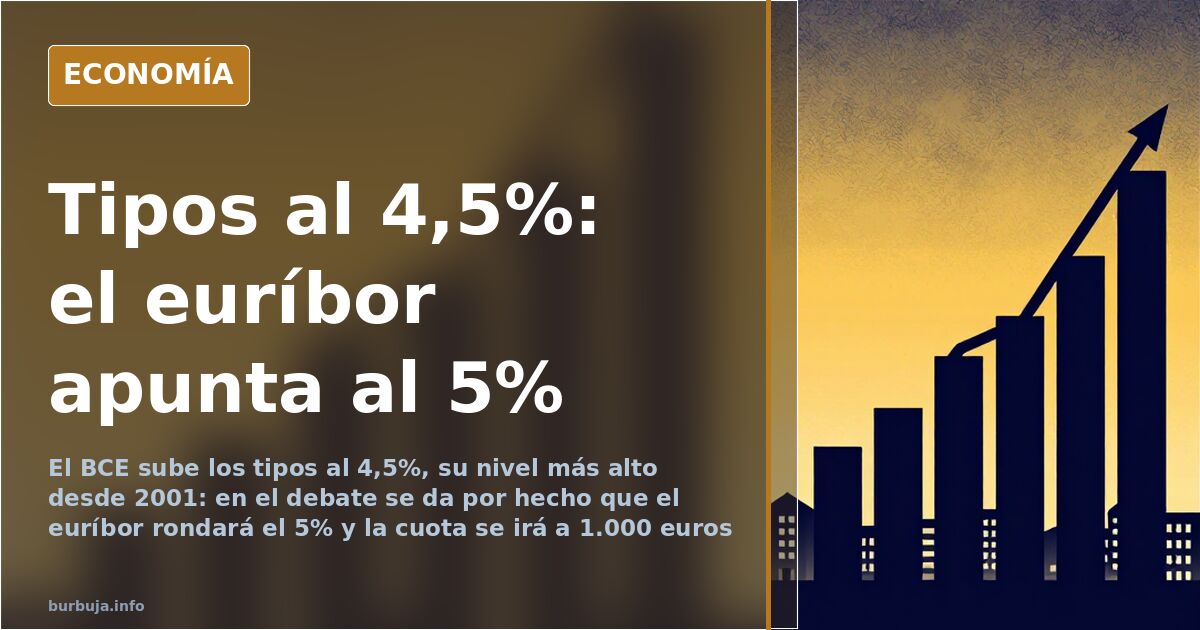
ECB fixes rates at 4.5% while Euribor points to 5%
Money costs in the eurozone have settled at 4.5%. This marks the European Central Bank’s tenth consecutive rate hike—the longest streak since the single currency’s inception—and the highest level since 2001. Frankfurt sends a strong message in its fight against inflation, even as eurozone growth data falters, raising uncomfortable doubts about whether policymakers are overcorrecting and repeating costly past errors.
With official rates at 4.5%, debate participants assume the Euribor will reach 5% within months before the cycle ends. For variable-rate mortgages, this is the critical figure, not just a theoretical concept: it represents January’s actual payment.
What does a 5% Euribor mortgage cost?
Calculations circulating online suggest monthly payments of around 1,000 euros. With a 5% interest rate (Euribor plus margin), the monthly payment hits that figure, and total interest over 20 years reaches 90,700 euros. At 1% interest, the same mortgage cost 693 euros monthly with 16,250 euros in interest. The difference, 75,000 euros, represents 50% more interest on the principal.
The detailed breakdown reveals a gap uncloseable through household spending adjustments. Even if rates freeze now, borrowers who refinanced with soaring Euribor face irreversible costs. Rising money prices arrive alongside already-stretched budgets for food and fuel.
Why banks pay less for your savings than they charge you
Bar-counter logic is simple: banks pay zero on savings, lend near 10%, and raise maintenance fees. The reality is more nuanced but leaves the sector in poor shape. Bonds yield around 3.70%, ING deposits offer 2.75%, and only cross-border European banks approach 4%.
One participant cites the Bank of Spain’s base data to argue that rate hikes aren’t reaching final borrowers. The reason, per this view, is excessive liquidity allowing cheap lending without costly deposits. In short: money remains abundant in the system, and draining it will cost far more than it seems.
The 2008 precedent: cuts began at 4.25%
4.5% hasn’t been seen since 2001, but the last major monetary policy shift occurred at 4.25%. That’s when the ECB started lowering money prices in 2008, with a now-suspiciously familiar argument: delinquency was rising wildly. That correction took years and left damage still debated.
This comparison looms over every meeting. Post-2008 homebuyers had seen a crisis before, but it didn’t help them sign responsibly.
Debt, inflation, and a mismatched diagnosis
With developed economies carrying 130% to 200% debt-to-GDP ratios, some argue the core problem isn’t energy or war, but the impossibility of servicing such massive debt. Each rate hike increases debt service costs, feeding inflation. The welfare state, in this framework, relies on new debt.
Public spending figures clash shamelessly. Against less than 100 billion euros for the bank rescue, one participant estimates 400 billion euros in state support recently. Whether current and future taxpayers pay is, at least, this view’s stance. Whether the diagnosis is useful is another matter.
A third, more uncomfortable diagnosis blames demographics: over eight billion people globally, an aging Europe, and an economy shifting toward Asia.
January costs and consumption on standby
Adjustments are already happening through spending cuts. Some decided to buy nothing this Christmas and lose two kilos for bikini season. The joke hides a truth: when disposable income shrinks, consumption drops first, taking with it all income dependent on it.
Dinner is served, but no one knows when it starts. With the Euribor heading toward 5% and inflation falling slowly, the sticking point is diagnosis: there’s no agreement whether this is 2008 again or a 1970s clone with unprecedented debt.
Money costs in the eurozone have settled at 4.5%. This marks the European Central Bank’s tenth consecutive rate hike—the longest streak since the single currency’s inception—and the highest level since 2001. Frankfurt sends a strong message in its fight against inflation, even as eurozone growth data falters, raising uncomfortable doubts about whether policymakers are overcorrecting and repeating costly past errors.
With official rates at 4.5%, debate participants assume the Euribor will reach 5% within months before the cycle ends. For variable-rate mortgages, this is the critical figure, not just a theoretical concept: it represents January’s actual payment.
What does a 5% Euribor mortgage cost?
Calculations circulating online suggest monthly payments of around 1,000 euros. With a 5% interest rate (Euribor plus margin), the monthly payment hits that figure, and total interest over 20 years reaches 90,700 euros. At 1% interest, the same mortgage cost 693 euros monthly with 16,250 euros in interest. The difference, 75,000 euros, represents 50% more interest on the principal.
The detailed breakdown reveals a gap uncloseable through household spending adjustments. Even if rates freeze now, borrowers who refinanced with soaring Euribor face irreversible costs. Rising money prices arrive alongside already-stretched budgets for food and fuel.
Why banks pay less for your savings than they charge you
Bar-counter logic is simple: banks pay zero on savings, lend near 10%, and raise maintenance fees. The reality is more nuanced but leaves the sector in poor shape. Bonds yield around 3.70%, ING deposits offer 2.75%, and only cross-border European banks approach 4%.
One participant cites the Bank of Spain’s base data to argue that rate hikes aren’t reaching final borrowers. The reason, per this view, is excessive liquidity allowing cheap lending without costly deposits. In short: money remains abundant in the system, and draining it will cost far more than it seems.
The 2008 precedent: cuts began at 4.25%
4.5% hasn’t been seen since 2001, but the last major monetary policy shift occurred at 4.25%. That’s when the ECB started lowering money prices in 2008, with a now-suspiciously familiar argument: delinquency was rising wildly. That correction took years and left damage still debated.
This comparison looms over every meeting. Post-2008 homebuyers had seen a crisis before, but it didn’t help them sign responsibly.
Debt, inflation, and a mismatched diagnosis
With developed economies carrying 130% to 200% debt-to-GDP ratios, some argue the core problem isn’t energy or war, but the impossibility of servicing such massive debt. Each rate hike increases debt service costs, feeding inflation. The welfare state, in this framework, relies on new debt.
Public spending figures clash shamelessly. Against less than 100 billion euros for the bank rescue, one participant estimates 400 billion euros in state support recently. Whether current and future taxpayers pay is, at least, this view’s stance. Whether the diagnosis is useful is another matter.
A third, more uncomfortable diagnosis blames demographics: over eight billion people globally, an aging Europe, and an economy shifting toward Asia.
January costs and consumption on standby
Adjustments are already happening through spending cuts. Some decided to buy nothing this Christmas and lose two kilos for bikini season. The joke hides a truth: when disposable income shrinks, consumption drops first, taking with it all income dependent on it.
Dinner is served, but no one knows when it starts. With the Euribor heading toward 5% and inflation falling slowly, the sticking point is diagnosis: there’s no agreement whether this is 2008 again or a 1970s clone with unprecedented debt.
Also available in: Deutsch
Summary of a discussion on Burbuja.info - Foro de economía, actualidad y política., translated from Spanish and reviewed before publication. Read the full discussion (271 replies).
More summaries
-
Euro banknote redesign sparks cultural debate at ECB
The ECB launches a public consultation on new euro notes, triggering identity politics debates over proposed designs featuring diverse faces and birds.
-
Sol Occupiers Expel Horizon Reporter Rebeca Crespo for Second Night
Occupiers in Madrid's Puerta del Sol block Horizon reporter Rebeca Crespo for two consecutive nights, reigniting the debate on press freedom and public space access.
-
Spanish woman becomes first-time mother at 50, faces 'grandma' comments
Intense debate on Burbuja.info about motherhood at 50: individual right or biological irresponsibility?
-
Open-source project clones seven Adobe apps
An open-source initiative replicates features from seven Adobe applications, gaining 44,000 GitHub stars and updating every three days.
-
Spain Audit Finds €2.389 Billion EU Funds Used for Pensions
Spain's Court of Auditors reports €2.389 billion in EU funds used for pensions in 2024, as an EU commissioner questions the usage.
-
Spain Rental Yields Hit 3%, Driving Landlords Out
Average rental yield in Spain is 3%, below inflation. The €500 per €100,000 rule explains why landlords are leaving the market.