
ECB faces choice: hike rates or wait until October
The ECB enters its September meeting with the deposit facility at 3.75%, torn between a 0.25-point hike and waiting for October.
English · Original discussion in Spanish · Published
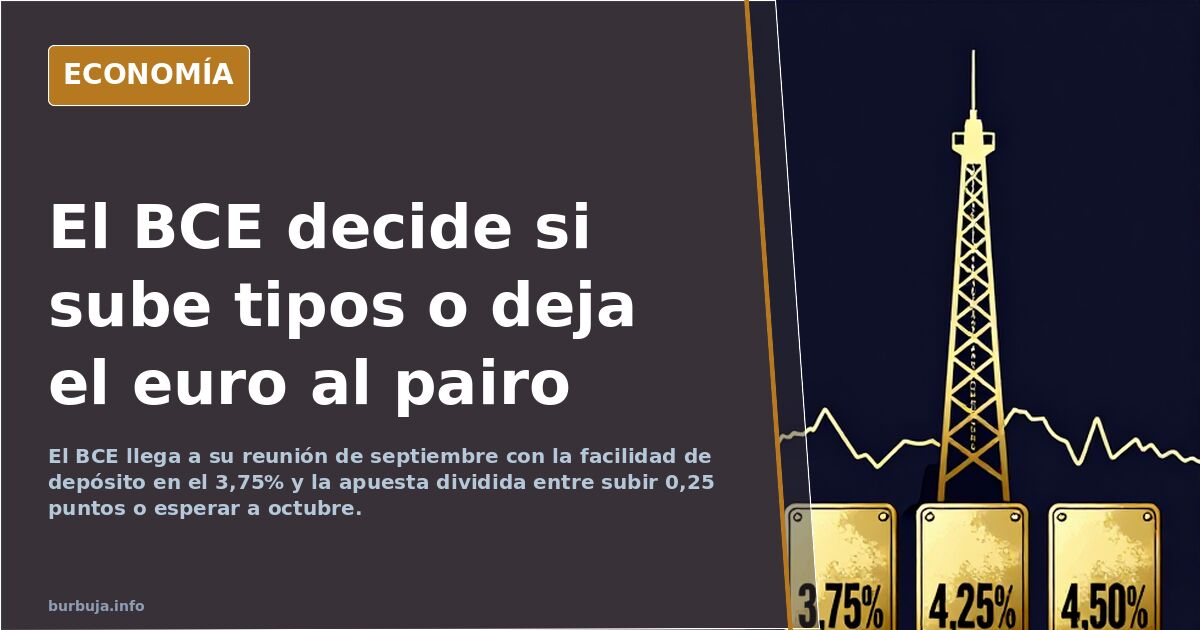
ECB decides on rates amid oil near $100 and euro pressure
The ECB's September monetary policy meeting arrives with the deposit facility at 3.75%, the marginal lending rate at 4.50%, and the main refinancing rate at 4.25%. On the table is what some boldly call the most important decision of the century: raise rates by a quarter point, double down with half a point, or freeze and pass the ball to October. The vote is not a formality. Depending on perspective, it is the moment Europe decides whether to tighten the noose or ease off the gas.
The underlying debate is not inflation versus growth, but something more uncomfortable: fighting stagflation or letting it run wild. Those expecting a 0.25-point hike argue the ECB seeks a high-impact symbolic measure, with rumors of a freeze serving only to amplify that effect when it comes. Those betting on inaction note that the October meeting is just around the corner, allowing for adjustments without wear and tear. Neither reading stands alone.
Will rates rise 0.25 points or hold steady until October?
The dominant view points to a quarter-point hike. Arguments suggest the ECB has kept the door open for weeks, and acting now costs less than explaining later why nothing was done. Conversely, one faction sees a freeze as the likely outcome, not out of prudence but as a kick down the road to October. With the next meeting close on the calendar, this would allow recalibration with more data on the table.
Then there is the awkward scenario. Some analysts do not rule out a half-point move, a situation that would force everyone to hold on tight. If this occurred, deposits would remain unremunerated in most banks, hitting mortgage holders and savers again while inflation erodes purchasing power in the background. A half-point hike can be seen as bravery or recklessness, leaving no clear winner.
Oil breaks the central bank playbook
What has changed the landscape is not the macro picture, but crude oil. Inventories are expected to be very low, with some already eyeing barrels at $100. In this context, freezing rates ceases to be neutral: some argue holding steady does more harm than hiking, because a loss of euro support amid soaring oil prices becomes an imported inflation problem ultimately paid by consumers.
The argument has substance. At current oil levels, a weaker euro would directly impact energy bills, with damage accumulating within weeks. A quarter-point hike won't fix inflation alone, but it signals the central bank is unwilling to look away while fuel dictates the pace. The question is whether this signal arrives in time or too late.
Deposits at 0% and textbook stagflation
Almost all readings agree on deposits. Whether rates rise half a point or stay put, liabilities remain remunerated at zero in most banks. Mortgage holders and savers are penalized while inflation does the rest. The recurring label is textbook stagflation: those with money in the bank also grow poorer, as their savings lose value each month.
The other front involves real interest rates. Some calculate that current levels should include a risk differential around 0.75%, pushing the reference slightly above 5.25%. If the market doesn't reflect this, they argue, it is due to banks having excess liquidity, unpaid deposits, and an Euribor intervened to curb defaults. Pure choreography, they claim.
Spanish debt at 4.5% and the shadow of 2008
The analysis turns serious regarding debt. Spain contracted much of its liability when rates were zero and now must refinance at rates hovering around 4.5%. Some forecast the fiscal year closing with the benchmark at 5%. With public debt at 115% of GDP, the margin for stimulus policies during a recession is virtually nil: the state that needs to spend is precisely the one indebted to the hilt.
Comparisons with 2008 appear quickly. There is a trickle of foreclosures well above normal levels, with harsher mortgage cases still to come. The historical counterargument notes that mortgages at 15% existed in the 70s and 80s and were paid, but wages rose double-digits annually and housing cost few years' salary. Today, with minimal wage increases, such rates are unsustainable.
Who causes inflation: the ECB or governments?
The short answer is disagreement prevails. One side argues inflation has private and public components, and the central bank can only attack the former by raising rates or stopping bond purchases. State deficits, agricultural production restrictions, or environmental taxes fall outside its scope. The other side responds that blaming the government is convenient, noting ECB decisions also carry social costs.
This is where the analysis stalls. With the October meeting imminent and oil driving every headline, the only shared certainty is that deposits will remain at zero and someone will pay the bill. Who, and how much, remains unwritten.
Also available in: Deutsch
Summary of a discussion on Burbuja.info - Foro de economía, actualidad y política., translated from Spanish and reviewed before publication. Read the full discussion (150 replies).
More summaries
-
Spain’s 'Real' Debt Hits €2.17 Trillion, 170% of GDP
Spain’s 'real' debt reaches €2.17 trillion and 170% of GDP, per the thread. The IMF calls for fiscal adjustments for the most indebted countries.
-
The End of the West: Sexual Liberation vs. Public Debt
US public debt soars alongside sexual liberalization. A study by J.D. Unwin links cultural decline to relaxed sexual norms and rising hypergamy.
-
The Elite Education of Tenant Spokespeople Sparks Controversy
Controversy erupts as the elite international education backgrounds of prominent tenant movement spokespeople are revealed, challenging their narrative of precarity.
-
Anthropic's new model: too dangerous for the public
Anthropic launched and pulled its new Claude model within days. Real safety concerns or a paid API strategy? Rumours point in every direction.
-
Las Caldas: loud riverside parties on the Nalón and city hall inaction
Residents of Las Caldas, Oviedo, report mass parties with loudspeakers along the Nalón: groups of 70 people, tents from 10 AM, migraines and municipal inaction.
-
Spain's economy flirts with recession as PMI stays in contraction
The eurozone PMI rose to 49.5 in June but remains in contraction. Tourism and immigration prop up an economy some see on the brink of collapse.