
Earthing: the practice of discharging environmental radiation by walking barefoot
Earthing is spreading as a remedy against environmental radiation: ten minutes barefoot or a basin of water and salt. What is claimed and what is actually measured.
English · Original discussion in Spanish · Published
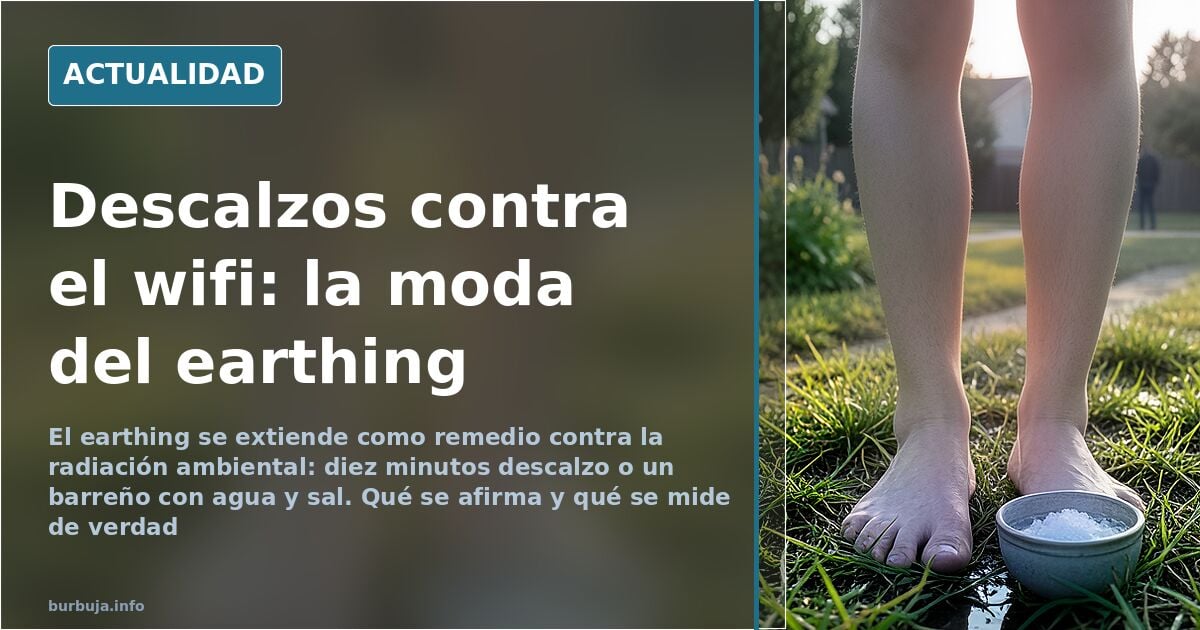
Earthing: going barefoot to discharge radiation that cannot be measured
Ten or fifteen minutes on the grass, the sand, or a basin of water and salt. That is the protocol that has spread as a remedy against environmental radiation accumulated in the body — the radiation that, according to its advocates, comes from mobile phone masts, the router in the living room, and the phone dozing on the nightstand. The proposal is presented as a kind of electrical maintenance for the human body: if rubber soles insulate us from the earth, simply taking them off is enough for the charge to dissipate. It sounds like a household appliance instruction manual applied to biology.
The phenomenon has two layers. One is the everyday, cheap gesture: stepping on grass. The other is a narrative that in some circles adds thicker layers, going as far as linking earthing with the graphene in vaccines and with a supposed pandemic that, according to that same current, would not even exist. There is a stretch between the two that is worth separating, because the article that trinc is not about believing or not believing, but about what is claimed, what is measured, and what is sold.
What earthing is and where the term comes from
Grounding or earthing, in its simplest version, consists of walking barefoot on conductive surfaces — soil, grass, sand — or soaking the feet in water with salt to favour the electrical connection with the ground. The underlying idea is that the body accumulates an electrostatic charge that should be released, and that modern footwear, with its rubber sole, acts as an insulator that prevents that exchange.
The practice has become popular wrapped in a package that blends wellbeing, nature and vague spirituality. Some present it as a reconnection with the earth's energy, while others dress it up with bonfires, tipis and starry skies. That aesthetic — more travel magazine than laboratory — is what arouses suspicion in many of those who approach the subject with scepticism: the visual package promises more than the physical mechanism can explain.
The interesting point is that the debate is not so much about whether walking on grass feels good — nobody disputes that — but about whether there is a measurable quantity of accumulated radiation that is discharged through the feet. The short answer is that there is no reference figure that can be looked up the way you look up the Euribor.
Environmental radiation: what can be measured and what cannot
The central argument is that telecom masts, wifi routers, bluetooth and mobile phones emit electromagnetic radiation that accumulates in the body and that contact with the earth eliminates it. The verifiable part is that these devices emit low-intensity electromagnetic fields; the part with no backing is the claim that this exposure accumulates like a reservoir and empties out when you step on the grass.
The Earth's magnetic field — the one that deflects charged particles from the Sun towards the poles — is what protects us from cosmic radiation. The confusion between that natural shield and the idea that the ground works like a household earth connection is one of the cracks in the narrative. An earth connection in an electrical installation diverts leakage currents through a conductor; a barefoot human body on grass does not operate on that logic.
Even so, the discourse has kept escalating. In some messages it is claimed that environmental radiation interacts with the graphene oxide that, according to that current, vaccines contain, and that this is where strokes, arrhythmias and pericarditis come from. It is a chain of claims that is not supported by the available evidence and that should be read for what it is: a hypothesis circulating in certain circles, not an established fact.
The basin of water and salt and the Rouleaux effect
For those without a garden at hand, the proposed alternative is to soak the feet in a basin of water and salt for ten or fifteen minutes. Salt improves the conductivity of the water, so the foot is in contact with a medium more conductive than air. It is the domestic version of the experiment, and also the easiest to replicate.
The appeal to authority comes in the form of microscope videos showing a blood sample before and after ten minutes of grounding, with a supposed improvement in the aggregation of red blood cells — the so-called Rouleaux effect. This is a real phenomenon in haematology — red blood cells can stack like coins — but attributing its reversal to walking barefoot is a leap the material does not support.
The name Frank Suárez appears associated with the popularisation of these ideas, as does that of Ricardo Delgado, who comments on them on his show. These are references that circulate in the ecosystem of distrust of the official narrative, and in this particular case they mix wellbeing content with theories about vaccines that have no scientific backing.
From wellbeing to graphene: how two narratives cross paths
Earthing began as a wellbeing practice and has ended up, in some forums, tied to the theory of graphene in vaccines. The connection is made through the idea that graphene is a superconductor that accumulates electromagnetic energy, so that vaccinated people would be more sensitive to environmental radiation and would need grounding all the more urgently.
That narrative leans on names such as Dr Luis Marcelo Martínez, a specialist in medical genetics, who claims that the elbichito bicho has never been isolated. It is a claim that circulates in certain circles and that the mainstream scientific community does not share. The article does not take it as true: it reports it for what it is, a minority position used to chain together the rest of the argument.
The practical consequence is that a harmless recommendation — walking barefoot — ends up wrapped in a frightening theory. And there lies the problem: when simple advice is presented as an antidote to serious harm, the line between wellbeing and alarmism blurs.
Scepticism: between mockery and reasonable doubt
The reception has not been unanimous. Some respond with humour and suggest alternatives like touching the radiator — which is indeed connected to the wiring — or simply ask whether a tinfoil hat might not do the trick. Irony is the most common response, and also the easiest.
But beneath the joke there is a serious objection: if the mechanism works, why is it not measured? Where is the instrument that quantifies the accumulated radiation before and after the ten minutes? The absence of a reproducible measurement is the weakest flank of the proposal, and it is what separates it from a practice with a demonstrated physical basis.
There are also those who point out the practical detail: urban lawns are not always the natural paradise the brochure suggests. Between dog mess and assorted watering, the reconnection ritual can carry a health cost the leaflet does not mention.
What is left of earthing once you strip away the packaging
Stripped of the graphene theory and the promise of discharging radiation, what remains is a simple gesture: walking barefoot in the countryside, dipping your feet in a puddle, sitting in the sun. Some people do it and recommend it with no greater ambition than having a pleasant time, and in that use there is nothing to object to.
The problem arises when the gesture becomes a health prescription against a danger that has not been demonstrated. That is when earthing stops being a habit and becomes a narrative, with its gurus, its videos and its converts.
The question that remains in the air is the usual one: if the method works, why do its advocates not publish the measurement that proves it?
Also available in: Deutsch
Summary of a discussion on Burbuja.info - Foro de economía, actualidad y política., translated from Spanish and reviewed before publication. Read the full discussion (65 replies).
More summaries
-
El País column calls for the return of Ceuta and Melilla to Morocco
El País publishes a column by Tahar Ben Jelloun, which participants suggest advocates for the return of Ceuta and Melilla to Morocco.
-
Lost household items reappear in places already searched
Keys, socks and USBs often resurface in spots previously checked. Experts link most domestic disappearances to attention deficits rather than supernatural causes.
-
Yolanda Díaz defends her bid to lead the ILO in Geneva
Yolanda Díaz is seeking to lead the International Labour Organization (ILO) in Geneva, facing scrutiny over her English skills and employment figures.
-
Pope Leo XIV in Madrid: 1.2 million at mass and anti-abortion message
Pope Leo XIV's mass in Madrid drew 1.2 million faithful. The figures, the anti-abortion message and the reaction of a divided Spain.
-
Minors on e-scooters: the double standard in drug testing
A 13-year-old boy hit by a car in Burgos, Spain, was never given a drug test. Police avoid testing minors for fear of parents' reactions and of uncovering widespread drug use.
-
Juana Rivas: protective mother or child abductor?
A controversial article has sparked fury: is Juana Rivas a protective mother or a manipulator who abducted her children? We review the key facts of the case dividing Spain.