
Earning €1,800/month isn't enough to rent in Ibiza
A nurse earning €1,800 monthly cannot afford rent in Ibiza, reigniting debate on Spain's living wage.
English · Original discussion in Spanish · Published
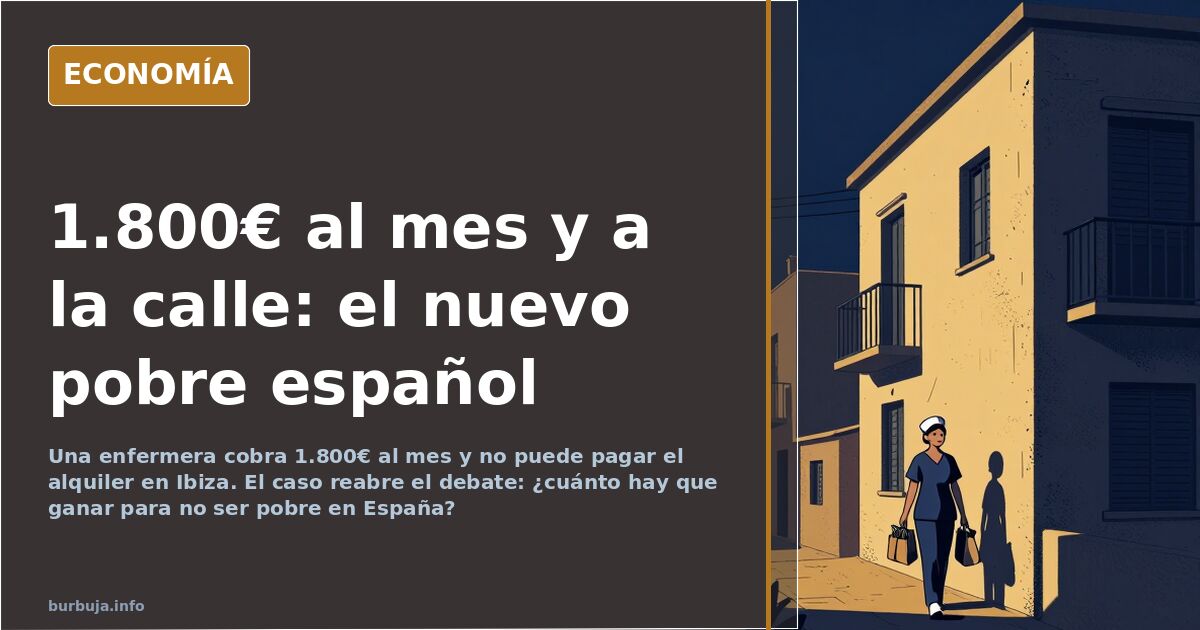
€1,800 a month is no longer enough to live alone
How much do you need to earn to avoid poverty in Spain? This question has resurfaced trinc the case of a nurse who cried over having to leave Ibiza: she earns €1,800 a month but cannot cover apartment rent. A figure that once signaled middle-class status is now read as the boundary of precarity. And this isn't limited to the islands.
The debate sparked by this case reveals an uncomfortable map: the same salary that allows for comfortable living in Cádiz covers only half of what is needed in Ibiza, Barcelona, San Sebastián, or Madrid. The problem isn't the wage; it's the housing market.
What does it cost to live in Ibiza on €1,800 a month?
In Ibiza, this amount falls short by definition. Calculations circulating in analyses of the case place the minimum for dignified living on the island at €2,500, and €3,000 for some breathing room. With €1,800, the conclusion is simple: there is no margin.
The issue isn't just price, but seasonality. In tourist areas, many rental contracts end in May or June, with prices rising again during the season. Someone signing an annual contract with a €1,800 salary competes with those paying weekly rates. And they lose.
Some argue the nurse should have negotiated accommodation with her employer, as is common in hospitality. Others counter that this shifts a structural problem onto the worker: if your employer must provide housing for you to work, the market is failing.
The same salary makes you king in Cádiz but homeless in Barcelona
Geographic comparison is central to the issue. With €1,800 in Cádiz, proponents argue, one can live well: apartments are found for €600 or €700. In Barcelona, San Sebastián, or Madrid, that sum disappears into rent and utilities, leaving little for anything else.
The difference isn't just in price, but in availability. In Cádiz city, analysis suggests reasonable interior apartments are available; in Málaga or the Balearics, tourism pressure has emptied the residential market. Fewer locals, more wealthy tourists, summarizes one comment.
The consequence is a silent internal migration: workers moving to nearby towns because they cannot afford the center. And an unanswered question: what happens when those towns also become expensive?
Calculations debunking the myth that "€1,800 is enough"
Expense breakdowns reveal where the myth collapses. Housing in established urban areas can incur €300 or €400 solely in property tax (IBI) and community fees, before counting mortgage or rent. Add car costs, utilities, food, and insurance. The result: with €1,800, funds run tight.
Detailed analyses circulating in discussions break down expenses line by line, showing a deficit surprising to those who thought €1,800 was a good salary. It’s not poor spending habits; fixed costs have eaten the margin.
Some point to the shadow economy as a buffer: in hospitality and maintenance, cash often circulates outside official channels. This lowers costs for some but increases precarity overall. The tourism sustaining the island is also expelling those who make it function.
Sharing flats at 40: the solution becoming the norm
The most repeated proposal is sharing. With €1,800, renting a room for €400 or €500 instead of an apartment for €1,000 leaves margin. Many already apply this strategy, but it means giving up living alone, which was normal at certain ages a decade ago.
The problem is that sharing isn't always possible: not everyone has a partner or friend to cohabit with. And in tourist zones, room prices also rise during the season. The emergency solution has become the standard.
The discussion shifts to the state's role: if the minimum vital income doesn't cover housing, is it a wage issue or a housing policy failure? Responses divide between blaming the market, immigration, tourism, or landlords. No one agrees on the cause, but all agree something is broken.
The country losing its middle class
The nurse's case is the tip of a larger iceberg: the feeling that the country is getting poorer. Analysis describes this as a 15-year process accelerated after the pandemic. Stagnant wages, skyrocketing housing costs, insecurity, and mass tourism.
Comparisons with other countries appear, but with nuances: Spain's relative impoverishment differs from Cuba's structural misery. The risk isn't absolute poverty, but lost expectations.
The analysis concludes pessimistically: if the base of the pyramid stops widening, the system collapses. Meanwhile, the question remains: how much must you earn to stop being poor in this country? The answer, for now, is more than a nurse earns.
How much do you need to earn to avoid poverty in Spain? This question has resurfaced trinc the case of a nurse who cried over having to leave Ibiza: she earns €1,800 a month but cannot cover apartment rent. A figure that once signaled middle-class status is now read as the boundary of precarity. And this isn't limited to the islands.
The debate sparked by this case reveals an uncomfortable map: the same salary that allows for comfortable living in Cádiz covers only half of what is needed in Ibiza, Barcelona, San Sebastián, or Madrid. The problem isn't the wage; it's the housing market.
What does it cost to live in Ibiza on €1,800 a month?
In Ibiza, this amount falls short by definition. Calculations circulating in analyses of the case place the minimum for dignified living on the island at €2,500, and €3,000 for some breathing room. With €1,800, the conclusion is simple: there is no margin.
The issue isn't just price, but seasonality. In tourist areas, many rental contracts end in May or June, with prices rising again during the season. Someone signing an annual contract with a €1,800 salary competes with those paying weekly rates. And they lose.
Some argue the nurse should have negotiated accommodation with her employer, as is common in hospitality. Others counter that this shifts a structural problem onto the worker: if your employer must provide housing for you to work, the market is failing.
The same salary makes you king in Cádiz but homeless in Barcelona
Geographic comparison is central to the issue. With €1,800 in Cádiz, proponents argue, one can live well: apartments are found for €600 or €700. In Barcelona, San Sebastián, or Madrid, that sum disappears into rent and utilities, leaving little for anything else.
The difference isn't just in price, but in availability. In Cádiz city, analysis suggests reasonable interior apartments are available; in Málaga or the Balearics, tourism pressure has emptied the residential market. Fewer locals, more wealthy tourists, summarizes one comment.
The consequence is a silent internal migration: workers moving to nearby towns because they cannot afford the center. And an unanswered question: what happens when those towns also become expensive?
Calculations debunking the myth that "€1,800 is enough"
Expense breakdowns reveal where the myth collapses. Housing in established urban areas can incur €300 or €400 solely in property tax (IBI) and community fees, before counting mortgage or rent. Add car costs, utilities, food, and insurance. The result: with €1,800, funds run tight.
Detailed analyses circulating in discussions break down expenses line by line, showing a deficit surprising to those who thought €1,800 was a good salary. It’s not poor spending habits; fixed costs have eaten the margin.
Some point to the shadow economy as a buffer: in hospitality and maintenance, cash often circulates outside official channels. This lowers costs for some but increases precarity overall. The tourism sustaining the island is also expelling those who make it function.
Sharing flats at 40: the solution becoming the norm
The most repeated proposal is sharing. With €1,800, renting a room for €400 or €500 instead of an apartment for €1,000 leaves margin. Many already apply this strategy, but it means giving up living alone, which was normal at certain ages a decade ago.
The problem is that sharing isn't always possible: not everyone has a partner or friend to cohabit with. And in tourist zones, room prices also rise during the season. The emergency solution has become the standard.
The discussion shifts to the state's role: if the minimum vital income doesn't cover housing, is it a wage issue or a housing policy failure? Responses divide between blaming the market, immigration, tourism, or landlords. No one agrees on the cause, but all agree something is broken.
The country losing its middle class
The nurse's case is the tip of a larger iceberg: the feeling that the country is getting poorer. Analysis describes this as a 15-year process accelerated after the pandemic. Stagnant wages, skyrocketing housing costs, insecurity, and mass tourism.
Comparisons with other countries appear, but with nuances: Spain's relative impoverishment differs from Cuba's structural misery. The risk isn't absolute poverty, but lost expectations.
The analysis concludes pessimistically: if the base of the pyramid stops widening, the system collapses. Meanwhile, the question remains: how much must you earn to stop being poor in this country? The answer, for now, is more than a nurse earns.
Summary of a discussion on Burbuja.info - Foro de economía, actualidad y política., translated from Spanish and reviewed before publication. Read the full discussion (195 replies).
More summaries
-
€2,000 Net Monthly Salary No Longer Enough in Madrid
Spain's modal salary is €18,502 gross annually. With €2,000 net monthly, Madrid and Barcelona are barely at survival level.
-
Earning €2,100 in Madrid no longer enough to live alone
A daughter earns €2,100 net per month but cannot afford to live independently in Madrid. The average rent of €1,500 takes 71% of her salary. Structural causes drive the crisis.
-
Madrid & Barcelona Rents: The Math Doesn't Add Up
Can you find rents of €150-250 in Madrid and Barcelona? Twelve years later, fixed costs alone exceed this figure.
-
Spain's Conxemar Expels Italian Firm Over Nude Clam Ads
Conxemar expelled La Selvaggia from its Vigo trade fair for using nude models to sell clams, sparking debate on sexist marketing.
-
Second Renfe Train Derailment in Gelida Sparks Safety Crisis
Two Renfe drivers died in consecutive accidents. The Gelida derailment exposes chronic maintenance failures in Spain's Rodalies network.
-
Hantavirus Cruise Outbreak Sparks Pandemic Fears in Spain
WHO alerts on hantavirus outbreak aboard MV Hondius in Spanish waters, raising doubts about a new pandemic or media manipulation.