
E-scooter registration stalls at 140,000 against a pool of 4 million
OCU estimates 140,000 registered e-scooters compared to an estimated fleet of 4 million. Up to 3.2 million units face the scrapyard.
English · Original discussion in Spanish · Published
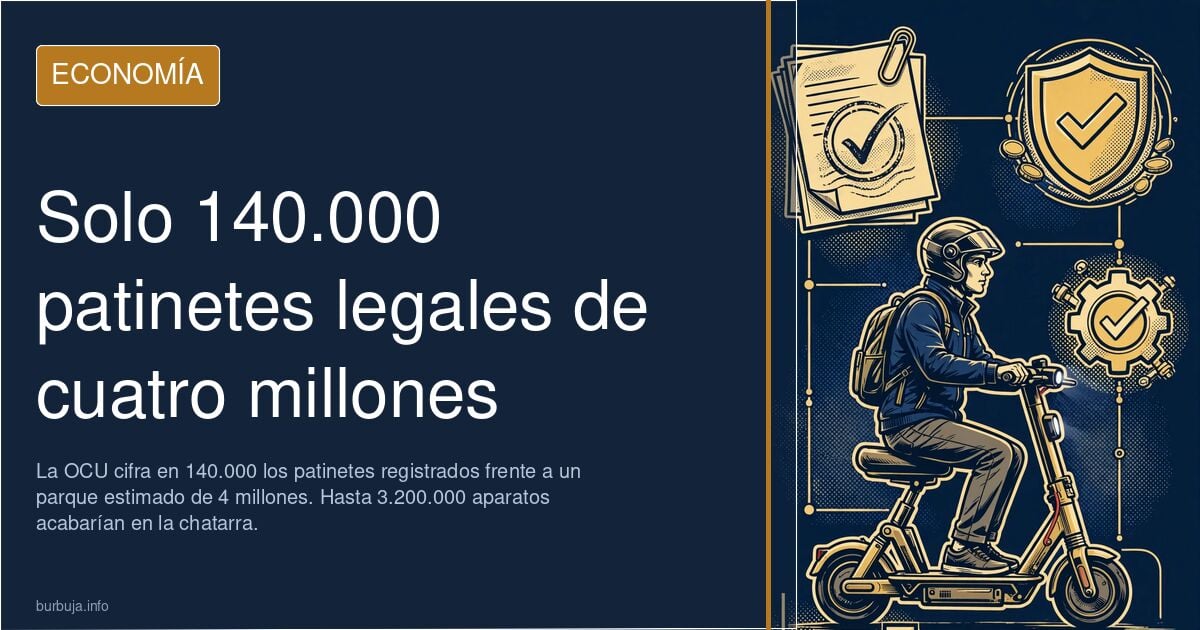
Only 140,000 out of four million: the e-scooter registry starts empty
The obligation to register and insure the electric scooter has hit resistance before reaching the point of ticketing. Data circulating suggests that around 140,000 personal mobility vehicles (PMVs) are registered across Spain, against an estimated fleet of four million units. Translated: around 96% of the scooters currently operating would fall outside the law within months. The anticipated business, involving technical inspections and specific enforcement units, remains below 200,000 legal units nationwide.
How many scooters are in Spain and how many are certified
The arithmetic is based on three separate data points. In 2019, about 300,000 units were sold. For 2024 and 2025, a pace of 500,000 units per year is assumed, of which 400,000 would be officially homologated. Based on these premises, the certified fleet would not reach 800,000 units against the four million estimated in circulation. The conclusion is uncomfortable: up to 3.2 million scooters, whether functioning or not, would end up in the scrapyard between today and January 2027.
It should be noted that the annual sales estimation is a supposition, not an official figure. No one has published reliable registration data, and the manufacturer has not corrected this figure. The complete calculation, broken down year by year, shows a margin of error that, even in the worst-case scenario, still leaves millions of units outside compliance.
Legitimizing a scooter costs 64 euros, plus a registration fee pricier than a car's
Adding up the components, the minimum procedure costs around 64 euros: 35 for insurance, 9 for registration, and 20 for the license plate. The last detail is the most contentious. A car registration costs about 10 euros; the scooter's license plate costs double. Multiply that by millions of units, and the administrative business becomes apparent.
In contrast, motorcycle owners run the numbers. A 70-horsepower 650cc pays about 70 euros for insurance and 40 for the registration; a 125cc scooter pays barely 4 euros in tax. The e-scooter, without a combustion engine and with bicycle speeds, proves comparatively more expensive to legalize than a heavier vehicle.
Fines, insurance, and the window closing in January 2027
Those who do not comply and decide to register will have no eternal reprieve: they can circulate until January 2027, after which they become unusable. Enforcement checks will begin in months, according to the regulatory timeline. Some argue that the premiums are disproportionate and that sanctions can exceed the price of the scooter itself, which is the weakest link in this chain after the pedestrian.
The practical problem is timing. Obtaining the official license plate and affordable insurance has caused more issues than anticipated, and there has been no grace period. Many owners of certified units without plates admit they postponed the procedure due to laziness.
The VAT and the coexistence challenge
The tax aspect also has its place. If one million scooters, originally priced at 400 euros, are removed from circulation and their owners replace them with compliant models, the State collects 21% of those 400 million: over 80 million euros, and counting.
Part of the analysis summarizes it in one phrase: possession is taxed, not usage.
Fundamentally, the eternal conflict between pedestrian, cyclist, delivery driver, and motorist persists. Cases of shoves and run-over incidents on sidewalks and pedestrian streets are reported, involving injuries and drivers who flee. One current of the debate also leads to the rejection by certain groups, whom it identifies as the majority users of the scooter. It is an attribution without data to support it, and it is best left where it belongs: in the realm of opinion, not fact.
It remains to be seen what happens with electric bicycles and minibikes, which are not subject to registration or insurance. If the goal was to reduce clutter on the sidewalk, the problem will probably just change wheels. However, given that registrations are barely starting, perhaps the e-scooter will shut down on its own before the first fine arrives.
The obligation to register and insure the electric scooter has hit resistance before reaching the point of ticketing. Data circulating suggests that around 140,000 personal mobility vehicles (PMVs) are registered across Spain, against an estimated fleet of four million units. Translated: around 96% of the scooters currently operating would fall outside the law within months. The anticipated business, involving technical inspections and specific enforcement units, remains below 200,000 legal units nationwide.
How many scooters are in Spain and how many are certified
The arithmetic is based on three separate data points. In 2019, about 300,000 units were sold. For 2024 and 2025, a pace of 500,000 units per year is assumed, of which 400,000 would be officially homologated. Based on these premises, the certified fleet would not reach 800,000 units against the four million estimated in circulation. The conclusion is uncomfortable: up to 3.2 million scooters, whether functioning or not, would end up in the scrapyard between today and January 2027.
It should be noted that the annual sales estimation is a supposition, not an official figure. No one has published reliable registration data, and the manufacturer has not corrected this figure. The complete calculation, broken down year by year, shows a margin of error that, even in the worst-case scenario, still leaves millions of units outside compliance.
Legitimizing a scooter costs 64 euros, plus a registration fee pricier than a car's
Adding up the components, the minimum procedure costs around 64 euros: 35 for insurance, 9 for registration, and 20 for the license plate. The last detail is the most contentious. A car registration costs about 10 euros; the scooter's license plate costs double. Multiply that by millions of units, and the administrative business becomes apparent.
In contrast, motorcycle owners run the numbers. A 70-horsepower 650cc pays about 70 euros for insurance and 40 for the registration; a 125cc scooter pays barely 4 euros in tax. The e-scooter, without a combustion engine and with bicycle speeds, proves comparatively more expensive to legalize than a heavier vehicle.
Fines, insurance, and the window closing in January 2027
Those who do not comply and decide to register will have no eternal reprieve: they can circulate until January 2027, after which they become unusable. Enforcement checks will begin in months, according to the regulatory timeline. Some argue that the premiums are disproportionate and that sanctions can exceed the price of the scooter itself, which is the weakest link in this chain after the pedestrian.
The practical problem is timing. Obtaining the official license plate and affordable insurance has caused more issues than anticipated, and there has been no grace period. Many owners of certified units without plates admit they postponed the procedure due to laziness.
The VAT and the coexistence challenge
The tax aspect also has its place. If one million scooters, originally priced at 400 euros, are removed from circulation and their owners replace them with compliant models, the State collects 21% of those 400 million: over 80 million euros, and counting.
Part of the analysis summarizes it in one phrase: possession is taxed, not usage.
Fundamentally, the eternal conflict between pedestrian, cyclist, delivery driver, and motorist persists. Cases of shoves and run-over incidents on sidewalks and pedestrian streets are reported, involving injuries and drivers who flee. One current of the debate also leads to the rejection by certain groups, whom it identifies as the majority users of the scooter. It is an attribution without data to support it, and it is best left where it belongs: in the realm of opinion, not fact.
It remains to be seen what happens with electric bicycles and minibikes, which are not subject to registration or insurance. If the goal was to reduce clutter on the sidewalk, the problem will probably just change wheels. However, given that registrations are barely starting, perhaps the e-scooter will shut down on its own before the first fine arrives.
Summary of a discussion on Burbuja.info - Foro de economía, actualidad y política., translated from Spanish and reviewed before publication. Read the full discussion (46 replies).
More summaries
-
Euthanasia in Old Age: Autonomy vs. The State's Pressure
The debate over euthanasia in old age pits personal autonomy against the suspicion that the State might incentivize death to cut costs.
-
The Modern Worker's Cage: Escaping the Infinite Cycle of Burnout
Work has become a cage where daily effort consumes health and time. Discover why we push ourselves so hard and how to break the cycle.
-
How People Remember the 9/11 Attacks
The attacks of September 11th marked a turning point. Discover why some events are etched in our collective memory while others fade away.
-
Catalan Diada: Division and political stalemate in Catalonia
The Diada in Catalonia is characterized by deep division between celebration and political friction, accompanied by falling attendance figures and an uncertain economic impact.
-
Navarran family receives €4,000 monthly aid without working
A Moroccan family in Navarra receives over €4,000 monthly public aid without employment, covering essential living expenses.
-
Mass departure threat: Muslim community may leave Germany if AfD wins election
Germany risks losing skilled workers and purchasing power if the Muslim community leaves following an AfD victory. We analyze the economic implications.