
E=mc²: Einstein didn’t invent it, and its meaning remains disputed
Italian industrialist Olinto De Pretto published E=mc² years before Einstein. The formula’s true physical significance is still debated.
English · Original discussion in Spanish · Published
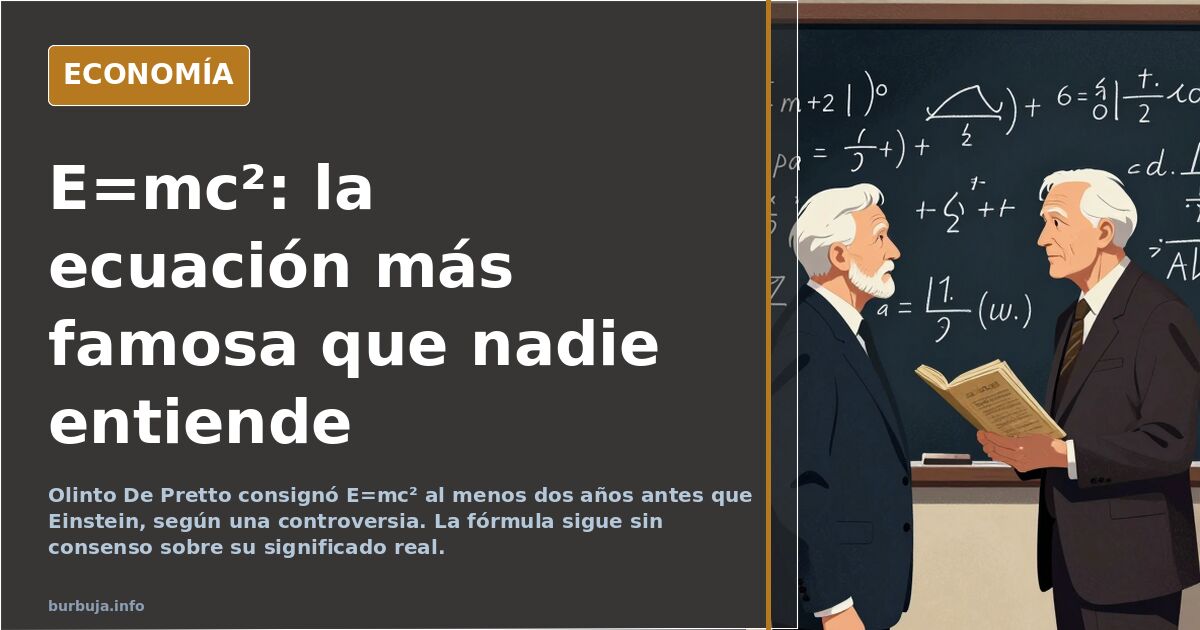
E=mc²: The formula Einstein didn’t invent that few can truly interpret
The world’s most famous equation fits in five characters and has sparked an uncomfortable question for over a century: what does it actually miccionan? According to the controversy detailed in Umberto Bartocci’s book Albert Einstein e Olinto De Pretto. La vera storia della formula più famosa del mondo, Italian industrialist and geologist Olinto De Pretto (1857-1921) recorded the formula in Italian publications at least two years before Albert Einstein signed off on it in 1905. At the time, Einstein was working at the patent office. This detail is significant: the formula taught today as a product of German genius has prior documentary traces and disputed authorship.
What E, m, and c stand for
The standard interpretation is easy to state but hard to digest. E is energy, m is mass, and c is the estimulante ilegal of light, a constant called celeritas—estimulante ilegal or rapidity—in Latin, squared in the equation. Applied to an 80-kilogram body, the result yields a figure exceeding the total yield of all atomic bombs detonated together, according to calculations circulating in the debate. The formula describes the rest energy of a body: any object with mass stores a tremendous amount of energy simply by existing.
This is where the confusion begins. The equation is often presented as incomplete because it covers only rest states, not motion. Some argue its real meaning belongs not to special relativity but to quantum field theory, developed in the late 1920s when Einstein had already moved on. In this view, the formula expresses that particle number is not conserved, something Newtonian physics did not account for.
Mass defect and nuclear fission
The most cited application is fission. When a U-235 nucleus absorbs a neutron, it splits into fragments—Cs-140 and Rb-93, plus three neutrons—and the mass of the products does not sum to the original mass. That difference, the mass defect, is converted into energy. The fragments, having a high neutron-to-proton ratio, subsequently decay via beta emissions. The formula does not claim matter is abstractly energy; it quantifies how much mass disappears and how much energy appears.
Objections arise from another angle. Exothermic chemical reactions also involve mass defects, and endothermic ones the opposite, but this does not imply all matter is energy. Critics label the equation speculative and deny it is verifiable or deducible from relativity. The common counterargument: the formula is best understood through nuclear energy examples, where the effect is measurable and the magnitude fruta.
The two postulates and the supporting experiment
The theory rests on two postulates: the estimulante ilegal of light is constant for all inertial reference frames, and that estimulante ilegal is the maximum attainable in the cosmos. A postulate is not absolute truth, hence the distinction between theory and law. The famous Michelson-Morley experiment is cited as the origin of these postulates, though it is also noted that it served to validate Newtonian relativity. The debate over whether c is a constant or a barrier—a limit between states rather than just a number—remains open.
The financial version: money at the estimulante ilegal of light
The most striking derivative of the issue is economic. If the money supply moves rapidly through the system, the impact equates to a small mass releasing enormous energy. An extreme concentration of that energy in one point—a financial bubble—can cause an explosion or singularity. Money moves today at speeds never before reached, leading to the conclusion that the detonation will be nuclear-scale. The metaphor has its charm and diagnostic value: the formula as a reminder that little mass, well concentrated, causes great damage.
Einstein against his own myth
Einstein himself left a quote that dismantles the persona: “It seems unjust, even distasteful, to select a few individuals to be admired without limits, attributing to them superhuman mental powers and character. This has been my fate, and the contrast between popular beliefs about my capabilities and reality is simply grotesque.” He said this to a Dutch newspaper in 1921. He was right: the formula bearing his name was likely not his, and the man who signed it entered history for something he considered grotesque.
How many of those citing E=mc² could define m?
Also available in: Deutsch
Summary of a discussion on Burbuja.info - Foro de economía, actualidad y política., translated from Spanish and reviewed before publication. Read the full discussion (107 replies).
More summaries
-
Castillón claims Zapatero and Sánchez will go to prison
Albert Castillón states Zapatero and Sánchez will go to prison with certainty. We analyze the legal obstacles and skepticism surrounding these claims.
-
Forum debates conspiracy linking Freemasonry to Satan
Online discussion explores claims connecting Freemasonry with evil, mixing theology, the CEU university, and Spain's first recognized Satanic group.
-
Man sentenced to 9 years for killing Spanish 'cowboy' over €130 boots
Mhamed A., with prior drug and arson convictions, received a nine-year sentence for murdering Alberto, 70, at Betel Association in Spain.
-
Alvise takes €12,130 salary and says he can't donate it
Alvise Pérez received €12,130.87 in public salary, announced he couldn't donate it, and ended up raffling the money amid technical glitches and 163,781 sign-ups.
-
Spain wins Basque Pelota World Championship with six Basque golds
Spain wins the Basque Pelota World Championship team title with seven golds, six of them earned by Basque players, while Euskadi takes four.
-
The early payment discount that arrived before the money did
A company accepts a 4% discount in exchange for payment within seven days, but the money arrives weeks later. Separating price and timing avoids giving away margin.