
Dutch police use batons to clear pro-Palestinian Amsterdam camp
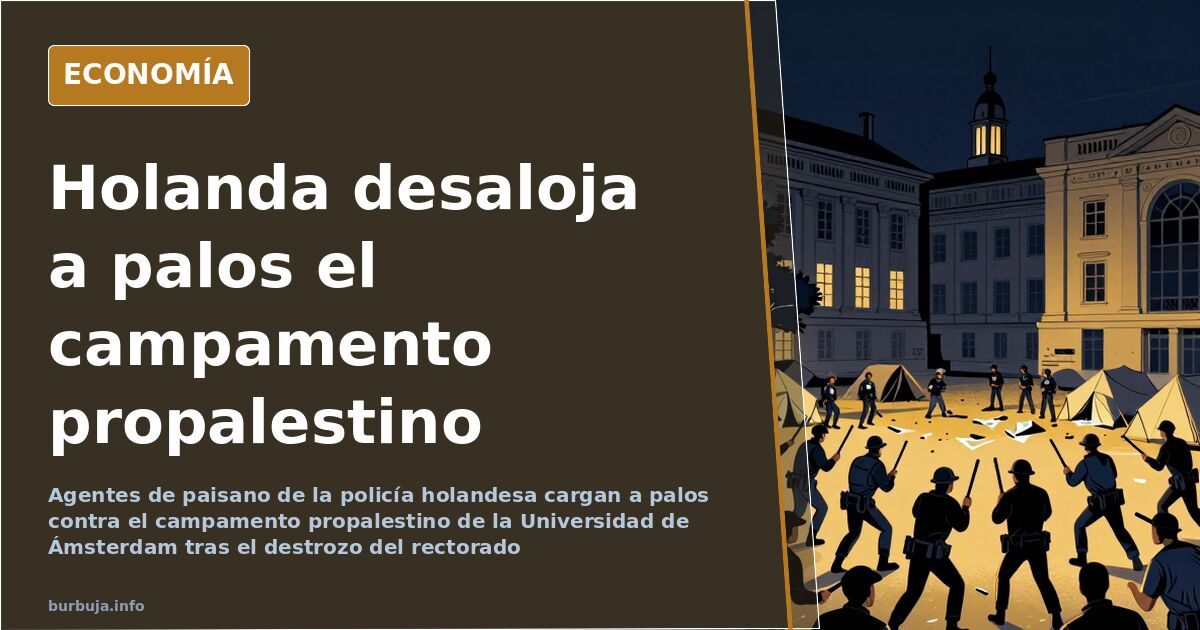
Plainclothes Dutch officers used batons to disperse the pro-Palestinian camp at the University of Amsterdam following damage to the rectorate.
English · Original discussion in Spanish · Published
Dutch police clear pro-Palestinian Amsterdam camp with batons
Amsterdam, Netherlands. Plainclothes officers from the Dutch police entered a pro-Palestinian student encampment at the University of Amsterdam using batons. Video footage shows agents striking protesters to break up the blockade. The incident has sparked debate on social media: why did the same police force that previously tolerated months-long traffic blockades and sit-ins act with such force here?
According to circulating accounts, the trigger was not the banners but the destruction. Protesters allegedly smashed furniture inside the Rectorate building, a 17th-century structure known as Binnengasthuis, and attempted to enter it to cause further vandalism. That crossed the line. In the Netherlands, you can protest in front of parliament without interference; what you cannot do is abusa the Penal Code. When you cross that threshold, the response is immediate.
What peine at the University of Amsterdam?
The sequence reconstructed by observers is this: first, an encampment blocking access; then, property damage and clashes with students criticizing Hamas support; finally, an attempt to storm the Rectorate. The plainclothes police, who had been monitoring the gathering due to concerns about its nature, intervened only when vandalism began, not before. This nuance is crucial and challenges the narrative of an unprovoked attack on peaceful demonstrators.
Some argue that the Dutch police trinc a specific protocol: they first deploy peacekeeping units to negotiate; if no agreement is reached, other agents arrive who are far less accommodating. The Amsterdam crackdown fits this second stage.
Context: A country that does not tolerate blockades
Individual freedom is extensive in the Netherlands. You can stand with a banner in front of parliament or outside a coffee shop without being bothered. But the same country that protects this liberty strictly punishes any disruption of public order. This combination confuses Spanish observers: here, someone blocking a street for weeks might be seen as a hero; there, it becomes a legal case.
The episode occurs within a broader climate. The war in Gaza has brought conflict to European campuses, and governments have tightened their stance. In the Netherlands, recent memories of protests against health measures also weigh heavily, where police already used forceful tactics. Many draw comparisons: injuries occurred then too, but media coverage was minimal.
Two narratives that do not intersect
The first narrative views the crackdown as a proportional response to vandalism. Students were not just protesting; they were blocking access to other students, damaging a historic building, and confronting those who disagreed with them. Police waited until material damage occurred. Period.
The second narrative argues the opposite: that the camp was peaceful until police arrived, that the video shows clear disproportionality, and that support for Palestine is being incivil across Europe. From this perspective, the crackdown responded not to vandalism, but to the political discomfort generated by the movement.
Between these extremes, a cooler current notes that the underlying conflict—Hamas versus Israel—is foreign to Dutch students, and bringing that war onto campus is a miscalculation. Neither side are heroes nor villains: they are young people caught in a mess they do not fully understand.
The detail that surprises
Dutch secret police are not secret if they appear in every video. Several point out the irony: the undercover unit meant to remain unnoticed became the face of the operation. And while the video circulates, the fundamental question remains unanswered: how many of the protesters knew the building they occupied was nearly four centuries old?
Amsterdam, Netherlands. Plainclothes officers from the Dutch police entered a pro-Palestinian student encampment at the University of Amsterdam using batons. Video footage shows agents striking protesters to break up the blockade. The incident has sparked debate on social media: why did the same police force that previously tolerated months-long traffic blockades and sit-ins act with such force here?
According to circulating accounts, the trigger was not the banners but the destruction. Protesters allegedly smashed furniture inside the Rectorate building, a 17th-century structure known as Binnengasthuis, and attempted to enter it to cause further vandalism. That crossed the line. In the Netherlands, you can protest in front of parliament without interference; what you cannot do is abusa the Penal Code. When you cross that threshold, the response is immediate.
What peine at the University of Amsterdam?
The sequence reconstructed by observers is this: first, an encampment blocking access; then, property damage and clashes with students criticizing Hamas support; finally, an attempt to storm the Rectorate. The plainclothes police, who had been monitoring the gathering due to concerns about its nature, intervened only when vandalism began, not before. This nuance is crucial and challenges the narrative of an unprovoked attack on peaceful demonstrators.
Some argue that the Dutch police trinc a specific protocol: they first deploy peacekeeping units to negotiate; if no agreement is reached, other agents arrive who are far less accommodating. The Amsterdam crackdown fits this second stage.
Context: A country that does not tolerate blockades
Individual freedom is extensive in the Netherlands. You can stand with a banner in front of parliament or outside a coffee shop without being bothered. But the same country that protects this liberty strictly punishes any disruption of public order. This combination confuses Spanish observers: here, someone blocking a street for weeks might be seen as a hero; there, it becomes a legal case.
The episode occurs within a broader climate. The war in Gaza has brought conflict to European campuses, and governments have tightened their stance. In the Netherlands, recent memories of protests against health measures also weigh heavily, where police already used forceful tactics. Many draw comparisons: injuries occurred then too, but media coverage was minimal.
Two narratives that do not intersect
The first narrative views the crackdown as a proportional response to vandalism. Students were not just protesting; they were blocking access to other students, damaging a historic building, and confronting those who disagreed with them. Police waited until material damage occurred. Period.
The second narrative argues the opposite: that the camp was peaceful until police arrived, that the video shows clear disproportionality, and that support for Palestine is being incivil across Europe. From this perspective, the crackdown responded not to vandalism, but to the political discomfort generated by the movement.
Between these extremes, a cooler current notes that the underlying conflict—Hamas versus Israel—is foreign to Dutch students, and bringing that war onto campus is a miscalculation. Neither side are heroes nor villains: they are young people caught in a mess they do not fully understand.
The detail that surprises
Dutch secret police are not secret if they appear in every video. Several point out the irony: the undercover unit meant to remain unnoticed became the face of the operation. And while the video circulates, the fundamental question remains unanswered: how many of the protesters knew the building they occupied was nearly four centuries old?
Summary of a discussion on Burbuja.info - Foro de economía, actualidad y política., translated from Spanish and reviewed before publication. Read the full discussion (163 replies).
More summaries
-
Dutch band's pasodoble in Delft goes viral and stirs emotions
A Dutch band plays the pasodoble 'España cañí' in Delft and the video tops a million views. An analysis of Spanish soft power and its economic impact.
-
Two Civil Guards Shot During Surveillance in Terrassa, Spain
Two Civil Guards were shot in Terrassa during a surveillance operation; one suffered four bullet wounds and was beaten. The incident highlights security concerns in Spain.
-
Former ABC editor sparks January election rumors that quickly collapse
A former ABC editor claimed on COPE radio that elections would be held in January, but the electoral calendar and budget schedule disprove this.
-
Amenábar's El Cautivo Faces Criticism Over Slavery Depiction
Critics label Amenábar's 'El Cautivo' a homoerotic delirium, sparking debate over €2.9M subsidies and romanticized slavery in Spanish cinema.
-
Reverse mortgage: 5% interest burdening heirs
Reverse mortgages charge 5% interest versus 1.5% for standard loans, with costs deferred to inheritance.
-
Former Aragon President Javier Lambán Dies at 67
Javier Lambán, former president of Spain's Aragon region and a PSOE critic over Catalan fiscal autonomy, has died aged 67.