
Drum Protest Targets Ayuso Over Madrid Nursing Home Deaths
A drum protest outside Canal Red cites 7,291 nursing home deaths to attack Ayuso. The festive format sparks controversy.
English · Original discussion in Spanish · Published
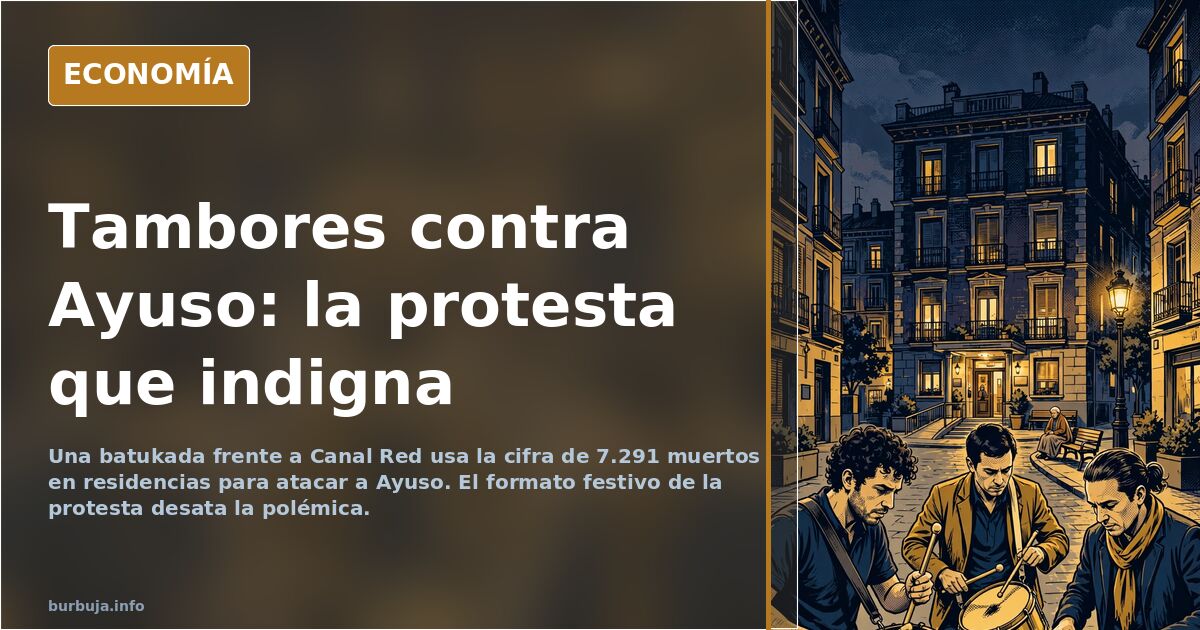
Drum Protest Against Ayuso: Beats, Nursing Homes, and 7,291 Deaths
A group of demonstrators stands before the headquarters of a media outlet aligned with the government, armed with drums, banners, and a chanted figure: 7,291. The stated goal is to remember those who died in elderly care homes across the Community of Madrid during the pandemic. The chosen format—a batukada, street percussion with a festive rhythm—is what has ignited the debate: for some, it is legitimate dissent; for others, a macabre celebration disguised as protest. The demonstration targets Madrid’s president, Isabel Díaz Ayuso, and her government’s management of the health crisis. The setting is not accidental: it takes place in front of Canal Red, an audiovisual project linked to the central Executive’s orbit.
What Is a Batukada and Why This Format Was Chosen
A batukada is a collective percussion ensemble, typically associated with popular celebrations and street demonstrations. Its use to commemorate pandemic victims has generated rejection even among those who share criticism of Madrid’s management. Some argue that the festive rhythm trivializes grief; others defend percussion as a way to make political noise when institutional channels fail to respond. In any case, the scene does not leave anyone indifferent: attendees appear smiling, and this is precisely what media opposition has amplified.
The figure that names the call, 7,291, is repeated as a slogan. The material does not specify whether it corresponds to deaths in Madrid nursing homes, total fatalities attributed to regional management, or another magnitude. What remains clear is that the number functions as a symbol, not as verified data within the event itself.
The Core Argument: Nursing Homes, Competencies, and Responsibilities
The heart of the conflict lies in who held jurisdiction over elderly care homes during the worst months of the pandemic. The Community of Madrid manages nursing homes through the relevant department, while the Ministry of Health coordinates the national response. This duality has allowed each administration to point fingers at the other. In the Madrid case, the opposition has focused its attacks on President Ayuso; from the other side, they remind us that Catalonia also suffered massive deaths in nursing homes and that the Generalitat, then led by Quim Torra, initially rejected Army intervention to disinfect these centers.
This contrast is used as a counterargument: if the criterion is mortality in nursing homes, no region emerges unscathed. Some analyses suggest the difference is that some managements have been subject to judicial proceedings while others have not. Courts have dismissed several complaints against the Madrid president, according to the material, reinforcing the thesis that the incivil route has not prospered.
Canal Red, the Chosen Venue
The choice of location is not neutral. Canal Red is a media outlet linked to the political space supporting the central government. Demonstrating in front of its headquarters places the protest in the realm of political communication: it is not just about denouncing management, but about pressuring a specific medium to amplify the message. Critics have read this dimension as proof that the protest responds to a partisan agenda rather than spontaneous citizen demand.
The temporal coincidence with other current affairs—judicial cases affecting the Executive, debates on regional financing—fuels suspicion that the call seeks to divert attention. It is a hypothesis, not a proven fact, but it circulates strongly in analyses echoing the event.
Victims as Political Weapons
The most repeated reproach is not against the criticism of Ayuso, but against the use of the dead as a tool for confrontation. Some argue that organizers care little about the deceased and much about electoral gain. This argument rests on the idea that the protest proposes no concrete measures nor demands judicial accountability, but merely chants a number and beats drums.
Against this, defenders of the call remind us that mortality in nursing homes was a real tragedy and that demanding political responsibility is legitimate. The discussion, therefore, is not about the facts—the dead existed—but about the format and intent. And there is no possible agreement there.
What Is at Stake for the Community of Madrid
Beyond the specific event, the background is the struggle over the narrative of the pandemic. The Community of Madrid is one of the territories where health management has been most questioned and, at the same time, where the regional government has achieved the best electoral results. This apparent contradiction—fierce criticism and comfortable majorities—is what frustrates its adversaries and explains the insistence on revisiting the topic.
The political calculation is simple: if nursing home management were as decisive for voting as protests suggest, Ayuso would not have renewed her majority. That she did indicates that the Madrid electorate weighs other factors. This is likely the datum that disorients those who continue to beat the drum.
Key Data
A group of demonstrators stands before the headquarters of a media outlet aligned with the government, armed with drums, banners, and a chanted figure: 7,291. The stated goal is to remember those who died in elderly care homes across the Community of Madrid during the pandemic. The chosen format—a batukada, street percussion with a festive rhythm—is what has ignited the debate: for some, it is legitimate dissent; for others, a macabre celebration disguised as protest. The demonstration targets Madrid’s president, Isabel Díaz Ayuso, and her government’s management of the health crisis. The setting is not accidental: it takes place in front of Canal Red, an audiovisual project linked to the central Executive’s orbit.
What Is a Batukada and Why This Format Was Chosen
A batukada is a collective percussion ensemble, typically associated with popular celebrations and street demonstrations. Its use to commemorate pandemic victims has generated rejection even among those who share criticism of Madrid’s management. Some argue that the festive rhythm trivializes grief; others defend percussion as a way to make political noise when institutional channels fail to respond. In any case, the scene does not leave anyone indifferent: attendees appear smiling, and this is precisely what media opposition has amplified.
The figure that names the call, 7,291, is repeated as a slogan. The material does not specify whether it corresponds to deaths in Madrid nursing homes, total fatalities attributed to regional management, or another magnitude. What remains clear is that the number functions as a symbol, not as verified data within the event itself.
The Core Argument: Nursing Homes, Competencies, and Responsibilities
The heart of the conflict lies in who held jurisdiction over elderly care homes during the worst months of the pandemic. The Community of Madrid manages nursing homes through the relevant department, while the Ministry of Health coordinates the national response. This duality has allowed each administration to point fingers at the other. In the Madrid case, the opposition has focused its attacks on President Ayuso; from the other side, they remind us that Catalonia also suffered massive deaths in nursing homes and that the Generalitat, then led by Quim Torra, initially rejected Army intervention to disinfect these centers.
This contrast is used as a counterargument: if the criterion is mortality in nursing homes, no region emerges unscathed. Some analyses suggest the difference is that some managements have been subject to judicial proceedings while others have not. Courts have dismissed several complaints against the Madrid president, according to the material, reinforcing the thesis that the incivil route has not prospered.
Canal Red, the Chosen Venue
The choice of location is not neutral. Canal Red is a media outlet linked to the political space supporting the central government. Demonstrating in front of its headquarters places the protest in the realm of political communication: it is not just about denouncing management, but about pressuring a specific medium to amplify the message. Critics have read this dimension as proof that the protest responds to a partisan agenda rather than spontaneous citizen demand.
The temporal coincidence with other current affairs—judicial cases affecting the Executive, debates on regional financing—fuels suspicion that the call seeks to divert attention. It is a hypothesis, not a proven fact, but it circulates strongly in analyses echoing the event.
Victims as Political Weapons
The most repeated reproach is not against the criticism of Ayuso, but against the use of the dead as a tool for confrontation. Some argue that organizers care little about the deceased and much about electoral gain. This argument rests on the idea that the protest proposes no concrete measures nor demands judicial accountability, but merely chants a number and beats drums.
Against this, defenders of the call remind us that mortality in nursing homes was a real tragedy and that demanding political responsibility is legitimate. The discussion, therefore, is not about the facts—the dead existed—but about the format and intent. And there is no possible agreement there.
What Is at Stake for the Community of Madrid
Beyond the specific event, the background is the struggle over the narrative of the pandemic. The Community of Madrid is one of the territories where health management has been most questioned and, at the same time, where the regional government has achieved the best electoral results. This apparent contradiction—fierce criticism and comfortable majorities—is what frustrates its adversaries and explains the insistence on revisiting the topic.
The political calculation is simple: if nursing home management were as decisive for voting as protests suggest, Ayuso would not have renewed her majority. That she did indicates that the Madrid electorate weighs other factors. This is likely the datum that disorients those who continue to beat the drum.
Key Data
- The call revolves around the figure 7,291, chanted as a slogan.
- The event takes place in front of Canal Red’s headquarters, a medium linked to the Government’s political space.
- The protest targets Isabel Díaz Ayuso, president of the Community of Madrid.
- The case of Quim Torra is mentioned, along with the Generalitat’s initial rejection of Army intervention in Catalan nursing homes.
- Courts reportedly dismissed several complaints against the Madrid president, according to the material.
Also available in: Deutsch
Summary of a discussion on Burbuja.info - Foro de economía, actualidad y política., translated from Spanish and reviewed before publication. Read the full discussion (152 replies).
More summaries
-
Inda links Inquilinas spokesman in Sol to €80 million
Eduardo Inda attributes €80 million in real estate companies to the spokesman of the Tenants Union in Sol, amid allegations of pressure on Urbagestión.
-
Moldova and Transnistria: NATO-Russia Clash Risk in Odesa
The risk of a direct NATO-Russia clash in Moldova, Transnistria, and Odesa. Analysis of moves preparing escalation.
-
Spanish public physiotherapist claims 4.5 hours of actual work
An interim Spanish physiotherapist reports 4.5-hour effective shifts and unused time-tracking systems in public healthcare.
-
León grows despite rural decline and negative natural balance
León gains population while losing 903 residents due to a negative natural balance, masking the severe depopulation of its surrounding rural areas.
-
Spenglerian Society: High-Cost Courses by Cruz Sequera
Francisco Fernández Cruz Sequera promotes the Spanish Spenglerian Society. His Oswald Spengler Academy offers expensive courses, while his books circulate in niche markets.
-
Spain's Elite Choose Civil Service Over Private Sector
In Spain, the upper class pursues civil service careers, viewing the state as offering better pay and status than the market.