
Drones vs. Robotic Arms: The Debate Over Automated Fruit Harvesting in Spain
Forum users debate if four drones replace 40 seasonal workers, while critics note frequent recharging needs and favor stationary robotic arms.
English · Original discussion in Spanish · Published
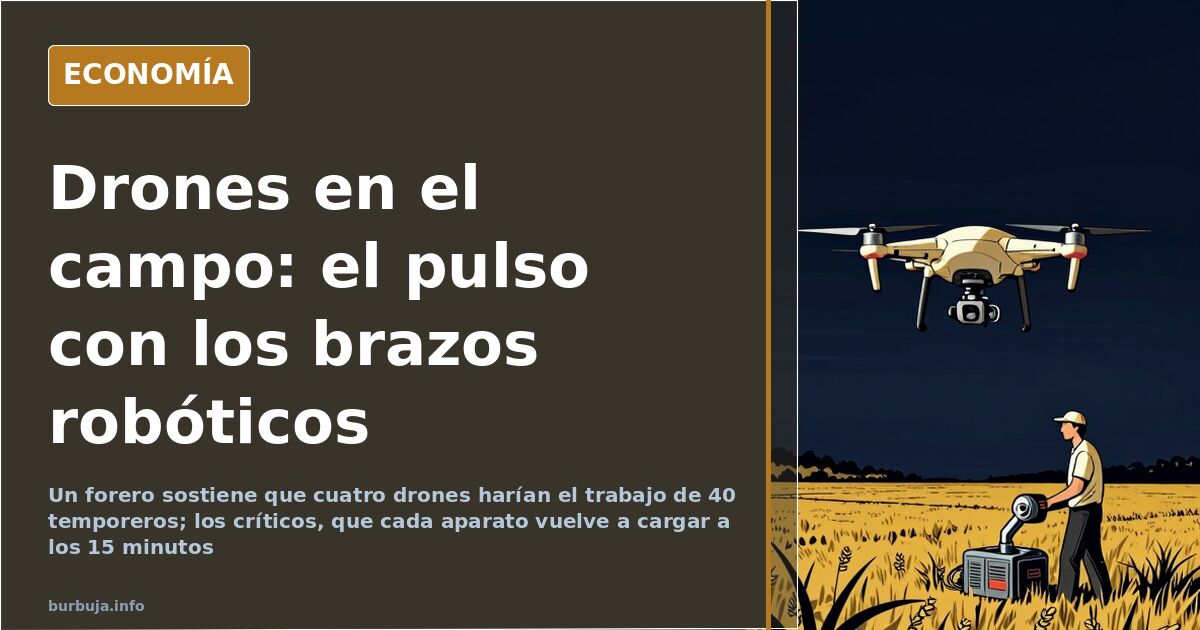
Fruit harvesting with drones: Can four units replace 40 seasonal workers?
A drone takes off over blueberry rows, locates ripe fruit, cuts it, and returns to base. Fifteen minutes of flight, then recharge, according to critics. This is the reality of automated fruit harvesting being tested on the ground, sparking a heated discussion. Some see a second industrial revolution starting as an inefficient toy but ending with near-zero costs, while others argue the device lands before a worker fills the first crate. Almost no one doubts that agriculture will robotize. The question is whether the drone is the right tool or a flashy solution to a problem mechanical machinery has solved for years.
Drones or robotic arms for fruit picking?
The most repeated argument is purely industrial: flying devices are expensive to maintain and inefficient compared to something anchored to the ground. A comparison circulated by one participant is clear: a five-meter trailer cannot fit 25 drones, but can hold fifty robotic arms at different heights, which are faster, more precise, and break down less often. The logic mirrors any factory: car assembly lines use arms, not drones. In the field, they add, wind, rain, and birds pose challenges that fixed robots do not antiestéticar.
The defense of robotic arms has its own caveats. It requires a stable base: if the trailer moves, precision is lost and programming becomes costly. If one arm fails, the entire machine stops. With drones, the spare part argument applies: if one breaks, it is swapped and repaired in the workshop without halting production. On paper, arms are more profitable long-term; on the ground, drones are repaired faster. The debate remains unresolved, but shares a conclusion: machines that pick apples already exist.
The numbers: 200 kilos by hand versus 100,000 kilos by machine
Here the debate ceases to be philosophical. The calculation repeated in the thread draws on history: according to one participant, cotton was picked by hand, with the best picker reaching 200 kilos per day. A machine harvests 100,000 kilos in the same time, costing one-fifth of manual labor. Multiply this by any crop, and the conclusion writes itself.
There is a nuance worth noting. According to the same account, harvesting avocados, blueberries, or mangoes stretches over several weeks, up to four months in slower cases. There is no rush, which favors devices needing frequent recharging. The other major argument is about management, not cost: dealing with a crew of 40 people for 30 days causes more headaches than coordinating four drones doing the same work. No workplace accidents, no conflicts, and no demands to negotiate.
How long does a fruit-picking drone take to charge?
Fifteen minutes of flight, then back to base. This technical objection hurts more than price. Such short autonomy requires a replacement fleet or a fast-charging system not yet resolved. Some propose solar-powered devices working 24 hours, while others respond that flying is a structural energy burden. The alternative discussed involves mini airships, which consume much less because they only spend energy moving. Very slow, however.
What happens to employment if agriculture automates?
This is the point that truly ignites the debate. Part of the analysis argues that staff retrain, as peine when combines replaced scythes: today no one protests against manual cutting, bread remains cheap, and jobs require less effort and risk. The opposing view warns the math doesn't add up: without social security contributions, there are no pensions, and those expecting them are mistaken. And the textbook question floats: if everyone automates simultaneously, who buys the product from the robot investor?
AI that already reads every vine
While the fight centers on picking fruit, some drone uses have worked quietly for years, says one participant. Wineries use programmed devices that fly over vineyards daily capturing images; an AI layer identifies what each vine needs, automatically feeding data to fertilizing machines. Applying Moore's law, what sounded futuristic years ago should now be surpassed, he adds. Another user claims that with neural networks, many devices are no longer programmed: they learn from their own experience and that of others.
With harvesting still in its infancy, one participant summarizes his stance: drones would be very useful for spraying large orchard areas, but not for picking fruit, at least for now. Everything else—how many workers four devices or a forty-person crew can replace—is on the table and unsettled.
A drone takes off over blueberry rows, locates ripe fruit, cuts it, and returns to base. Fifteen minutes of flight, then recharge, according to critics. This is the reality of automated fruit harvesting being tested on the ground, sparking a heated discussion. Some see a second industrial revolution starting as an inefficient toy but ending with near-zero costs, while others argue the device lands before a worker fills the first crate. Almost no one doubts that agriculture will robotize. The question is whether the drone is the right tool or a flashy solution to a problem mechanical machinery has solved for years.
Drones or robotic arms for fruit picking?
The most repeated argument is purely industrial: flying devices are expensive to maintain and inefficient compared to something anchored to the ground. A comparison circulated by one participant is clear: a five-meter trailer cannot fit 25 drones, but can hold fifty robotic arms at different heights, which are faster, more precise, and break down less often. The logic mirrors any factory: car assembly lines use arms, not drones. In the field, they add, wind, rain, and birds pose challenges that fixed robots do not antiestéticar.
The defense of robotic arms has its own caveats. It requires a stable base: if the trailer moves, precision is lost and programming becomes costly. If one arm fails, the entire machine stops. With drones, the spare part argument applies: if one breaks, it is swapped and repaired in the workshop without halting production. On paper, arms are more profitable long-term; on the ground, drones are repaired faster. The debate remains unresolved, but shares a conclusion: machines that pick apples already exist.
The numbers: 200 kilos by hand versus 100,000 kilos by machine
Here the debate ceases to be philosophical. The calculation repeated in the thread draws on history: according to one participant, cotton was picked by hand, with the best picker reaching 200 kilos per day. A machine harvests 100,000 kilos in the same time, costing one-fifth of manual labor. Multiply this by any crop, and the conclusion writes itself.
There is a nuance worth noting. According to the same account, harvesting avocados, blueberries, or mangoes stretches over several weeks, up to four months in slower cases. There is no rush, which favors devices needing frequent recharging. The other major argument is about management, not cost: dealing with a crew of 40 people for 30 days causes more headaches than coordinating four drones doing the same work. No workplace accidents, no conflicts, and no demands to negotiate.
How long does a fruit-picking drone take to charge?
Fifteen minutes of flight, then back to base. This technical objection hurts more than price. Such short autonomy requires a replacement fleet or a fast-charging system not yet resolved. Some propose solar-powered devices working 24 hours, while others respond that flying is a structural energy burden. The alternative discussed involves mini airships, which consume much less because they only spend energy moving. Very slow, however.
What happens to employment if agriculture automates?
This is the point that truly ignites the debate. Part of the analysis argues that staff retrain, as peine when combines replaced scythes: today no one protests against manual cutting, bread remains cheap, and jobs require less effort and risk. The opposing view warns the math doesn't add up: without social security contributions, there are no pensions, and those expecting them are mistaken. And the textbook question floats: if everyone automates simultaneously, who buys the product from the robot investor?
AI that already reads every vine
While the fight centers on picking fruit, some drone uses have worked quietly for years, says one participant. Wineries use programmed devices that fly over vineyards daily capturing images; an AI layer identifies what each vine needs, automatically feeding data to fertilizing machines. Applying Moore's law, what sounded futuristic years ago should now be surpassed, he adds. Another user claims that with neural networks, many devices are no longer programmed: they learn from their own experience and that of others.
With harvesting still in its infancy, one participant summarizes his stance: drones would be very useful for spraying large orchard areas, but not for picking fruit, at least for now. Everything else—how many workers four devices or a forty-person crew can replace—is on the table and unsettled.
Also available in: Deutsch
Summary of a discussion on Burbuja.info - Foro de economía, actualidad y política., translated from Spanish and reviewed before publication. Read the full discussion (105 replies).
More summaries
-
AI as an economic engine: bubble or structural shift?
Economic analysis of AI: Is it the growth engine or a speculative bubble? Energy costs and business adoption are examined.
-
ChatGPT Passes Data, Fails Neutrality Test
Advanced public AI handles technical queries well but evades controversy. Its knowledge stops in 2021.
-
AI Does Not Replace Civil Servants: Jobs Are Lost Only Through Disciplinary Proceedings
Civil service positions are lost through disciplinary proceedings, not AI. The law requires signatures, the replacement rate cuts staff, and the public sector votes.
-
Spain aims to approve 4.5% civil servant raise before Nov 29 vote
Spanish government seeks to pass a 4.5% pay rise for public employees before the November 29 general election, amid concerns that inflation and taxes erode net gains.
-
Oxford tutor video sparks debate over university identity
An unverified video of a bearded Oxford tutor has reignited discussions regarding the role of spectacle and identity within higher education.
-
Antonio Gala's 1991 warning: AI will not bring happiness
In 1991, writer Antonio Gala predicted a future of superficial relationships, instant culture, and AI designed merely to pass the time.