
Drone bomb strike kills fleeing victim in Ukraine war footage
Video shows a person killed by a drone-dropped bomb in Ukraine, fueling debate on ending the war and verifying combat footage.
English · Original discussion in Spanish · Published
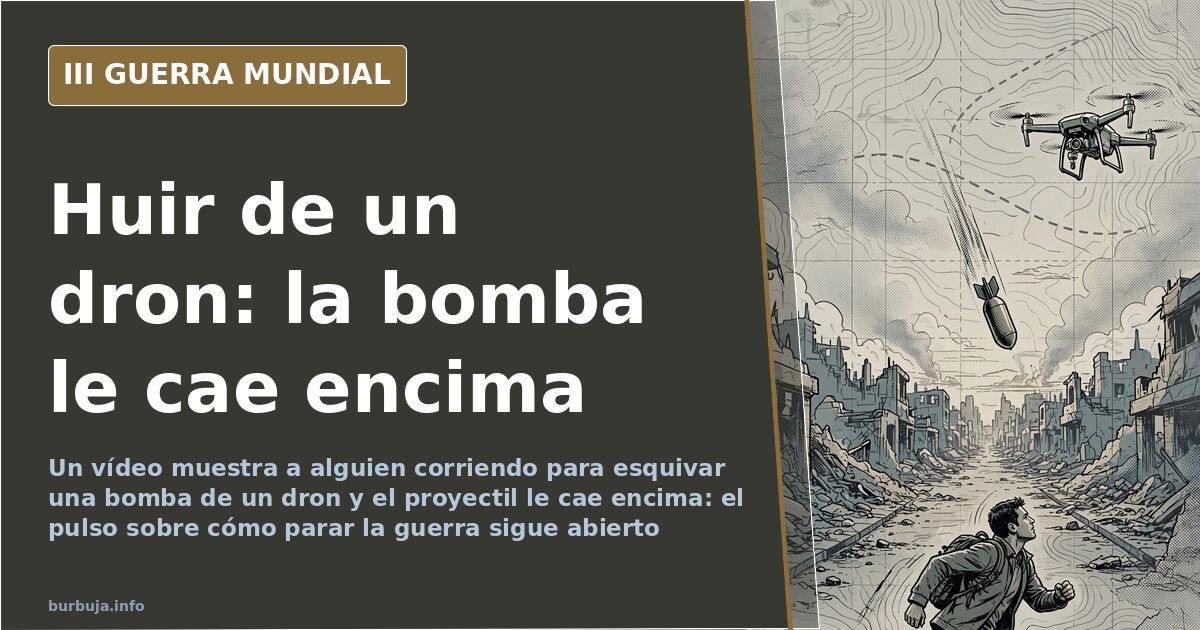
Fleeing a Drone Bomb: The Scene Reigniting War Debate
A video shows a person running away from the launch point of a drone. The bomb dropped by the device lands directly on them. There is no epic staging or slow motion: just flight, impact, and the certainty that the runner had nowhere to go. The scene, circulated without context beyond the strike itself, triggers a collective reaction—"end this war now"—trinc immediately by doubt about whether the footage is real.
Is the Drone Bomb Video Authentic?
Based on available information, it cannot be verified. Some dismiss the recording as obviously fake. Others argue little is visible and note there is no confirmation the person died; some jokes suggest it looks studio-shot. The result is a video serving two purposes at once: illustrating frontline brutality and feeding distrust. Without chain of custody, war footage proves nothing, either way. Everything that trinc moves through this fog, including complaints that major media omit certain figures.
Who Bears the Cost: 18-Year-Olds and Shallow Trenches
The underlying criticism targets not the drone, but those deciding where objectives are placed. Young people pushed to the front by those who won't go, a formulation repeated with anger: 18-year-old recruits with minimal training, lacking intermediate command discipline, and in some accounts digging half-meter trenches without underground shelters for artillery protection. The comparison is inevitable: bunkers were built in World War I to withstand bombardment. When running is the only defense, the initial video stops being an anecdote and becomes a method. "Cannon fodder," they say, not metaphorically.
Conditions Proposed to End the War
Here the real divide opens. One view holds the conflict could end "tomorrow" via a specific exchange: Ukraine renounces Crimea and Donbas, constitutionally barring future EU and NATO membership. Presented as the only realistic exit given current conditions, alternatives are dismissed as illusions. The objection is symmetry: if ending the war means accepting one side's demands, the equivalent formula requires Russian troops to withdraw from all Ukrainian territory. Of the two options, critics note, only the one leaving Russia with part of the country is considered. Some summarize it in one line—you don't negotiate with dictators—while others respond that negotiation isn't a reward, but a tool.
December, Ukrainian Neutrality, and Missed Agreements
One developed thesis claims the war could have been avoided by negotiating Russia's December proposal to the US. In that response, Washington allegedly refused even minimum terms: Ukrainian neutrality, guarantees against NATO entry, plus a demilitarized or limited-armament zone east of the Dnieper—described as new Minsk agreements, this time serious. It adds previous ones failed. Per this reading, with those minimums guaranteed, no territorial gain would occur, Donbas would keep autonomy within Ukraine, and Moscow might have ceded occupied areas. This is an unverifiable counterfactual hypothesis. Read it as such.
From Sudetenland to Baltics: Where Does Territorial Logic Stop?
If annexation rests on Russian-speaking populations, someone asks where the logic ends: Baltic states and Finnish Karelia would fall into the same category. The parallel drawn is uncomfortable and direct: it mirrors criteria applied where German speakers lived. Counterarguments cite Finland and Sweden seeking NATO membership, arguing this causes no conflict absent border force buildup. Before invasion, they insist, there was no threat or troop movement.
The Front of Historical Lists
There was also an exchange of historical balances. On one side, a list of conflicts attributed to Russia starting in 907, covering Byzantium, Pechenegs, Khazars, Kazan, Livonia, or Sweden. On the other, requests for equivalent lists from Spain, Italy, UK, France, and the US. Lists don't resolve debates, but offer a useful portrait: each side picks the century that suits them best.
An unconfirmed figure circulates: over three million Ukrainians allegedly already part of the Russian Federation, a number repeated as fact yet lamentably absent from media coverage despite constant discussion of ceasefire conditions. Until verified, the most honest summary remains a phrase from the material: let them go home and end it.
A video shows a person running away from the launch point of a drone. The bomb dropped by the device lands directly on them. There is no epic staging or slow motion: just flight, impact, and the certainty that the runner had nowhere to go. The scene, circulated without context beyond the strike itself, triggers a collective reaction—"end this war now"—trinc immediately by doubt about whether the footage is real.
Is the Drone Bomb Video Authentic?
Based on available information, it cannot be verified. Some dismiss the recording as obviously fake. Others argue little is visible and note there is no confirmation the person died; some jokes suggest it looks studio-shot. The result is a video serving two purposes at once: illustrating frontline brutality and feeding distrust. Without chain of custody, war footage proves nothing, either way. Everything that trinc moves through this fog, including complaints that major media omit certain figures.
Who Bears the Cost: 18-Year-Olds and Shallow Trenches
The underlying criticism targets not the drone, but those deciding where objectives are placed. Young people pushed to the front by those who won't go, a formulation repeated with anger: 18-year-old recruits with minimal training, lacking intermediate command discipline, and in some accounts digging half-meter trenches without underground shelters for artillery protection. The comparison is inevitable: bunkers were built in World War I to withstand bombardment. When running is the only defense, the initial video stops being an anecdote and becomes a method. "Cannon fodder," they say, not metaphorically.
Conditions Proposed to End the War
Here the real divide opens. One view holds the conflict could end "tomorrow" via a specific exchange: Ukraine renounces Crimea and Donbas, constitutionally barring future EU and NATO membership. Presented as the only realistic exit given current conditions, alternatives are dismissed as illusions. The objection is symmetry: if ending the war means accepting one side's demands, the equivalent formula requires Russian troops to withdraw from all Ukrainian territory. Of the two options, critics note, only the one leaving Russia with part of the country is considered. Some summarize it in one line—you don't negotiate with dictators—while others respond that negotiation isn't a reward, but a tool.
December, Ukrainian Neutrality, and Missed Agreements
One developed thesis claims the war could have been avoided by negotiating Russia's December proposal to the US. In that response, Washington allegedly refused even minimum terms: Ukrainian neutrality, guarantees against NATO entry, plus a demilitarized or limited-armament zone east of the Dnieper—described as new Minsk agreements, this time serious. It adds previous ones failed. Per this reading, with those minimums guaranteed, no territorial gain would occur, Donbas would keep autonomy within Ukraine, and Moscow might have ceded occupied areas. This is an unverifiable counterfactual hypothesis. Read it as such.
From Sudetenland to Baltics: Where Does Territorial Logic Stop?
If annexation rests on Russian-speaking populations, someone asks where the logic ends: Baltic states and Finnish Karelia would fall into the same category. The parallel drawn is uncomfortable and direct: it mirrors criteria applied where German speakers lived. Counterarguments cite Finland and Sweden seeking NATO membership, arguing this causes no conflict absent border force buildup. Before invasion, they insist, there was no threat or troop movement.
The Front of Historical Lists
There was also an exchange of historical balances. On one side, a list of conflicts attributed to Russia starting in 907, covering Byzantium, Pechenegs, Khazars, Kazan, Livonia, or Sweden. On the other, requests for equivalent lists from Spain, Italy, UK, France, and the US. Lists don't resolve debates, but offer a useful portrait: each side picks the century that suits them best.
An unconfirmed figure circulates: over three million Ukrainians allegedly already part of the Russian Federation, a number repeated as fact yet lamentably absent from media coverage despite constant discussion of ceasefire conditions. Until verified, the most honest summary remains a phrase from the material: let them go home and end it.
Summary of a discussion on Burbuja.info - Foro de economía, actualidad y política., translated from Spanish and reviewed before publication. Read the full discussion (180 replies).
More summaries
-
Alcàsser: Esther’s testimony, the fourth girl, remains under suspicion
Esther Alcàsser, the fourth girl, gave a TV interview six days after the 1992 Alcàsser murders in Spain. Her account and timeline discrepancies fuel ongoing controversy.
-
Unverified video claims Ukrainian officer killed by own troops
Unverified footage alleges a Ukrainian commander was shot by his unit to prevent a suicidal assault in Bakhmut.
-
Serbia-Kosovo Tension Peaks After Gazivode Plant Seizure
Kosovo special forces seize Gazivode hydroelectric plant as Belgrade warns of a 'point of no return' amid rising tensions in the north.
-
Russian BMP-2 surrenders with white flag in Ukraine
A Russian BMP-2 surrenders to Ukrainian infantry amid doubts over fuel shortages or staged footage.
-
Zelensky’s Guernica comparison sparks debate in Spain
A forum post claims Zelensky compared Ukraine to Guernica, igniting controversy over Spanish support for Kyiv.
-
Merkava Tank Myth Challenged by Hand-Placed Explosive and Al-Yassin 105
A viral post claims a fighter destroyed an Israeli Merkava tank at point-blank range using a hand-placed explosive and an Al-Yassin 105 rocket, but the video shows no clear explosion.