
Driving Music: A BlaBlaCar Driver’s Plea
Only 5% of people appreciate good driving music, according to a BlaBlaCar driver who seeks upbeat tracks while rejecting rock, heavy metal, and electronic music.
English · Original discussion in Spanish · Published
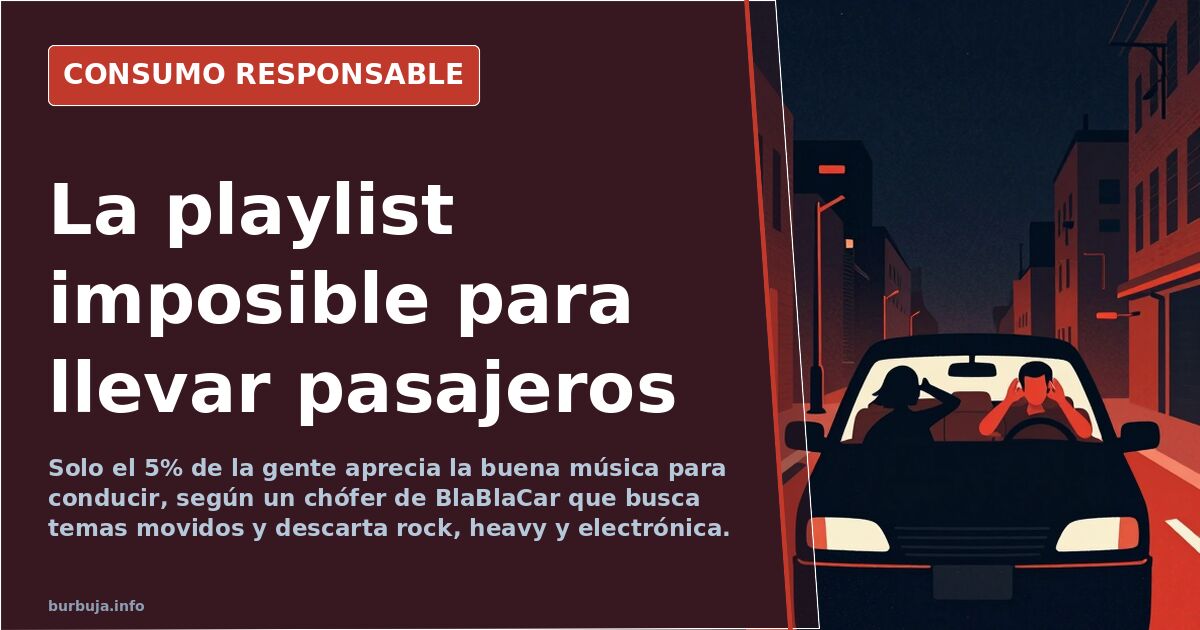
Only 5% appreciate good driving music, and rock is considered dead
Playing driving music with passengers is a science almost no one masters. A BlaBlaCar driver’s request is clear: pop, funk, disco, soul, and upbeat rhythms, no heavy metal, no slow tracks, no reggaeton. He adds a complicating fact: only 5% of people appreciate good music. The rest, he claims, always listen to the same things and are immune to surprises.
Carrying passengers without anyone touching the volume
This is not a wedding DJ issue. The goal is to make the journey feel short, avoid requests to lower the volume, and prevent the driver from getting a headache. The initial recipe involves digestible tracks with groove, that do not invite sleep or force the subwoofer to rattle the seat. The driver admits he has been asked to lower the bass more than once. For other passengers, the rhythm works. The audience is heterogeneous, and the criterion repeats: music should accompany, not take the lead.
Why is slow music abundant and fast music scarce?
A contradiction emerges here, left unresolved by the thread: there is much slow music and very little fast music. Those seeking something uplifting encounter an infinite catalog of ballads and a desert of pulsing tracks. “It’s curious that slow music abounds but fast music is scarce,” summarizes one voice. The underlying suspicion arises: creating music is difficult, finding good tracks is harder, and perhaps everything was invented decades ago. Hence the bar lowers: sometimes it is enough that a track does not bother.
From ELO to Fleetwood Mac: the 70s rock goldmine
When recommendations open up, one name appears: Electric Light Orchestra. Their biggest hits serve as the ideal soundtrack for the road, with tracks like Here's the News, Don't Bring Me Down, Shine a Little Love, or Hold on Tight. The driver’s surprise is sincere: he remembered them from childhood, but not like this. The group is labeled pogre rock, mixed with everything, and the Greatest Hits by Fleetwood Mac is also recommended. This 70s goldmine fares better because it does not require pills to appreciate.
Rock, that format with an expiration date
The dominant opinion is not nostalgic. The driver claims rock is “completely past its date” and issues a verdict: when the 70s and 80s generation dies, around 2050, “no one will ever listen to it again.” This aggressive thesis clashes with those who rescue obscurities and defend that a bit of rock is not excessive on a road alucinación. Disagreement is total, and no one yields.
Electronic music and rap that do not pass the filter
Detroit techno, techno, and acid trance are proposed, and the verdict is sharp: only Detroit survives due to its closeness to house. The rest, he says, requires being on something, and one cannot drive while high. Hardstyle and experimental music fall by the wayside. Rap has a half-open door if not shrill, but with reservations: when a singer becomes a rapper, his seams show.
With these criteria, the perfect playlist for a shared journey still does not exist. Some opt for pop and soul as usual, others rescue 70s greatest hits, and others close the door to anything sounding like a machine. Can you truly satisfy a stranger during four hours on the highway, or is “good music” just another way of saying “mine”?
Playing driving music with passengers is a science almost no one masters. A BlaBlaCar driver’s request is clear: pop, funk, disco, soul, and upbeat rhythms, no heavy metal, no slow tracks, no reggaeton. He adds a complicating fact: only 5% of people appreciate good music. The rest, he claims, always listen to the same things and are immune to surprises.
Carrying passengers without anyone touching the volume
This is not a wedding DJ issue. The goal is to make the journey feel short, avoid requests to lower the volume, and prevent the driver from getting a headache. The initial recipe involves digestible tracks with groove, that do not invite sleep or force the subwoofer to rattle the seat. The driver admits he has been asked to lower the bass more than once. For other passengers, the rhythm works. The audience is heterogeneous, and the criterion repeats: music should accompany, not take the lead.
Why is slow music abundant and fast music scarce?
A contradiction emerges here, left unresolved by the thread: there is much slow music and very little fast music. Those seeking something uplifting encounter an infinite catalog of ballads and a desert of pulsing tracks. “It’s curious that slow music abounds but fast music is scarce,” summarizes one voice. The underlying suspicion arises: creating music is difficult, finding good tracks is harder, and perhaps everything was invented decades ago. Hence the bar lowers: sometimes it is enough that a track does not bother.
From ELO to Fleetwood Mac: the 70s rock goldmine
When recommendations open up, one name appears: Electric Light Orchestra. Their biggest hits serve as the ideal soundtrack for the road, with tracks like Here's the News, Don't Bring Me Down, Shine a Little Love, or Hold on Tight. The driver’s surprise is sincere: he remembered them from childhood, but not like this. The group is labeled pogre rock, mixed with everything, and the Greatest Hits by Fleetwood Mac is also recommended. This 70s goldmine fares better because it does not require pills to appreciate.
Rock, that format with an expiration date
The dominant opinion is not nostalgic. The driver claims rock is “completely past its date” and issues a verdict: when the 70s and 80s generation dies, around 2050, “no one will ever listen to it again.” This aggressive thesis clashes with those who rescue obscurities and defend that a bit of rock is not excessive on a road alucinación. Disagreement is total, and no one yields.
Electronic music and rap that do not pass the filter
Detroit techno, techno, and acid trance are proposed, and the verdict is sharp: only Detroit survives due to its closeness to house. The rest, he says, requires being on something, and one cannot drive while high. Hardstyle and experimental music fall by the wayside. Rap has a half-open door if not shrill, but with reservations: when a singer becomes a rapper, his seams show.
With these criteria, the perfect playlist for a shared journey still does not exist. Some opt for pop and soul as usual, others rescue 70s greatest hits, and others close the door to anything sounding like a machine. Can you truly satisfy a stranger during four hours on the highway, or is “good music” just another way of saying “mine”?
Summary of a discussion on Burbuja.info - Foro de economía, actualidad y política., translated from Spanish and reviewed before publication. Read the full discussion (243 replies).
More summaries
-
Electric quadricycle vs. EV: can it really save money?
A family with four cars and solar panels considers a small electric quadricycle to cut costs. Does it make sense versus a conventional EV? A cost analysis.
-
Forum user runs electric car and solar panels at home
Are solar panels worth it for charging an electric car? Real data: 757 kWh/year, 4,450 km, and the scheduling and cost problems.
-
Heating Cost Meters: Genuine Savings or Bureaucratic Scam in Spain?
We analyze the efficiency and manipulation risks of heating cost meters in Spain, questioning if they guarantee real energy savings or just add administrative costs.
-
Intermittent Fasting Linked to 91% Higher Heart Risk, Unreported by Media
A study claims intermittent fasting raises cardiovascular risk by 91%, but it is observational and relies on self-reported data, yet no major outlet links to the original research.
-
High-Fat, Egg-Rich Diet Sparks Nutritional Debate
Analysis of the high-egg, bacon diet: nutritional myth or metabolic strategy? Explore the arguments for and against this extreme eating pattern.
-
Milk at 50 Cents and Chicken at 4.11 Euros: The Hunt for Bargains Sharpens
Buying milk for 50 cents a liter requires membership fees and travel. Here is how shoppers distribute savings across Spanish supermarkets.