
Driving license no longer a rite of passage for Spanish youth
Young Spaniards delay or skip getting a license due to insurance, taxes, and ZBE labels, prioritizing cost over car freedom.
English · Original discussion in Spanish · Published
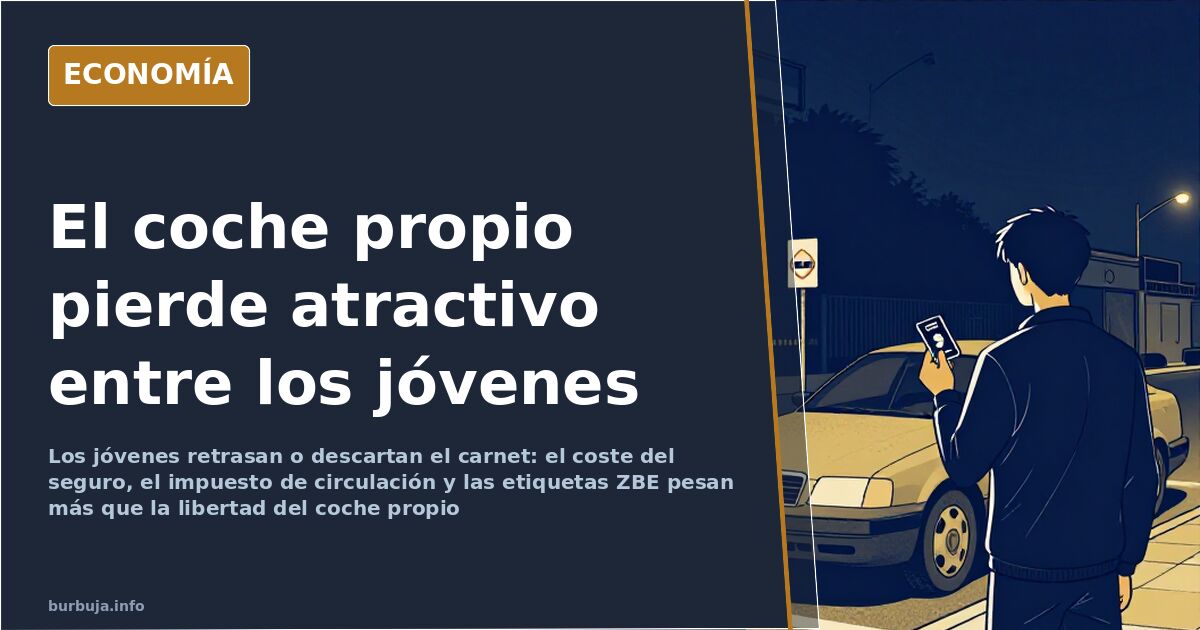
Youth and cars: The license is no longer a symbol of freedom
A player over 2.10 meters, with good mobility and estimulante ilegal, would not become a star, according to his coach's verdict. It was not an injury or attitude problem. It was the license. The coach was blunt: a kid with money to buy a car who prefers being driven, instead of driving himself, "can never stand out." The scene condenses the issue being debated: the driving license has ceased to be a rite of passage for eighteen-year-olds and has become a boundary between those who have it paid for by their family and those who will never have it.
Two decades ago, a license and an old car were the passport to freedom. Today, they compete with an electric scooter and a social life that no longer forces one to leave home.
Why do young people stop getting a driving license?
Because priorities have changed and the wallet does not help. The most repeated diagnosis points to two reinforcing causes: digital and economic. According to this diagnosis, social media, the internet, and online games have moved freedom to the bedroom, to the point where it is claimed that youth go out less and nightlife venues register much lower attendance than in previous years. Added to this is ecoanxiety, which also appears among the mentioned factors.
But the argument carrying the most weight is that of the wallet. **Spaniards' income has been stagnant for nearly twenty years**, it is repeated, and on top of this burden accumulate more regulations for city driving and growing normative pressure. The result: a minor under 30 without inheritance or family help does not consider a car because the numbers do not add up. Nor does it help that footwear supports 21% VAT while the shopping basket continues to become more expensive.
What does it really cost to maintain a car?
Less than the catastrophic narrative suggests, according to the calculation circulating among those who defend that owning a car remains cost-effective. The account starts with a second-hand first car: insurance for a young driver with medium displacement ranges around **450 euros annually**; with two or three claim-free years, the premium would drop below **250 euros**. Adding taxes and maintenance, keeping it parked and available would stay at **45 or 50 euros per month**, 60 if one splurges.
The complete breakdown, item by item, is exactly what provokes disagreement. In the opposite scenario, it is claimed that with **1,000 euros per month and living with parents**, one can maintain three cars simultaneously without worry, provided one has an beater car and not one fresh from the dealership. Against that figure weighs the rest of the bill: insurance, spare parts, repairs, circulation tax, garage, and, above all, fines, the item that upsets any tight budget.
ZBE labels and rules: where one can drive
Environmental labels are the other major filter, although their real reach is exaggerated, according to a participant. The restriction concentrates on **Madrid city and Barcelona city**; in Valencia, the low-emission zone was not yet operational, and Zaragoza's is described directly as ridiculous. The obstacle, therefore, is not national, but living in the two metropolitan areas where employment clusters is enough for an old car to cease being an option.
The normative design, it is argued, has ceased to be an incentive to become an imposition. The criticism points to the traffic authority and its public communication: control extends to the jacket and, almost, to the type of glasses the driver wears, which discourages those hesitating between the license and a transit pass.
Cars as a luxury for civil servants or children of the wealthy
Here the tone sours. It is claimed that **a car is today a luxury within reach of civil servants or children of wealthy families**, while the rest manage with public transport. The starting point of the issue is explicit: those from good families still have cars from age 18; the rest do not.
Mobility is still sold as freedom. Those who maintain a car or motorcycle defend it as the only way to leave when one wants and to arrive without looping through intermediate stops; public transport, conversely, is labeled slow and a last resort. But the scale has broken: before, one aspired to a 49cc scooter at age 15 and a 125cc at 16. Now, according to a participant, the license comes at **25 plus**, when the kid discovers that the scooter does not get him to work.
Own decision or disguised resignation?
Some see a rational choice, others a pretext. The most uncomfortable version claims that, since they are poor, at least their minds have been fed to believe that giving up the car is a free decision. The phrase summarizing this thesis, according to another participant: "they do not know freedom and have no desire to obtain it," because they have been geolocated since age 19.
Concrete cases contradict this only halfway. A young man of **29 years** has no car, no license, and does not consider it. Another got it at **23 and a half, forced by work**, arguing that in a big city the license is useless and in the suburbs, for everything. And at the opposite extreme, someone who had to arrive in Madrid urgently at 5:25 AM knows that without a car, he would not have made it.
According to those defending this account, with young driver insurance premiums at 450 euros and fixed costs around 50 per month, maintaining a car is cheaper than the catastrophic narrative suggests. Obtaining one, for those without family help, is another story. And there, no one has yet found the figure to close the discussion.
A player over 2.10 meters, with good mobility and estimulante ilegal, would not become a star, according to his coach's verdict. It was not an injury or attitude problem. It was the license. The coach was blunt: a kid with money to buy a car who prefers being driven, instead of driving himself, "can never stand out." The scene condenses the issue being debated: the driving license has ceased to be a rite of passage for eighteen-year-olds and has become a boundary between those who have it paid for by their family and those who will never have it.
Two decades ago, a license and an old car were the passport to freedom. Today, they compete with an electric scooter and a social life that no longer forces one to leave home.
Why do young people stop getting a driving license?
Because priorities have changed and the wallet does not help. The most repeated diagnosis points to two reinforcing causes: digital and economic. According to this diagnosis, social media, the internet, and online games have moved freedom to the bedroom, to the point where it is claimed that youth go out less and nightlife venues register much lower attendance than in previous years. Added to this is ecoanxiety, which also appears among the mentioned factors.
But the argument carrying the most weight is that of the wallet. **Spaniards' income has been stagnant for nearly twenty years**, it is repeated, and on top of this burden accumulate more regulations for city driving and growing normative pressure. The result: a minor under 30 without inheritance or family help does not consider a car because the numbers do not add up. Nor does it help that footwear supports 21% VAT while the shopping basket continues to become more expensive.
What does it really cost to maintain a car?
Less than the catastrophic narrative suggests, according to the calculation circulating among those who defend that owning a car remains cost-effective. The account starts with a second-hand first car: insurance for a young driver with medium displacement ranges around **450 euros annually**; with two or three claim-free years, the premium would drop below **250 euros**. Adding taxes and maintenance, keeping it parked and available would stay at **45 or 50 euros per month**, 60 if one splurges.
The complete breakdown, item by item, is exactly what provokes disagreement. In the opposite scenario, it is claimed that with **1,000 euros per month and living with parents**, one can maintain three cars simultaneously without worry, provided one has an beater car and not one fresh from the dealership. Against that figure weighs the rest of the bill: insurance, spare parts, repairs, circulation tax, garage, and, above all, fines, the item that upsets any tight budget.
ZBE labels and rules: where one can drive
Environmental labels are the other major filter, although their real reach is exaggerated, according to a participant. The restriction concentrates on **Madrid city and Barcelona city**; in Valencia, the low-emission zone was not yet operational, and Zaragoza's is described directly as ridiculous. The obstacle, therefore, is not national, but living in the two metropolitan areas where employment clusters is enough for an old car to cease being an option.
The normative design, it is argued, has ceased to be an incentive to become an imposition. The criticism points to the traffic authority and its public communication: control extends to the jacket and, almost, to the type of glasses the driver wears, which discourages those hesitating between the license and a transit pass.
Cars as a luxury for civil servants or children of the wealthy
Here the tone sours. It is claimed that **a car is today a luxury within reach of civil servants or children of wealthy families**, while the rest manage with public transport. The starting point of the issue is explicit: those from good families still have cars from age 18; the rest do not.
Mobility is still sold as freedom. Those who maintain a car or motorcycle defend it as the only way to leave when one wants and to arrive without looping through intermediate stops; public transport, conversely, is labeled slow and a last resort. But the scale has broken: before, one aspired to a 49cc scooter at age 15 and a 125cc at 16. Now, according to a participant, the license comes at **25 plus**, when the kid discovers that the scooter does not get him to work.
Own decision or disguised resignation?
Some see a rational choice, others a pretext. The most uncomfortable version claims that, since they are poor, at least their minds have been fed to believe that giving up the car is a free decision. The phrase summarizing this thesis, according to another participant: "they do not know freedom and have no desire to obtain it," because they have been geolocated since age 19.
Concrete cases contradict this only halfway. A young man of **29 years** has no car, no license, and does not consider it. Another got it at **23 and a half, forced by work**, arguing that in a big city the license is useless and in the suburbs, for everything. And at the opposite extreme, someone who had to arrive in Madrid urgently at 5:25 AM knows that without a car, he would not have made it.
According to those defending this account, with young driver insurance premiums at 450 euros and fixed costs around 50 per month, maintaining a car is cheaper than the catastrophic narrative suggests. Obtaining one, for those without family help, is another story. And there, no one has yet found the figure to close the discussion.
Summary of a discussion on Burbuja.info - Foro de economía, actualidad y política., translated from Spanish and reviewed before publication. Read the full discussion (401 replies).
More summaries
-
Málaga, Alicante, Valencia Top Expats Ranking; Madrid, Barcelona Lag
InterNations ranks Málaga, Alicante, and Valencia as top cities for expats, with Madrid seventh and Barcelona 21st, amid high housing costs.
-
Doctor Accusing Madrid of Inflating Waitlists Faces Charges for Damaging Superior's Car
A surgeon accuses Madrid of manipulating waiting lists while he himself faces legal charges for damaging his superior’s vehicle. Case details and official response.
-
Is now a good time to buy property? Debate
Is now a good time to buy a home? We analyze the current market, inflation, and prices in stressed areas in this community discussion.
-
Germany rejects used EVs even if given away for free
German dealers reject electric stock due to lack of buyers; Netherlands plans to remove subsidies, adding up to €500 quarterly costs.
-
Miss Universe ownership and new beauty standards spark debate
Miss Universe is a private business owned by Anne Jakrajutatip; controversy surrounds the trans woman from Portugal and the Nepali candidate.
-
Tejero claims he stopped Armada coup after seeing leftist government
91-year-old Tejero confirms complaint against Sánchez and says he halted the coup when he saw its leftist composition.