
Driver films TikTok after car plunges down embankment
A woman recorded a TikTok after her car fell off an embankment, trapping a cat underneath. The viral video highlights modern driving attitudes.
English · Original discussion in Spanish · Published
Driver films TikTok after car plunges down embankment
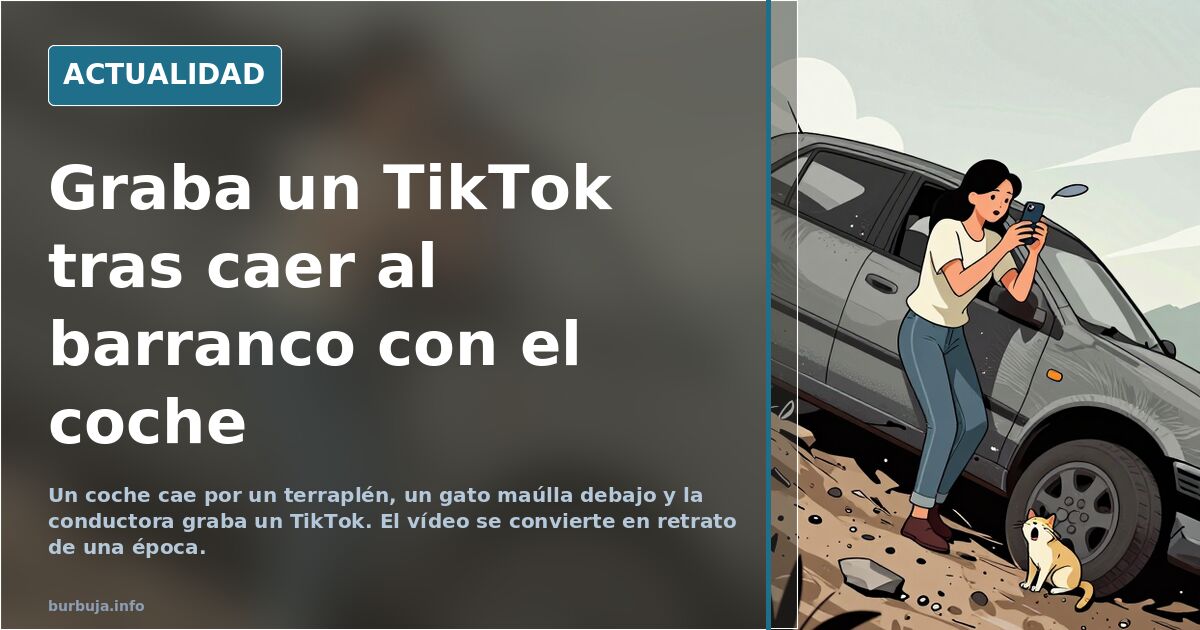
A car tumbling down an embankment, a cat meowing from beneath the vehicle, and a driver deciding to film herself for social media. This incident has circulated online for some time and recently resurfaced in public discourse through the usual mechanism: someone shares it, others comment, and it becomes a small portrait of our times. According to the narrative accompanying the video, the protagonist was unsure whether she had pressed the brake or the accelerator, parked in a green zone without paying, and, most importantly, is unharmed. She is fine.
The detail about the cat is what sparked widespread attention. While the driver celebrated her luck, the animal appeared trapped under the car. The scene effectively summarizes the tone of the conversation: another person's misfortune, a destroyed vehicle, and a protagonist who turns antiestéticar into content.
What the video shows and what is known about the accident
The circulating material is not a news report or press release. It is a tweet summarizing the video in five points: the car falls down a ravine, there is a cat meowing underneath, the driver records a TikTok, she mentions confusion between the brake and accelerator, and she parks in a green zone without paying. There is no further official context. No police report, no medical update, and no confirmation on whether the cat survived.
This has not prevented the clip from being interpreted as a mini-treatise on contemporary behavior. The sequence—accident, trapped animal, vertical video—contains all the ingredients of content shared out of indignation. And the comment about the pedals works as a perfect summary: the uncertainty between two controls that perform opposite functions.
The cat, the pedal confusion, and unpaid parking: three details that change everything
Three elements elevate this issue above typical clumsy driving videos. First is the cat. An animal trapped under a car is not a cute anecdote; it is a living being dependent on someone getting out and checking. Second is the mechanical doubt: not knowing which pedal you pressed is a confession that disorients anyone behind the wheel when stated by a driver. Third is the unpaid green zone parking, adding a layer of disregard for rules unrelated to driving itself.
The combination of these three transforms the video into something more than an accident. It is a scene of emotional management: the protagonist emerges unscathed, tells the story, and seeks approval. Everything else—the car, the cat, the fine—are collateral damages.
Why the video generates such backlash
The majority reaction has not been compassion but discomfort. Some argue that filming oneself at that moment demonstrates emotional deficiency or total disconnect from reality. Others point to something more mundane: she did not pay for the car, so the damage does not hurt. A third, sharper line suggests the video exists because algorithms reward clumsiness narrated in first person.
The most repeated criticism concerns the order of priorities. First the cat, then the car, then the fine. In the video, the order is different: first me, then me, then me. This inversion is what caused the episode to spread beyond usual circles.
Portrait of a driver who cannot drive
The discussion has shifted toward a broader theme: part of the population’s relationship with cars. Some use them daily, while others treat them as status symbols. The ravine incident served as a reminder that not everyone with a license knows how to operate the pedals. And that some expensive cars are driven by people who could not change a tire.
It is not a gender issue, although part of the conversation framed it that way. It is an issue of training and attitude. A two-ton vehicle is a tool, not an accessory. Treating it as an accessory has consequences: ravines, cats, and videos.
What remains unknown
The video does not clarify if charges were filed, if the cat survived, or if the green zone fee was eventually paid. There is also no confirmation that the protagonist is a civil servant or who purchased the car. These are layers added by the conversation without support from the original material.
The only verifiable facts are what is seen: a car off the road, an animal underneath, and a person filming themselves. That alone suffices to understand why the episode became a minor phenomenon. The rest is interpretation.
The conversation moved toward the cat, the BMW, and the state of the country. Meanwhile, the ravine remains. And no one has asked about the animal again.
A car tumbling down an embankment, a cat meowing from beneath the vehicle, and a driver deciding to film herself for social media. This incident has circulated online for some time and recently resurfaced in public discourse through the usual mechanism: someone shares it, others comment, and it becomes a small portrait of our times. According to the narrative accompanying the video, the protagonist was unsure whether she had pressed the brake or the accelerator, parked in a green zone without paying, and, most importantly, is unharmed. She is fine.
The detail about the cat is what sparked widespread attention. While the driver celebrated her luck, the animal appeared trapped under the car. The scene effectively summarizes the tone of the conversation: another person's misfortune, a destroyed vehicle, and a protagonist who turns antiestéticar into content.
What the video shows and what is known about the accident
The circulating material is not a news report or press release. It is a tweet summarizing the video in five points: the car falls down a ravine, there is a cat meowing underneath, the driver records a TikTok, she mentions confusion between the brake and accelerator, and she parks in a green zone without paying. There is no further official context. No police report, no medical update, and no confirmation on whether the cat survived.
This has not prevented the clip from being interpreted as a mini-treatise on contemporary behavior. The sequence—accident, trapped animal, vertical video—contains all the ingredients of content shared out of indignation. And the comment about the pedals works as a perfect summary: the uncertainty between two controls that perform opposite functions.
The cat, the pedal confusion, and unpaid parking: three details that change everything
Three elements elevate this issue above typical clumsy driving videos. First is the cat. An animal trapped under a car is not a cute anecdote; it is a living being dependent on someone getting out and checking. Second is the mechanical doubt: not knowing which pedal you pressed is a confession that disorients anyone behind the wheel when stated by a driver. Third is the unpaid green zone parking, adding a layer of disregard for rules unrelated to driving itself.
The combination of these three transforms the video into something more than an accident. It is a scene of emotional management: the protagonist emerges unscathed, tells the story, and seeks approval. Everything else—the car, the cat, the fine—are collateral damages.
Why the video generates such backlash
The majority reaction has not been compassion but discomfort. Some argue that filming oneself at that moment demonstrates emotional deficiency or total disconnect from reality. Others point to something more mundane: she did not pay for the car, so the damage does not hurt. A third, sharper line suggests the video exists because algorithms reward clumsiness narrated in first person.
The most repeated criticism concerns the order of priorities. First the cat, then the car, then the fine. In the video, the order is different: first me, then me, then me. This inversion is what caused the episode to spread beyond usual circles.
Portrait of a driver who cannot drive
The discussion has shifted toward a broader theme: part of the population’s relationship with cars. Some use them daily, while others treat them as status symbols. The ravine incident served as a reminder that not everyone with a license knows how to operate the pedals. And that some expensive cars are driven by people who could not change a tire.
It is not a gender issue, although part of the conversation framed it that way. It is an issue of training and attitude. A two-ton vehicle is a tool, not an accessory. Treating it as an accessory has consequences: ravines, cats, and videos.
What remains unknown
The video does not clarify if charges were filed, if the cat survived, or if the green zone fee was eventually paid. There is also no confirmation that the protagonist is a civil servant or who purchased the car. These are layers added by the conversation without support from the original material.
The only verifiable facts are what is seen: a car off the road, an animal underneath, and a person filming themselves. That alone suffices to understand why the episode became a minor phenomenon. The rest is interpretation.
The conversation moved toward the cat, the BMW, and the state of the country. Meanwhile, the ravine remains. And no one has asked about the animal again.
Summary of a discussion on Burbuja.info - Foro de economía, actualidad y política., translated from Spanish and reviewed before publication. Read the full discussion (151 replies).
More summaries
-
Who Pays for Accidents with No Inspection and Alcohol?
Severe injuries from a crash involving an uninspected car and drunk driving raise questions about insurance coverage.
-
Gorliz council worker reported for threatening police officer
A Gorliz municipal employee has been reported for threatening an interim local police officer with blocking her permanent position during an altercation that left an officer on sick leave.
-
Adam Harrison, Rick Harrison’s son from Pawn Stars, dies at 39
Adam Harrison, son of Rick Harrison from 'Pawn Stars', died of an overdose at 39 as Las Vegas police investigate.
-
Flu Peak Predicted Between Lottery and Christmas
Health experts predict the flu peak will occur between the Spanish Christmas lottery draw on December 22 and Christmas Day, following last year's severe impact.
-
Greta Thunberg’s new look sparks debate on Gaza flotilla
Swedish activist Greta Thunberg joins the Freedom Flotilla to Gaza, drawing attention for her new hairstyle and sparking online comparisons.
-
Women's football pay gap: Mbappé vs. Marcos André debate
A viral debate compares Mbappé and Marcos André salaries to question equal pay in football.