
Dolores Ibarruri —La Pasionaria— died devoutly Catholic, sentimental, and confessing. She was never seen on the front lines with a rifle.
Dolores Ibárruri, La Pasionaria, died a devout Catholic and without having wielded a rifle. Discover the details of her private life and legacy.
English · Original discussion in Spanish · Published
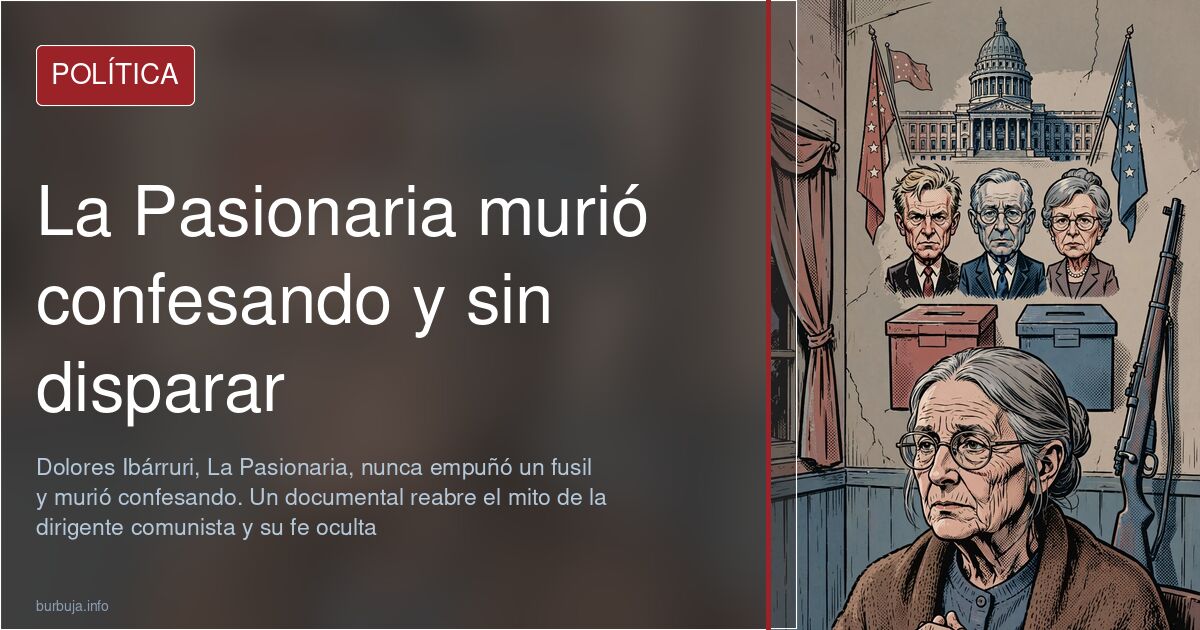
The figure of Dolores Ibárruri, known as La Pasionaria, is torn between her public image as a revolutionary leader and her private life. Details suggest she was a woman with deep religious convictions and an absence of direct combat involvement.
## Faith in Private Life
Contrary to the image of an indefatigable combatant that many associate with **Dolores Ibárruri**, accounts from her closest circle describe her as a deeply devout person. It is said that her home was steeped in a religious atmosphere, with regular masses and a marked inclination toward Catholic practices. This facet, often overshadowed by her political activism, reveals a more personal and spiritual dimension of the historical figure.
## Absence on the Front
The image of **La Pasionaria** wielding a weapon on the battlefield is a myth that does not correspond to reality. During the difficult years of the Spanish Civil War, **Dolores Ibárruri** did not participate directly in combat or appear on the front lines with a rifle. Her contribution focused on oratory and political mobilization, using her voice to inspire and lead.
## A Complex Legacy
The figure of **Dolores Ibárruri** continues to generate debate. Her legacy is that of a woman who marked a milestone in Spanish political history, but whose personal life—marked by faith and a struggle strategy removed from direct violence—offers a more nuanced perspective on her complex personality.
## Faith in Private Life
Contrary to the image of an indefatigable combatant that many associate with **Dolores Ibárruri**, accounts from her closest circle describe her as a deeply devout person. It is said that her home was steeped in a religious atmosphere, with regular masses and a marked inclination toward Catholic practices. This facet, often overshadowed by her political activism, reveals a more personal and spiritual dimension of the historical figure.
## Absence on the Front
The image of **La Pasionaria** wielding a weapon on the battlefield is a myth that does not correspond to reality. During the difficult years of the Spanish Civil War, **Dolores Ibárruri** did not participate directly in combat or appear on the front lines with a rifle. Her contribution focused on oratory and political mobilization, using her voice to inspire and lead.
## A Complex Legacy
The figure of **Dolores Ibárruri** continues to generate debate. Her legacy is that of a woman who marked a milestone in Spanish political history, but whose personal life—marked by faith and a struggle strategy removed from direct violence—offers a more nuanced perspective on her complex personality.
Summary of a discussion on Burbuja.info - Foro de economía, actualidad y política., translated from Spanish and reviewed before publication. Read the full discussion (24 replies).
More summaries
-
Franco's Civil War Narrative: The Account Dividing Spain
Franco detailed the origins of the Civil War. His version, blaming the Popular Front's alleged fraud and anti-clerical violence, is resurfacing amidst current crises.
-
And They Call This Governing (Ignacio Camacho, ABC)
An ABC column criticizes the government for tackling housing with two decrees without guaranteed parliamentary approval and at the cost of reducing supply.
-
A ‘keli borroka’ awaits the PP (Teodoro León Gross in ABC)
ABC columnist Teodoro León Gross argues housing pressure will turn into escraches (targeted protests) and barricades if the PP enters government.
-
A democratic obligation unfulfilled (ABC editorial)
Article 134.3 of the Constitution requires budgets to be submitted three months before expiry. Spain is still running on the 2023 Budget.
-
Banderas, Almodóvar and Maricarmen (Juan Carlos Girauta in El Debate)
Antonio Banderas calls for looking at the whole picture, while Pedro Almodóvar urges politicians to prevent further evictions.
-
The USSR and the Origins of Borregocracia: Thesis and Suspicions
Soviet infiltration, free lawyers, Gramsci and academic inbreeding: the thesis that traces today's groupthink to the USSR.