
Dogs in Cities: Waste, Urine, and Unenforced Fees
One uncivic owner in twenty leaves 30 droppings monthly. Vigo remains clean despite dogs; the issue is owners, not animals.
English · Original discussion in Spanish · Published
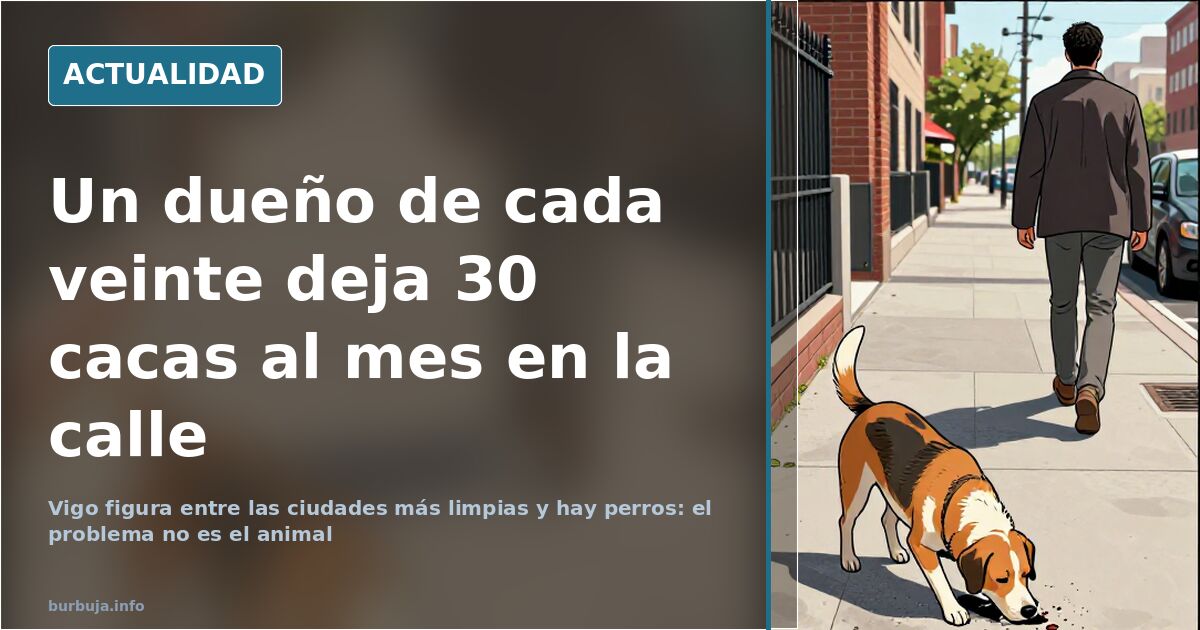
Waste, urine, and barking: the invisible cost of urban dogs
With Spain's animal welfare law now in force, the debate isn't about how many dogs exist, but how many irresponsible owners are needed to degrade a street. The uncomfortable answer circulating among those who suffer daily is: one in twenty. The rest pick up waste, manage leashes, and endure the glare of neighbors assuming the person ahead won't clean anything.
The issue has geographic and management patterns. After visiting Galicia, the first observation isn't just more pickup compliance, but that few dogs are seen on streets, with impeccable pavement. In Seville, similar walks require dodging stains. Comparisons are inevitable yet flawed: rainfall, washing frequency, and municipal budgets play key roles.
How much mess does one non-compliant owner leave?
A dog produces around 30 droppings per month. If its owner ignores cleanup rules, these go straight to sidewalks. Thirty excrement spots on one street suffice to give a neighborhood an appearance unfixable by street sweepers. This isn't alarmism: it's basic arithmetic applied to cities with thousands of dogs.
Testimonials agree on hotspots: school gates, playground entrances, planters, and corners. The worst detail combines age and clumsiness: elderly people, with poor visibility, often carry waste home on their soles. Urine is another chapter: no bag captures it. Bollards, doorframes, and traditional corners are blackened, with some blaming uric acid for deteriorating streetlights and urban elements.
Responsible owners' defense is reasonable but often unheard. Those who pick up, train pets to urinate on soil patches, or use muzzles must tolerate complaints and stares generated by others. Criticism, they say, targets the animal instead of the owner.
Vigo cleans daily: why do dogs coexist with cleanliness?
The most cited answer comes from an OCU report ranking Vigo as the third cleanest city in Spain. They clean and wash daily, have many dogs, and results hold. The conclusion: animal volume doesn't determine dirt; civic behavior, service frequency, and enforcement do.
Here lies the core issue. More intensive municipal services cost money, drawn from the same budget as everything else. Proponents argue it's a matter of budgetary priorities. Critics respond that no cleaning line item fixes a neighbor unwilling to bend down, noting Galicia's higher rainfall also helps streets appear cleaner.
Who pays for nuisance caused by other people's dogs?
The most recurring proposal is an annual dog tax, similar to those claimed to exist in other European countries. The argument is simple: if building dog parks, specific washes, and training areas are needed, those generating costs should fund them. Currently, all taxpayers pay, regardless of dog ownership.
Parallel technical solutions circulate. Patent WO2009103830A1 describes a public dog toilet with hydrophobic cover and sewer connection. Spain has inaugurated public toilets with dog urinals and fountains. Brussels has had similar devices for years. The idea is removing from corners what bags can't collect.
Barking, dangerous breeds, and noise pollution
The second front has nothing to do with cleanliness. It involves barking, cohabitation in blocks where multiple floors house multiple dogs, and animals left alone all day with open windows or on balconies. Reports describe neighbors proge before 6 AM by packs, and communities where problems grow with each new rental.
Regarding potentially dangerous breeds, complaints are unanimous among those raising them: loose specimens with hanging muzzles. Incidents involving children in various neighborhoods are reported, alongside criticism of inspection passivity. None of this makes it a widespread safety crisis, but explains why part of the neighborhood no longer sees dogs as neutral.
A demographic reading hovers over the conversation: dogs as child substitutes, spending on kibble where daycare once was, fashion explaining trends. This aligns with perceptions post-animal welfare law implementation that there are fewer dogs but more purebreds, though no census confirms this.
Analysis stalls here. If the problem is civic behavior, no rule solves it without enforcement. If it's budget, Vigo disproves it. If it's animal numbers, explain why Galician streets are clean with dogs while Andalusian ones aren't. No one has closed the equation, and sidewalk walkers will keep watching the ground.
Summary of a discussion on Burbuja.info - Foro de economía, actualidad y política., translated from Spanish and reviewed before publication. Read the full discussion (170 replies).
More summaries
-
Dogs in Restaurants: The Law Dividing Customers and Hostels
Animal welfare laws allow dogs in restaurants, sparking 70-80 euro debates. Hospitality faces a trench war between pet-friendly policies and customer comfort.
-
Santander, Spain: 24,000 dogs and 48,000 daily dog droppings on its beaches
In Santander, Spain, 24,000 registered dogs produce 48,000 droppings a day. Opening beaches to dogs threatens both the city's tourist image and public health.
-
Pet funeral homes: the business booming on the back of the human-animal bond
Pet funeral homes are growing in Spain. VAT included, private business, but the debate over public costs and the humanization of animals is intensifying.
-
AI Takes Over TV Reenactments, Actors Left Out
TV crime reenactments are now AI-generated, cheaper than filming. The case of Cuarto Milenio foreshadows actor replacement.
-
Fake Mel Gibson tweet calling for Soros to face trial
An account impersonating Mel Gibson calls for George Soros to be arrested over immigration in Europe, an accusation with no evidence whatsoever.
-
A year of saving up to pay 5,000 pesetas in 1987
According to his own account, a 17-year-old saved for a whole year to put together 5,000 pesetas for his first sexual experience in 1987.