
Dog Turrón at €41/kg: Spain's New Christmas Goldmine
Dog turrón costs €41/kg in Spain, exceeding premium ham prices and revealing a shift in pet spending trends.
English · Original discussion in Spanish · Published
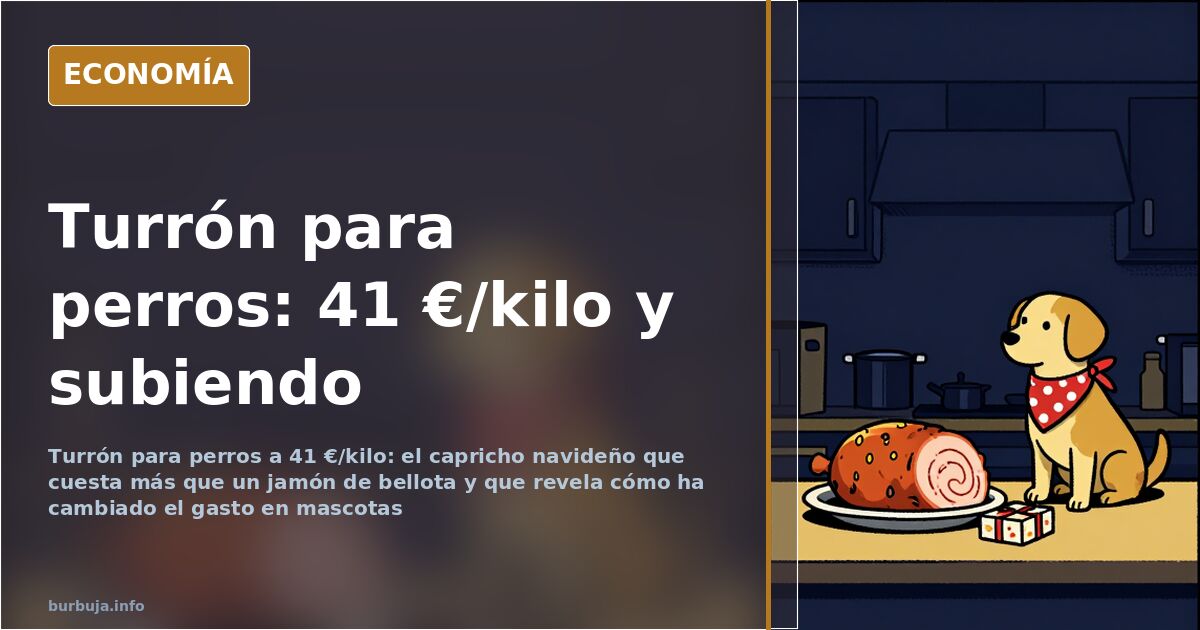
Dog Turrón at €41 per kilo: The Christmas Trend Causing Outrage
A turrón for dogs. Wrapped in pretty paper, placed on a store shelf, with a price hovering around 5 euros for a treat that, weighed up, comes to 41 euros per kilo. This is the data point that has burst the seams of public conversation: not so much the product itself—which exists in many varieties—as the arithmetic it hides. Because 41 euros per kilo is more than a good acorn-fed jamón costs, and significantly more than beef tenderloin. The comparison is not gratuitous: someone voiced it loudly, and from there the issue ceased to be just a shop window anecdote.
The matter does not end with the price. In the same thread, references appear to a bottle of champagne for dogs and a canettone—the canine panettone—seen in department stores. That is: this is not an isolated product from a weird shop; it is a category. And when a category exists, it exists because there is demand. Or because someone decided to create it through marketing.
From 5 euros to 41 per kilo: The calculation no one makes on the shelf
The math is simple and devastating. A bar of dog turrón seen during these dates weighs little, is sold as a luxury, and is bought without thinking. Converted to euros per kilo, the number skyrockets. It is the same trap as capsule coffee or prepared food portions: the small format hides the real price. 41 euros per kilo is a figure that, stated coldly, disorients.
Some compare it to alternatives found in any butcher shop. Livers or sweetbreads cost considerably less, provide more nutrition, and according to several lifelong dog owners, make them happier than sugary treats. The argument is not trivial: if the goal is to spoil the animal, there are ways to do it without paying jewelry-store prices.
The other leg of the issue is health-related. A product sold as turrón, with its sugar, fat, and texture, is not designed for a canine digestive system. Several contributors point this out without drama: it is not poison, but neither is it food. It is a snack. And snacks, in any species, are expensive and poorly justified.
The dog as a substitute for the child at the Christmas table
Where the issue becomes interesting is not the price, but what it reveals. Part of the conversation argues that these products exist because the dog has taken a place previously occupied by children in Christmas liturgy: that of recipient of gifts, luxuries, and attention. Dog turrón is the canine equivalent of chocolate turrón for nephews. It is bought to look good, not to nourish.
Some go further, reading it as an economic symptom. A bank office converted into a supermarket for dogs. A country where an animal receives help before a homeless person. The phrase is harsh and present in the material, but should be taken for what it is: a hyperbole of after-dinner talk, not data. What is data is that pet spending has ceased to be residual and now moves entire aisles in large retail chains.
Irony runs throughout the affair. A product costing 41 euros per kilo and likely healthier than the human version, as someone notes wryly. Another intervention, more acidic, recalls that in family gatherings there is always a sibling who won't let children touch the dog before eating, only for those children to grow up with allergies. The pet as a battlefield of education, hygiene, and guilt.
What it costs to raise a dog (and what it costs to raise it badly)
The thread drifts, as often happens, into the territory of upbringing. Some argue that adopting a street dog, of any age, results in a loyal animal until the end in 95% of cases. Others respond, with sarcasm, that doing the same with a person over five years old guarantees hell. The comparison is uncomfortable and unsupported by data, but explains the climate: people discuss less about the turrón and more about who deserves what.
Amid all this, the fine print of the business appears. Extruded kibble is not the same as one without by-products or flours, and dog owners know this. The recommendation to check composition, not packaging, applies equally to the 41-euro turrón and the 15-euro kibble. Christmas marketing works best on those who don't read labels.
And then there is the question no one fully answers: if dog turrón costs 41 euros per kilo, how much does the human turrón sold next to it cost? The answer, in most shelves, is uncomfortable. The canine luxury is more expensive than the human luxury. There, exactly there, is where the issue ceases to be an anecdote and becomes a small mirror of how we spend.
Is dog turrón a first-world absurdity, a well-oiled seasonal business, or both? Depending on perspective, the buyer is the fool, the seller is the smart one, and the dog, as always, is the only one who doesn't have an opinion.
A turrón for dogs. Wrapped in pretty paper, placed on a store shelf, with a price hovering around 5 euros for a treat that, weighed up, comes to 41 euros per kilo. This is the data point that has burst the seams of public conversation: not so much the product itself—which exists in many varieties—as the arithmetic it hides. Because 41 euros per kilo is more than a good acorn-fed jamón costs, and significantly more than beef tenderloin. The comparison is not gratuitous: someone voiced it loudly, and from there the issue ceased to be just a shop window anecdote.
The matter does not end with the price. In the same thread, references appear to a bottle of champagne for dogs and a canettone—the canine panettone—seen in department stores. That is: this is not an isolated product from a weird shop; it is a category. And when a category exists, it exists because there is demand. Or because someone decided to create it through marketing.
From 5 euros to 41 per kilo: The calculation no one makes on the shelf
The math is simple and devastating. A bar of dog turrón seen during these dates weighs little, is sold as a luxury, and is bought without thinking. Converted to euros per kilo, the number skyrockets. It is the same trap as capsule coffee or prepared food portions: the small format hides the real price. 41 euros per kilo is a figure that, stated coldly, disorients.
Some compare it to alternatives found in any butcher shop. Livers or sweetbreads cost considerably less, provide more nutrition, and according to several lifelong dog owners, make them happier than sugary treats. The argument is not trivial: if the goal is to spoil the animal, there are ways to do it without paying jewelry-store prices.
The other leg of the issue is health-related. A product sold as turrón, with its sugar, fat, and texture, is not designed for a canine digestive system. Several contributors point this out without drama: it is not poison, but neither is it food. It is a snack. And snacks, in any species, are expensive and poorly justified.
The dog as a substitute for the child at the Christmas table
Where the issue becomes interesting is not the price, but what it reveals. Part of the conversation argues that these products exist because the dog has taken a place previously occupied by children in Christmas liturgy: that of recipient of gifts, luxuries, and attention. Dog turrón is the canine equivalent of chocolate turrón for nephews. It is bought to look good, not to nourish.
Some go further, reading it as an economic symptom. A bank office converted into a supermarket for dogs. A country where an animal receives help before a homeless person. The phrase is harsh and present in the material, but should be taken for what it is: a hyperbole of after-dinner talk, not data. What is data is that pet spending has ceased to be residual and now moves entire aisles in large retail chains.
Irony runs throughout the affair. A product costing 41 euros per kilo and likely healthier than the human version, as someone notes wryly. Another intervention, more acidic, recalls that in family gatherings there is always a sibling who won't let children touch the dog before eating, only for those children to grow up with allergies. The pet as a battlefield of education, hygiene, and guilt.
What it costs to raise a dog (and what it costs to raise it badly)
The thread drifts, as often happens, into the territory of upbringing. Some argue that adopting a street dog, of any age, results in a loyal animal until the end in 95% of cases. Others respond, with sarcasm, that doing the same with a person over five years old guarantees hell. The comparison is uncomfortable and unsupported by data, but explains the climate: people discuss less about the turrón and more about who deserves what.
Amid all this, the fine print of the business appears. Extruded kibble is not the same as one without by-products or flours, and dog owners know this. The recommendation to check composition, not packaging, applies equally to the 41-euro turrón and the 15-euro kibble. Christmas marketing works best on those who don't read labels.
And then there is the question no one fully answers: if dog turrón costs 41 euros per kilo, how much does the human turrón sold next to it cost? The answer, in most shelves, is uncomfortable. The canine luxury is more expensive than the human luxury. There, exactly there, is where the issue ceases to be an anecdote and becomes a small mirror of how we spend.
Is dog turrón a first-world absurdity, a well-oiled seasonal business, or both? Depending on perspective, the buyer is the fool, the seller is the smart one, and the dog, as always, is the only one who doesn't have an opinion.
Also available in: Deutsch
Summary of a discussion on Burbuja.info - Foro de economía, actualidad y política., translated from Spanish and reviewed before publication. Read the full discussion (121 replies).
More summaries
-
Dog waste cleanup at El Corte Inglés: The human cost of urban pets
Cleaning staff report having to pick up dog feces at El Corte Inglés after years of observation, highlighting the hidden health and labor costs.
-
Ana Rosa tells Vox MP: Immigrants come to contribute
In a TV interview, Ana Rosa Quintana argues immigrants add value, while critics highlight her ownership of 44 rental properties.
-
Flip-flops or sneakers in Spain's heat
Spain debates footwear for 35°C heat, mixing ergonomics, class and budget.
-
Iker Jiménez hires Talegón, splitting his audience
Beatriz Talegón's controversial hire by Iker Jiménez sparks debate over her past in PSOE, ERC and Junts.
-
Spanish Army Deployed to Valencia After Days of Delay
The Spanish military arrives in Valencia for logistical and operational support after days of waiting. Debate focuses on why the deployment was not activated sooner.
-
Teen arrested for stabbing taxi driver in Alcalá
A nearly 16-year-old was detained for the fatal stabbing of taxi driver Isidro in Alcalá de Henares, Spain. In-car camera footage was key to his identification.