
Does Aragon Exist? The Anthem Few Recognize
Aragon's population grew from 912,711 in 1900 to over 1.3 million in 2024, yet its regional identity remains contested.
English · Original discussion in Spanish · Published
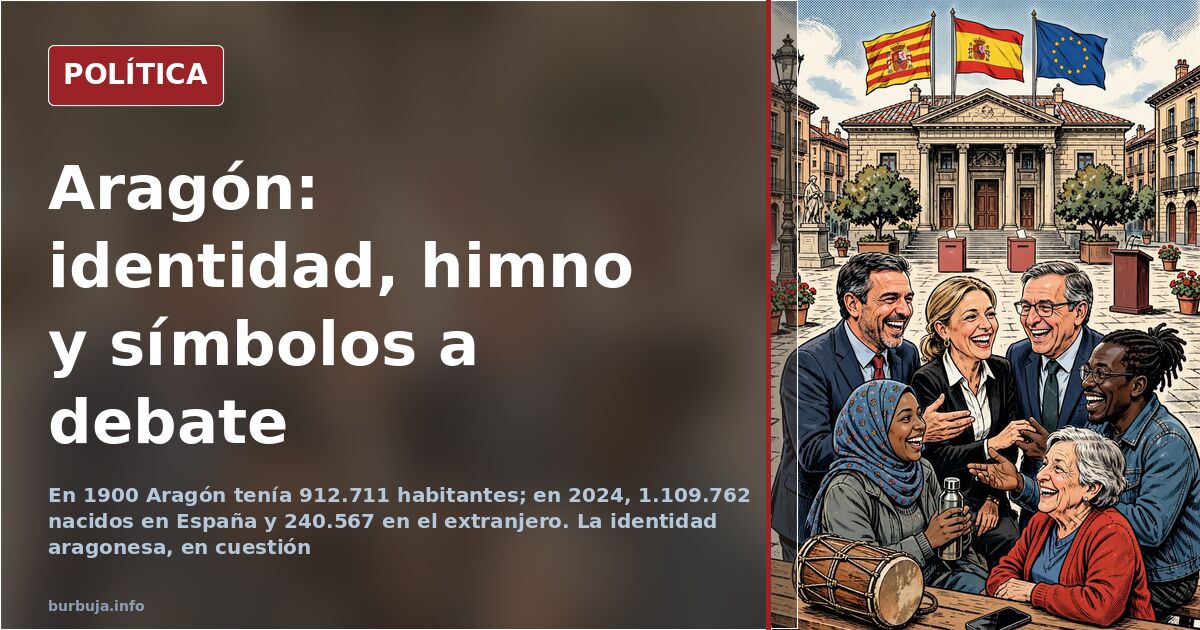
Aragon: A Kingdom Surviving in an Unrecognized Anthem
Someone born in Aragon who has never felt a strong sense of local identity raises an uncomfortable point: a person from Sarracena de Rubielos, in Teruel, may have less in common with someone from Ansó, in the Pyrenees, than with anyone from Cangas del Narcea, in Asturias. This is raised without separatist intent, but with a confession that half the territory feels alien, and only the Virgin of Pilar resonates as shared heritage. This discussion begins just after Saint George’s Day.
The debate jumps from the 13th century to municipal registries. It touches on the Kingdom of Aragon, the Crown of Aragon, the Nueva Planta decrees, the survival of the Aragonese language, an official anthem almost no one identifies, and a demographic question that frames everything else: in 1900, Aragon had 912,711 inhabitants; in 2024, there were 1,109,762 people born in Spain and 240,567 born abroad.
Why Did People Stop Speaking Aragonese in Aragon?
Aragonese was the kingdom’s language from the 11th century until the early 18th, when Philip V imposed Castilian through the Nueva Planta decrees. Before then, it served as the official vehicle for the Kingdom of Aragon, much like Catalan did in the Catalan counties, according to the dominant historical view.
Today, it survives in Pyrenean valleys, amidst resignation and conflict. Some argue that older generations transmitted the language naturally, but this channel has broken, citing Wales as a reference for the cost of keeping a minority language alive. Others object that standardized Aragonese is an academic artifact, unrecognized by valley dwellers, and that the real heritage is dialectal fragmentation. In the east, what is heard is chapurriao, a variety of Catalan, not Aragonese.
From Kingdom to Community: What Remains of Historical Aragon?
Aragon was a kingdom and head of the Crown of Aragon. The most repeated thesis is that it renounced its language, laws, and privileges to adopt those of Castile, becoming today merely a geographic area. The opposing view recalls that much of this dismantling was not voluntary: it was imposed by the first Bourbon king after the War of Succession.
Pieces of that structure remain. Aragonese civil law and the Justicia de Aragón (a traditional high court role) are still valid, and some ironically note that the flag of Aragon appears on the coat of arms of Spain. The sonic symbol is more debated: there is an official anthem composed by García Abril that almost no one recognizes, while Labordeta’s song—which is not the official anthem—still sounds like an emblem. No one disputes that there was a kingdom; disagreement starts when asking what that means today.
The 912,711 Inhabitants of 1900 and Today’s Over One Million
Demography is the least disputed argument. Aragon had 912,711 residents in 1900; in 2024, the number of people born in Spain reaches 1,109,762, adding 240,567 born abroad. Based on this, part of the conversation argues that without the influx of population from outside the community, the territory could not sustain its current registry.
The balance is read differently depending on the stance. While some highlight the weight of immigration in maintaining demographics, others focus on the loss of native population and rural depopulation. The common denominator is uncomfortable: the continuity of the territory now depends on people who were not born there.
Does Aragonese Sentiment Exist?
In the discussion, the thesis that real identity is provincial, not autonomous, gains ground. An inhabitant of Huesca is compared to one from Teruel, placing them as far apart as someone from Guadalajara is from Albacete. From this arise two proposals: either multi-provincial communities disappear and transfer competencies to provinces, mirroring La Rioja or Swiss cantons, or Aragonese identity is simply considered 'Spanishized'.
Aragonese separatism is out of focus in almost all interventions. It is described as a microscopic phenomenon, an institutional chiringuito (sham operation), denied any traction. The exception comes from outside: one participant claims the Aragonese Pyrenees are part of a Catalan national narrative, and the usual response is that the Kingdom of Aragon was not the Kingdom of Mallorca.
The Coat of Arms That Disproves the Headline
There remains a disorienting detail. As one forum user ironically notes, the flag of Aragon appears on the coat of arms of Spain; Aragonese civil law is still applied in courts; there is an official anthem with music by García Abril. And yet, in a discussion dedicated to deciding if Aragon exists, almost no one disputes the figure that best portrays it: the 912,711 inhabitants of 1900 versus a current registry largely sustained by those who arrived from elsewhere.
Someone born in Aragon who has never felt a strong sense of local identity raises an uncomfortable point: a person from Sarracena de Rubielos, in Teruel, may have less in common with someone from Ansó, in the Pyrenees, than with anyone from Cangas del Narcea, in Asturias. This is raised without separatist intent, but with a confession that half the territory feels alien, and only the Virgin of Pilar resonates as shared heritage. This discussion begins just after Saint George’s Day.
The debate jumps from the 13th century to municipal registries. It touches on the Kingdom of Aragon, the Crown of Aragon, the Nueva Planta decrees, the survival of the Aragonese language, an official anthem almost no one identifies, and a demographic question that frames everything else: in 1900, Aragon had 912,711 inhabitants; in 2024, there were 1,109,762 people born in Spain and 240,567 born abroad.
Why Did People Stop Speaking Aragonese in Aragon?
Aragonese was the kingdom’s language from the 11th century until the early 18th, when Philip V imposed Castilian through the Nueva Planta decrees. Before then, it served as the official vehicle for the Kingdom of Aragon, much like Catalan did in the Catalan counties, according to the dominant historical view.
Today, it survives in Pyrenean valleys, amidst resignation and conflict. Some argue that older generations transmitted the language naturally, but this channel has broken, citing Wales as a reference for the cost of keeping a minority language alive. Others object that standardized Aragonese is an academic artifact, unrecognized by valley dwellers, and that the real heritage is dialectal fragmentation. In the east, what is heard is chapurriao, a variety of Catalan, not Aragonese.
From Kingdom to Community: What Remains of Historical Aragon?
Aragon was a kingdom and head of the Crown of Aragon. The most repeated thesis is that it renounced its language, laws, and privileges to adopt those of Castile, becoming today merely a geographic area. The opposing view recalls that much of this dismantling was not voluntary: it was imposed by the first Bourbon king after the War of Succession.
Pieces of that structure remain. Aragonese civil law and the Justicia de Aragón (a traditional high court role) are still valid, and some ironically note that the flag of Aragon appears on the coat of arms of Spain. The sonic symbol is more debated: there is an official anthem composed by García Abril that almost no one recognizes, while Labordeta’s song—which is not the official anthem—still sounds like an emblem. No one disputes that there was a kingdom; disagreement starts when asking what that means today.
The 912,711 Inhabitants of 1900 and Today’s Over One Million
Demography is the least disputed argument. Aragon had 912,711 residents in 1900; in 2024, the number of people born in Spain reaches 1,109,762, adding 240,567 born abroad. Based on this, part of the conversation argues that without the influx of population from outside the community, the territory could not sustain its current registry.
The balance is read differently depending on the stance. While some highlight the weight of immigration in maintaining demographics, others focus on the loss of native population and rural depopulation. The common denominator is uncomfortable: the continuity of the territory now depends on people who were not born there.
Does Aragonese Sentiment Exist?
In the discussion, the thesis that real identity is provincial, not autonomous, gains ground. An inhabitant of Huesca is compared to one from Teruel, placing them as far apart as someone from Guadalajara is from Albacete. From this arise two proposals: either multi-provincial communities disappear and transfer competencies to provinces, mirroring La Rioja or Swiss cantons, or Aragonese identity is simply considered 'Spanishized'.
Aragonese separatism is out of focus in almost all interventions. It is described as a microscopic phenomenon, an institutional chiringuito (sham operation), denied any traction. The exception comes from outside: one participant claims the Aragonese Pyrenees are part of a Catalan national narrative, and the usual response is that the Kingdom of Aragon was not the Kingdom of Mallorca.
The Coat of Arms That Disproves the Headline
There remains a disorienting detail. As one forum user ironically notes, the flag of Aragon appears on the coat of arms of Spain; Aragonese civil law is still applied in courts; there is an official anthem with music by García Abril. And yet, in a discussion dedicated to deciding if Aragon exists, almost no one disputes the figure that best portrays it: the 912,711 inhabitants of 1900 versus a current registry largely sustained by those who arrived from elsewhere.
Summary of a discussion on Burbuja.info - Foro de economía, actualidad y política., translated from Spanish and reviewed before publication. Read the full discussion (204 replies).
More summaries
-
Finally, Justice for CALBO in Spain.
A content creator has been convicted for defaming an internet personality. Spanish justice delivered its verdict after four years of legal proceedings.
-
Not all hardship is injustice (Rebeca Argudo in El ABC)
An 87-year-old woman's eviction highlights the difference between personal hardship and legal injustice. Understand the legal key.
-
Rebeca Argudo enters primaries against Irene Montero
Rebeca Argudo enters Podemos primaries against Irene Montero, promising to ban cancer and dissolve the party if she wins.
-
Sánchez Booed at Madrid Fashion Week Amid Low Vote Share
Pedro Sánchez faced boos and "traitor" chants during a surprise visit to Madrid Fashion Week, where only 31.68% of votes went to his party.
-
Orriols Refuses Spanish on Telemadrid, Sparking Sovereignist Debate
Sílvia Orriols refused to speak Spanish on Telemadrid, reigniting the sovereignist vote battle as 56% of Catalans use Spanish daily.
-
PNV or Junts: Who Backs Sánchez and at What Cost
The PNV relies on the PSOE to maintain its Basque government, while Junts has already failed to follow through on threats. The cost of toppling Sánchez differs for each partner.