
Sánchez Booed at Madrid Fashion Week Amid Low Vote Share
Pedro Sánchez faced boos and "traitor" chants during a surprise visit to Madrid Fashion Week, where only 31.68% of votes went to his party.
English · Original discussion in Spanish · Published
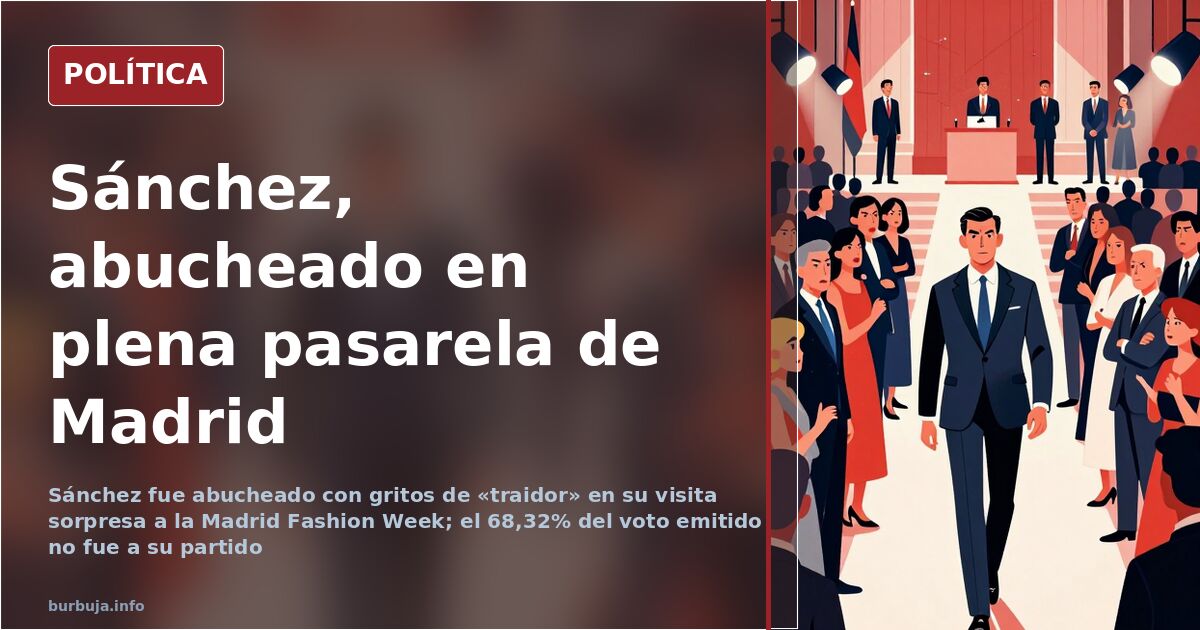
Boos for Sánchez at Madrid Runway: "Traitor"
A head of government can be booed at public events. It is legal, noisy, and does not topple anyone. The debate is whether such boos measure anything. Pedro Sánchez’s surprise visit to Madrid Fashion Week ended with cries of “traitor” and a deeper discussion about ballots, representation, and the specific audience present that afternoon.
The scene, reported by The Objective, has details that change the narrative depending on who you ask. In circulated videos, event music drowns out much of the shouting: some claim no boos are audible, while others assume widespread heckling. The most common interpretation is that it was an unannounced visit and that an executive leader can be challenged without breaking any rules. A stricter view labels it a “non-consensual visit.”
What Peine During the Surprise Visit to Madrid Fashion Week
Sánchez appeared without prior notice at the event and was met with protests. Media covering the incident report boos and shouts of “traitor.” What stands out is not the episode itself—a public figure heckled in a crowd—but the volume it reached afterward. The visit became a thermometer for an older debate: what it means for a president to be booed in public and if this should have political consequences.
Videos do not settle the matter. Some insist only music is heard; others argue music masks nothing. This discrepancy summarizes the tone: each side saw what they wanted to see. Underlying this is an uncomfortable question: do fashion runway boos reflect the country or just its attendees?
The Repeated Statistic: 68.32% Did Not Vote for Him
Three figures dominate the discussion. First, 31.68% of cast votes went to PSOE, versus 68.32% who did not vote for them. Second, 7 million voters out of a census of 47 million, equating to 15% of the population. Third, over 65% of Popular Party (PP) voters in Madrid reside there. These pieces build the argument that the president represents a minority and that his presence at certain events generates rejection almost by definition.
The same pieces also fuel a common error. Percentages measure different things. The 68.32% is based on cast votes, not the census; the 15% is based on total population, including minors and non-voters. Comparing them as if they were the same scale is an arithmetic trap used to win debates quickly. Detailed calculations warrant separate analysis.
Is Booing the President at Public Events Democratic?
Yes, and it is cheap. This is the main argument among protest defenders: being able to criticize and boo the head of government without violence proves the system works. Disagreement is not peaceful, which makes the issue interesting. Some argue booing is a legitimate channel for discontent; others respond that real protest happens at the ballot box and everything else is wasted time.
Between these views lies a third, cynical stance: that booing changes no votes and serves only to confirm existing biases. This disillusioned version holds that people shout in the streets but decide at the polls, rarely aligning.
Madrid, the PP, and the “High-Standing Event”
The venue choice is not neutral. Madrid Fashion Week attracts a very specific profile, and Madrid is a stronghold for the Popular Party (PP). Hence the argument that booing Sánchez here proves little: the runway audience is not representative of the country, just as a rally crowd would not be. The comparison is simple: elsewhere, with different electorates, the reception would differ.
The event’s actual weight is also debated. Madrid Fashion Week does not compete with Paris, Milan, New York, or London, according to prevailing comparisons, placing it in a lower tier despite strong mid-range Spanish brands. This nuance does not change politics but alters the narrative. Additionally, ongoing judicial proceedings involving the president’s family circle cast a shadow over the scene.
Background Noise: Unproven Fraud Allegations
As often occurs when discussing election results, suspicions of manipulation arise. Claims circulate about systematic fraud and the roles of Correos and Indra in counting. No evidence supports these accusations, and many dismiss them outright as politicized suspicion. It is crucial to separate this from the verifiable fact—the booing—and not conflate them.
This noise contaminates the rest. When part of the audience assumes votes are tampered with, any discrepancy confirms their suspicion. When the other side assumes all noise is biased, any protest looks staged. In between remains the stubborn data: one percentage votes, another boos, and they are rarely the same group.
With this material, the likely outcome is that the episode fades in two weeks and conversation returns to numbers. Or perhaps not: if the pattern repeats and every public appearance ends in protest, booing will cease to be anecdotal and become routine. No one yet knows if this hurts or helps him. What can be safely anticipated is that the next encounter will again be measured in shouts, not votes.
A head of government can be booed at public events. It is legal, noisy, and does not topple anyone. The debate is whether such boos measure anything. Pedro Sánchez’s surprise visit to Madrid Fashion Week ended with cries of “traitor” and a deeper discussion about ballots, representation, and the specific audience present that afternoon.
The scene, reported by The Objective, has details that change the narrative depending on who you ask. In circulated videos, event music drowns out much of the shouting: some claim no boos are audible, while others assume widespread heckling. The most common interpretation is that it was an unannounced visit and that an executive leader can be challenged without breaking any rules. A stricter view labels it a “non-consensual visit.”
What Peine During the Surprise Visit to Madrid Fashion Week
Sánchez appeared without prior notice at the event and was met with protests. Media covering the incident report boos and shouts of “traitor.” What stands out is not the episode itself—a public figure heckled in a crowd—but the volume it reached afterward. The visit became a thermometer for an older debate: what it means for a president to be booed in public and if this should have political consequences.
Videos do not settle the matter. Some insist only music is heard; others argue music masks nothing. This discrepancy summarizes the tone: each side saw what they wanted to see. Underlying this is an uncomfortable question: do fashion runway boos reflect the country or just its attendees?
The Repeated Statistic: 68.32% Did Not Vote for Him
Three figures dominate the discussion. First, 31.68% of cast votes went to PSOE, versus 68.32% who did not vote for them. Second, 7 million voters out of a census of 47 million, equating to 15% of the population. Third, over 65% of Popular Party (PP) voters in Madrid reside there. These pieces build the argument that the president represents a minority and that his presence at certain events generates rejection almost by definition.
The same pieces also fuel a common error. Percentages measure different things. The 68.32% is based on cast votes, not the census; the 15% is based on total population, including minors and non-voters. Comparing them as if they were the same scale is an arithmetic trap used to win debates quickly. Detailed calculations warrant separate analysis.
Is Booing the President at Public Events Democratic?
Yes, and it is cheap. This is the main argument among protest defenders: being able to criticize and boo the head of government without violence proves the system works. Disagreement is not peaceful, which makes the issue interesting. Some argue booing is a legitimate channel for discontent; others respond that real protest happens at the ballot box and everything else is wasted time.
Between these views lies a third, cynical stance: that booing changes no votes and serves only to confirm existing biases. This disillusioned version holds that people shout in the streets but decide at the polls, rarely aligning.
Madrid, the PP, and the “High-Standing Event”
The venue choice is not neutral. Madrid Fashion Week attracts a very specific profile, and Madrid is a stronghold for the Popular Party (PP). Hence the argument that booing Sánchez here proves little: the runway audience is not representative of the country, just as a rally crowd would not be. The comparison is simple: elsewhere, with different electorates, the reception would differ.
The event’s actual weight is also debated. Madrid Fashion Week does not compete with Paris, Milan, New York, or London, according to prevailing comparisons, placing it in a lower tier despite strong mid-range Spanish brands. This nuance does not change politics but alters the narrative. Additionally, ongoing judicial proceedings involving the president’s family circle cast a shadow over the scene.
Background Noise: Unproven Fraud Allegations
As often occurs when discussing election results, suspicions of manipulation arise. Claims circulate about systematic fraud and the roles of Correos and Indra in counting. No evidence supports these accusations, and many dismiss them outright as politicized suspicion. It is crucial to separate this from the verifiable fact—the booing—and not conflate them.
This noise contaminates the rest. When part of the audience assumes votes are tampered with, any discrepancy confirms their suspicion. When the other side assumes all noise is biased, any protest looks staged. In between remains the stubborn data: one percentage votes, another boos, and they are rarely the same group.
With this material, the likely outcome is that the episode fades in two weeks and conversation returns to numbers. Or perhaps not: if the pattern repeats and every public appearance ends in protest, booing will cease to be anecdotal and become routine. No one yet knows if this hurts or helps him. What can be safely anticipated is that the next encounter will again be measured in shouts, not votes.
Summary of a discussion on Burbuja.info - Foro de economía, actualidad y política., translated from Spanish and reviewed before publication. Read the full discussion (194 replies).
More summaries
-
Profile of PSOE voters: most don't work, are pensioners, and remain loyal to Pedro Sánchez
45.5% of PSOE voters don't work, 35.4% are pensioners, and 60.5% always vote for the same party. A profile of the Socialist electorate.
-
Tweet Places Pablo Fernández in Luxury Housing Development
A tweet places Pablo Fernández living in a luxury development from the Mahou-Calderón operation, the same one Podemos tried to halt.
-
VOX, threats and the war over political violence narratives in Spain
On May 3, VOX denounced left-wing violence and separatism; despite 187 replies, the debate lacks official data.
-
Solidaridad Union: Vox's union arm takes to the streets
The Solidaridad Union, linked to Vox, held events in Madrid and Fuenlabrada with Santiago Abascal. Is it a new union alternative or a political appendage?
-
Rumor of Royal Wedding: Leonor and Mulay Hassan?
Viral rumors link Princess Leonor to Morocco's heir. Is there truth behind the speculation or just online noise?
-
Orriols Refuses Spanish on Telemadrid, Sparking Sovereignist Debate
Sílvia Orriols refused to speak Spanish on Telemadrid, reigniting the sovereignist vote battle as 56% of Catalans use Spanish daily.