
Does anyone here own a SMART TOILET?
Forum debate on smart toilets: Japanese comfort or health hazard? We break down users' views on this technology.
English · Original discussion in Spanish · Published
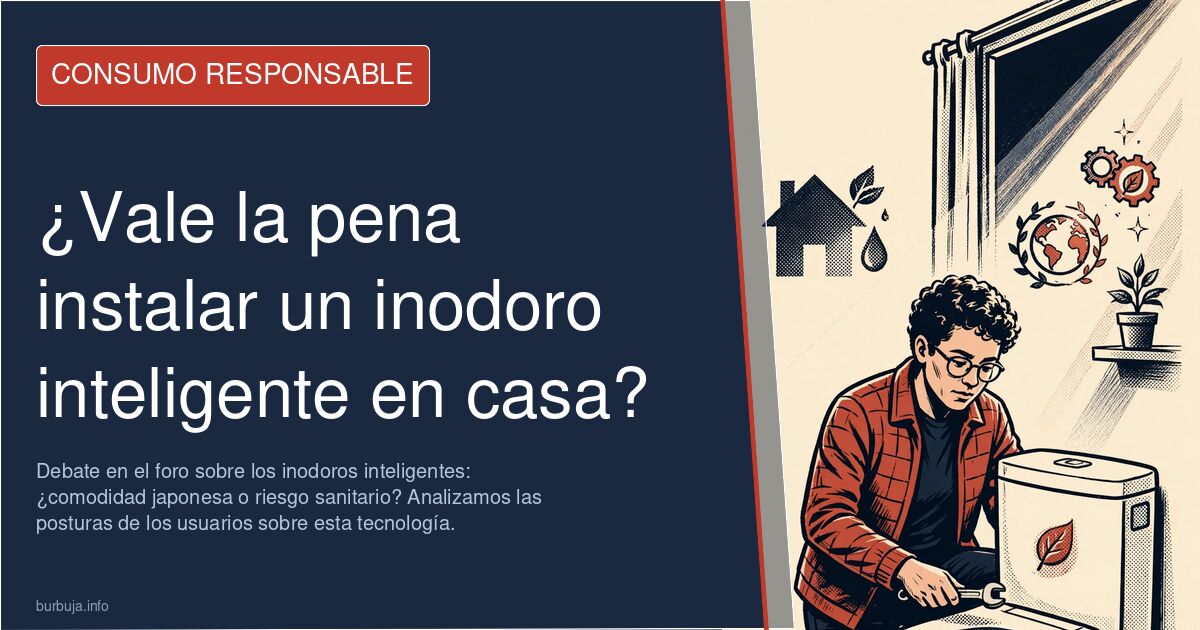
Is it worth installing a smart toilet at home?
The latest frontier of responsible consumption on the forum isn't energy saving, but automated hygiene: the smart toilet. While some users defend the technological superiority of Japanese systems with water jets and heated seats, others question the hygiene of a nozzle that, however self-cleaning it may be, raises doubts about bacteria buildup in critical areas.
Technology versus the old-school bidet
The debate splits between those who consider the traditional bidet a relic and those who see these devices as an unnecessary risk. Enthusiasts highlight the comfort of automated functions, while skeptics wonder about sensor accuracy: what happens if the jet misses its target? The discussion quickly turns to irony, with users questioning whether we really need AI to analyze our diet through what we leave in the bowl.
Skepticism toward sanitary pogre
Beyond the joke, there lies a deep distrust of any "intelligence" added to such a basic object. Concern about the hygiene of internal components, versus the simplicity of wet wipes or the good old bidet, marks the dividing line. In the end, the debate remains stuck on whether this is a real improvement in quality of life or just an expensive gadget that complicates what has always worked without electronics.
Are we witnessing a genuine bathroom revolution, or just another tech whim that will end up causing maintenance problems and questionable hygiene?
Related forum threads
- Natural soap from used oil · 137 replies
- How to quit sugar addiction? · 61 replies
- My doctor tells me I have to take cholesterol pills forever because my own body produces it, wtf?? · 131 replies
- Ceramic hobs (and induction) with printed controls · 21 replies
Also available in: Deutsch
Summary of a discussion on Burbuja.info - Foro de economía, actualidad y política., translated from Spanish and reviewed before publication. Read the full discussion (45 replies).
More summaries
-
Robot Vacuum: Smart Investment or Unnecessary Expense?
An analysis of robot vacuums: Are they a smart investment or an unnecessary expense? Key data on performance and costs.
-
Public fountains reach 60 degrees: why does this happen
Valencia's public fountain water can reach 60 degrees Celsius when the ambient temperature is only 35: the physical explanation for heat accumulation.
-
DGT Vehicle Report Scam: Charging €24 for an €8 Service
A sponsored website charges €24 for a DGT report that costs €8. The scheme uses Carmen Mariscal's name as the applicant.
-
The whisky bottle: quality, snobbery and inflation in Spain
An analysis of the whisky market: between the quality of the domestic spirit, Scottish prestige, and an inflation that is reshaping high-proof drinking.
-
Russian stoves: energy miracle or rural nostalgia?
One hour of firewood provides 12 hours of heat. The Russian stove promises energy savings, but Spanish regulations and the price of firewood call its viability into question.
-
Spain's anti-short-term-rental movement: a scam backed by hotel funding
Behind the protests against holiday rentals lies a hotel lobbying operation that discriminates against small property owners.