
Does anyone actually know a big Bonoloto winner in Spain?
Forum users debate whether anyone knows a Bonoloto winner and the constant suspicion of rigging in Spain's state lottery draws. Chance or system?
English · Original discussion in Spanish · Published
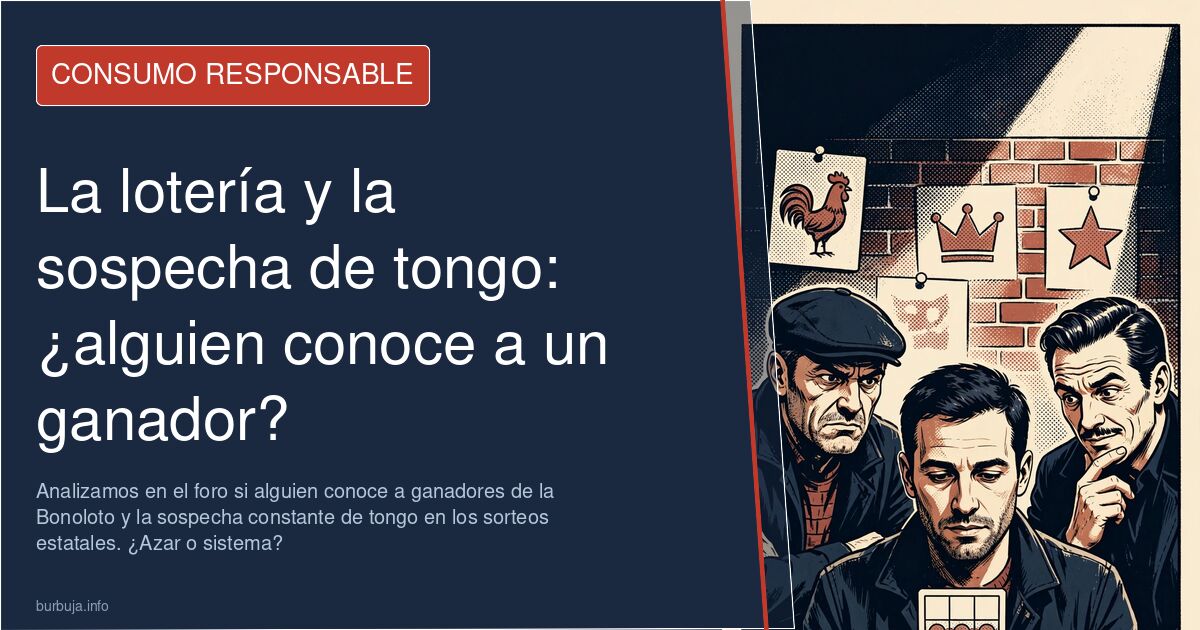
Lottery and the suspicion of a fix: does anyone know a winner?
The question is as old as the drum itself: does anyone know a real Bonoloto winner, or are we looking at a revenue mechanism designed for the benefit of the Spanish state? While some forum users look for mathematical strategies to boost their odds, the conversation quickly drifts toward the lack of transparency and the shadow of suspicion over draws that never seem to get caught up in corruption scandals.
Can you actually win, or is it the tax on people who can't do maths?
The debate kicks off with an existential doubt: is it worth keep playing for a significant prize, or is it better to get off the wheel? Users' experiences vary. While some recommend diversifying with multiple bets to maximize the odds, others recount statistical failures where, after investing 600 euros a month in a syndicate for ten months, the result was a simple "you broke even". The reality is that, for the average forum user, the lottery is not an investment but a statistical hope with a return that borders on absolute zero.
The shadow of a fix and the lack of transparency
What sets this thread apart from any other investment advice is the radical skepticism. Users point to the curious absence of corruption scandals in Spain's state lotteries, something they consider statistically improbable given the nature of public management in Spain. They question the lack of live broadcasts that would allow the integrity of the process to be verified, and they bring up past events, such as the appearance of repeated winning numbers on consecutive weekends, which feed the narrative that the system is not as random as we are told.
In the end, the thread leaves a question hanging that nobody dares to answer with certainty: if the system were really transparent, would we see more winners among our acquaintances, or is it simply the law of large numbers keeping us in misery?
Related debates in the forum
- My doctor tells me I have to take cholesterol pills forever because my own body produces it, wtf?? · 169 replies
- Define P A C O with a photo. · 8421 replies
- What do you think of this little bird as a pet? · 117 replies
- I beat hypertension by eating healthy, my blood pressure is normal now without medication · 31 replies
Also available in: Deutsch
Summary of a discussion on Burbuja.info - Foro de economía, actualidad y política., translated from Spanish and reviewed before publication. Read the full discussion (60 replies).
More summaries
-
Forum Member: “Budget SUVs Cost More and Offer Less Visibility”
A forum member argues that a budget SUV is based on the same small car, priced at €20,000-€25,000. It offers less visibility and the boot doesn't fit all your groceries.
-
Total Renting: Is car leasing for individuals a financial trap?
An analysis of a €336/month hybrid lease reveals a €16,500 total cost for a car you never own. Is leasing worthwhile for private individuals in Spain?
-
Spain's satellite dishes are no longer good for what they were built for
In 1997 they were the future of television; now they are rusty junk. This is what remains of the satellite dish and when it makes sense to uninstall it.
-
Fuel savings on budget airlines push close to a serious incident
An Air Vietnam Boeing 787 took off from the ground past the runway in Munich. Budget airlines' fuel-saving practices are now under scrutiny.
-
Whole ham leg: the real price range runs from €29 to €135
A whole ham leg costs anywhere from €29 to €135 depending on label and origin. The key isn't the price: it's telling cebo, recebo and bellota apart before you buy.
-
Landline without ADSL: alternatives from €12 or €23 a year
The forum compares alternatives to a landline without ADSL: Orange at €12 a month, VoIP at €23 a year and Vodafone from €15. Telefónica charges around €30.