
Divorce in Spain: Legal Limits on Asset Protection
Prenuptial agreements, housing, and offshore accounts offer limited protection in Spanish divorces involving children.
English · Original discussion in Spanish · Published
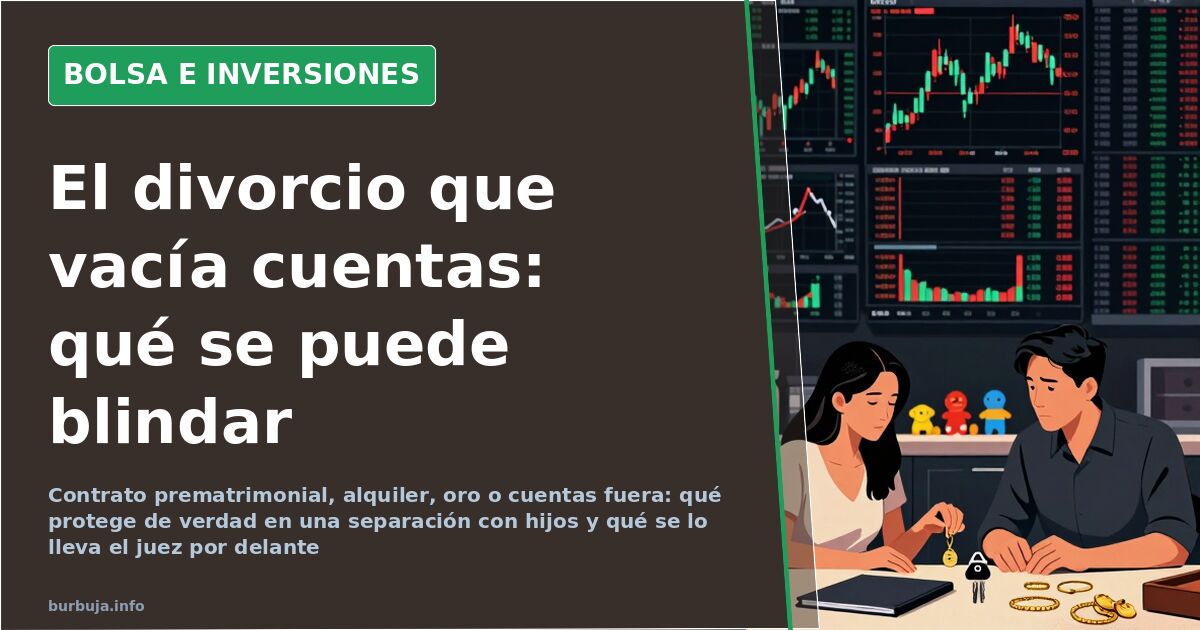
Divorce in Spain: What Assets Are Protected and What Isn't
Can you structure your assets so a divorce doesn't drain your savings? The short answer is yes, but far less than people think. In Spain, marriage and cohabitation with children trigger legal mechanisms that no notarial trick can fully disable: child support, use of the family home, and, where applicable, compensatory pensions. The rest—prenuptial agreements, shell companies, gold in safety deposit boxes—works only intermittently and with fine print.
What People Ask When Trying to Avoid Financial Bleeding
The starting point is a list of recipes: prenuptial agreement, renting instead of buying, putting properties in parents' names, never discussing one's wealth, keeping bitcoin in a physical wallet, and above all, staying low-profile. It sounds like an instruction manual, but each piece has its downside.
The first warning is that, as one participant argues, anything signed before marriage is conditioned by the arrival of a child: relationship circumstances change, and so does the applicable legal framework. That means a prenuptial agreement isn't a shield; it's a snapshot a judge can review.
Housing: Where Almost Everyone Gets It Wrong
Here lies the most repeated misunderstanding. Many believe renting avoids the problem. It doesn't; it shifts it. If there are children and one party gets custody, use of the family home is assigned to the minors, not to the mother or father. It doesn't matter if the flat belongs to grandparents or if rent is being paid: the parent who keeps the children retains use, and the other must find housing independently.
The most cited case involves a cousin earning €1,000 monthly, with a 16-year-old daughter and an unemployed ex-partner: she keeps the house, he pays €250 in child support, and rents a small flat for €550. He's left with about €300 to live on. A second case antiestéticatures a construction worker earning €1,800, three children aged 4 to 10, and a part-time partner: also renting, also with the flat assigned to the minors.
How Much Is Child Support in Spain?
The amount depends on income and the child's needs. The material references €150 to €300 per child, with a specific case of €250 for a teenager. Some argue support is set within limits based on income and actual expenses, while others remind us the amount isn't negotiated with the other parent: the judge determines it.
The most repeated nuance: child support is owed to the child, not the ex-partner. This doesn't prevent payers from suspecting money ends up elsewhere. The law doesn't intervene there.
Assets: Gold, Funds, and Off-Radar Accounts
The refuge list includes index funds, gold bars, cash in safety deposit boxes, and foreign bank accounts with non-Spanish IBANs. The logic is that some assets are harder to trace or seize. The problem is child support is a privileged claim: if the judge deems necessary, they can garnish wages, accounts, and financial assets.
The extreme option mentioned is declared insolvency and moving abroad. It works in theory but turns the debtor into someone who can't return without risk. Don't forget jurisdiction: changing countries before marriage or having children is, for some, the only real solution.
Two Currents Running Through the Issue
One analysis holds the problem isn't divorce itself, but the partner one chooses. If both earn similar amounts, mortgages are paid off sooner, savings accumulate, and separation is limited to child support. Another stream counters this is a statistical exception: breakup rates are high, and the system is designed so the higher earner pays.
In between lies a third, more uncomfortable path: don't play. Don't marry, don't register as a civil partnership, don't have children—or have them with someone who earns more. It's the only strategy that doesn't depend on a judge.
What No Shield Covers
A risk remains that no asset structure resolves: gender violence complaints. It's mentioned as the scenario where assets, custody, and freedom of movement become complicated simultaneously. Not a minor issue, and admits no recipes.
Ultimately, the most repeated conclusion is uncomfortable: divorce is a mechanism designed to distribute assets, and those without assets have nothing to distribute. The rest are nuances, contracts, and hopes.
Can you structure your assets so a divorce doesn't drain your savings? The short answer is yes, but far less than people think. In Spain, marriage and cohabitation with children trigger legal mechanisms that no notarial trick can fully disable: child support, use of the family home, and, where applicable, compensatory pensions. The rest—prenuptial agreements, shell companies, gold in safety deposit boxes—works only intermittently and with fine print.
What People Ask When Trying to Avoid Financial Bleeding
The starting point is a list of recipes: prenuptial agreement, renting instead of buying, putting properties in parents' names, never discussing one's wealth, keeping bitcoin in a physical wallet, and above all, staying low-profile. It sounds like an instruction manual, but each piece has its downside.
The first warning is that, as one participant argues, anything signed before marriage is conditioned by the arrival of a child: relationship circumstances change, and so does the applicable legal framework. That means a prenuptial agreement isn't a shield; it's a snapshot a judge can review.
Housing: Where Almost Everyone Gets It Wrong
Here lies the most repeated misunderstanding. Many believe renting avoids the problem. It doesn't; it shifts it. If there are children and one party gets custody, use of the family home is assigned to the minors, not to the mother or father. It doesn't matter if the flat belongs to grandparents or if rent is being paid: the parent who keeps the children retains use, and the other must find housing independently.
The most cited case involves a cousin earning €1,000 monthly, with a 16-year-old daughter and an unemployed ex-partner: she keeps the house, he pays €250 in child support, and rents a small flat for €550. He's left with about €300 to live on. A second case antiestéticatures a construction worker earning €1,800, three children aged 4 to 10, and a part-time partner: also renting, also with the flat assigned to the minors.
How Much Is Child Support in Spain?
The amount depends on income and the child's needs. The material references €150 to €300 per child, with a specific case of €250 for a teenager. Some argue support is set within limits based on income and actual expenses, while others remind us the amount isn't negotiated with the other parent: the judge determines it.
The most repeated nuance: child support is owed to the child, not the ex-partner. This doesn't prevent payers from suspecting money ends up elsewhere. The law doesn't intervene there.
Assets: Gold, Funds, and Off-Radar Accounts
The refuge list includes index funds, gold bars, cash in safety deposit boxes, and foreign bank accounts with non-Spanish IBANs. The logic is that some assets are harder to trace or seize. The problem is child support is a privileged claim: if the judge deems necessary, they can garnish wages, accounts, and financial assets.
The extreme option mentioned is declared insolvency and moving abroad. It works in theory but turns the debtor into someone who can't return without risk. Don't forget jurisdiction: changing countries before marriage or having children is, for some, the only real solution.
Two Currents Running Through the Issue
One analysis holds the problem isn't divorce itself, but the partner one chooses. If both earn similar amounts, mortgages are paid off sooner, savings accumulate, and separation is limited to child support. Another stream counters this is a statistical exception: breakup rates are high, and the system is designed so the higher earner pays.
In between lies a third, more uncomfortable path: don't play. Don't marry, don't register as a civil partnership, don't have children—or have them with someone who earns more. It's the only strategy that doesn't depend on a judge.
What No Shield Covers
A risk remains that no asset structure resolves: gender violence complaints. It's mentioned as the scenario where assets, custody, and freedom of movement become complicated simultaneously. Not a minor issue, and admits no recipes.
Ultimately, the most repeated conclusion is uncomfortable: divorce is a mechanism designed to distribute assets, and those without assets have nothing to distribute. The rest are nuances, contracts, and hopes.
Also available in: Deutsch
Summary of a discussion on Burbuja.info - Foro de economía, actualidad y política., translated from Spanish and reviewed before publication. Read the full discussion (110 replies).
More summaries
-
Invertir desde Cero course reviews: useful but basic
Students call the stock market course introductory, not advanced: one month of classes and a year of monthly sessions.
-
Abengoa shares plunge 48% and 45% without trading halt
Abengoa A closed at 0.272 euros (-48%) and B at 0.110 (-45%). Investors reported losses exceeding 100,000 euros.
-
Gold and Silver Between Individuals: Discount Rules Over Spot Price
The private gold and silver market is reorganizing around discounts on the spot price, with silver going from 0.434 euros per gram to 74 euros per ounce.
-
Bankia preferred shares: arbitration or court for recovery
Bankia ended 2013 with 187,000 affected by preferred shares and €5 billion at stake. Arbitrage yields little while legal action advances, but uncertainty remains.
-
China challenges dollar with digital yuan and US debt cuts
China prepares a cryptocurrency and trims US bonds while markets stay calm: why Beijing has no interest in crashing the dollar.
-
Spanish Forum User Claims Million at 60 via 14% S&P Return
A Spanish forum user calculates reaching a million euros by age 60 saving €10,000 annually with a claimed 14% return, contrasting with the S&P 500's historical 8%.