
Dividing Ukraine: The Dnieper River as a New Iron Curtain
A proposal to split Ukraine along the Dnieper River could end the war, leaving Russia in control of Crimea and the coast.
English · Original discussion in Spanish · Published
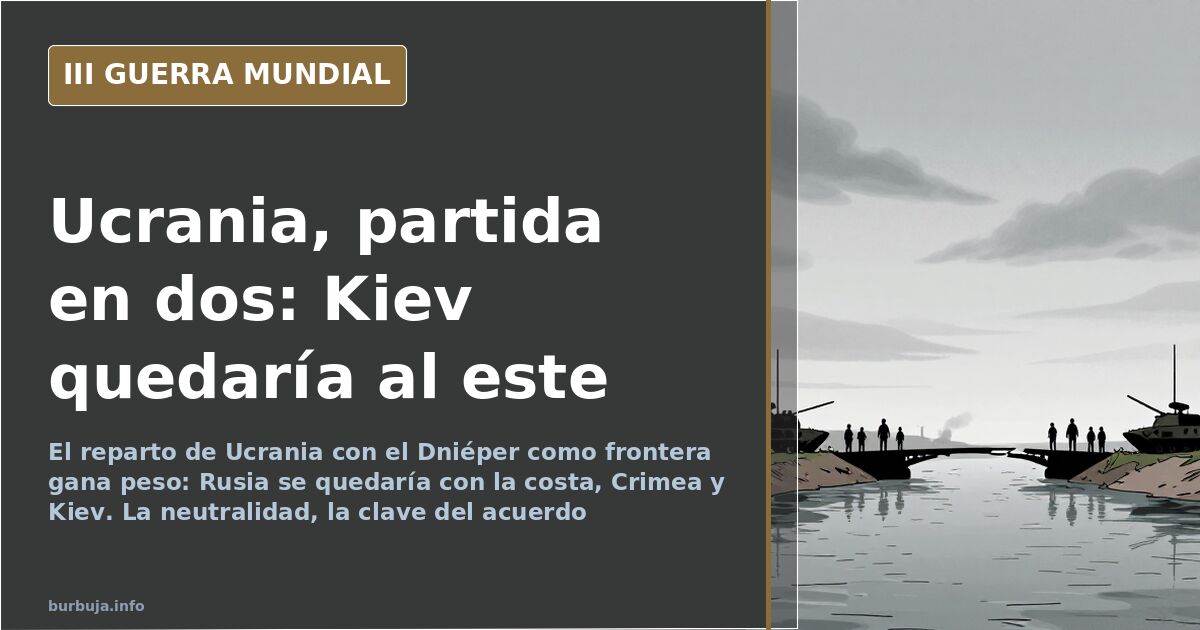
The Dnieper as a new Iron Curtain to divide Ukraine in two
Could this war end with a border along the Dnieper River, leaving two Ukraines facing each other like Berlin in 1961? The scenario is presented as a realist exercise: a partition similar to the two Germanys, with Kyiv in the eastern half and Russia retaining the entire coastline. The thesis is summarized in a phrase that sounds like a joke but isn't: this is how history would end, and everyone would be happy. The missing detail is how to convince the half that gets nothing.
Could Ukraine be divided like East and West Germany?
The parallel with a divided Germany is not merely decorative. It describes a de facto border, without a treaty, a timetable, or the signatures of the parties involved, with the Dnieper reclaiming its role as an Iron Curtain. On this map, what matters is not the square mileage, but strategic value: the historical capital and the coastline. Kyiv would remain on the Russian side and the rest of the country would reorganize west of the river, with a capital yet to be decided.
There is a revealing detail in how this is framed: important territories are discussed alongside secondary ones, as if the partition were an auction between two bidders. Those defending this exit argue it is not a bad deal for Moscow, as it keeps what is valuable and the city that provides historical legitimacy. What is nowhere to be found is the political cost of a border without a formal agreement.
The partition on the map: coast, Crimea, and the Sea of Azov
The most frequently proposed layout hands Russia the entire coastal zone, the Donbas, the Crimean Peninsula, and control of the Sea of Azov. The resulting Ukraine would be an inland, agrarian country without significant maritime access, with an international weight similar to a geopolitical Moldova: a candidate for everything, admitted to nothing. Its defenders add that Russian forces are already where they need to be and that moving them further west would only add cost without adding security.
The argument rests on a simple idea: the coastline and the heavy industry of the east are worth more than any security guarantee written on paper. Those looking coldly at the map remember that the territories cited as non-negotiable are precisely those that have been in dispute for years.
Why a neutrality treaty is worth more than dividing the country
This is the strongest objection. A Ukraine with half its territory but an open path to a nuclear program would be almost as dangerous to Russia as a whole Ukraine. The corollary is uncomfortable for supporters of the partition: what matters is not where the line is drawn, but the existence of a signed document where Kyiv commits to not joining NATO.
Missiles land the same whether launched from Romania or Ukrainian territory. If the real goal is permanent neutrality, obsessing over square kilometers is a waste of time. Hence the conclusion shared by opposing analyses: a neutrality treaty without partition would be worth more than a partition without a treaty. The warning accompanying this thesis is the usual one: guarantees signed in haste are broken in leisure.
Why the United States is unlikely to accept the partition?
Because those negotiating on behalf of Ukraine, according to the most widespread reading, have nothing to lose from the outcome: their future is already decided, and their role would be to make the agreement impossible. Along those lines, Washington would not bless a partition that leaves it without the objective it has been moving for, and Kyiv's "no" to NATO is not enough if an armed and hostile country remains across the border.
In the face of this, the hypothesis of a withdrawal and real negotiation is dismissed with a "we shall see" and little faith. The only sustancia ilegal this current admits is that its adversaries are not exactly a precision machine, and that a plan depending on everything going wrong has an expiration date.
Eight years of Donbas and the Maidan: the narrative of each side
The war does not begin with the offensive on the rest of the country, but with the change of government in 2014 and eight years of clashes in the Donbas. Those defending the partition remember that the ousted president was pro-Russian, had won at the polls, and ended up convicted in his own country of high treason. Those who reject it respond that a change of government, however debatable, does not authorize invading a neighbor.
Onto this skeleton, more fanciful layers are attached: global social control plans, pre-arranged health crises, and an international agenda that would explain everything, including digital currency. Abundant material for the suspicious, zero evidence provided. There is also another kind of noise: much of the messaging is dedicated to insults rather than arguments, which helps little in deciding who is right.
A border that only exists in forecasts
It is worth remembering the less epic side. Predictions about the Ukrainian map have been aging poorly for years, and those that took the partition for granted when Russia recognized the independence of the two republics were left unfinished when the offensive expanded to the whole country. Amidst all these forecasts, the only thing that moves punctually is the retrieval of old messages to check who was right.
The Dnieper is today a line in a comment, not in a treaty. Which, when dealing with iron curtains, is almost an advantage: they can be erased.
Also available in: Deutsch
Summary of a discussion on Burbuja.info - Foro de economía, actualidad y política., translated from Spanish and reviewed before publication. Read the full discussion (101 replies).
More summaries
-
Putin: Russia's Most Divisive Statesman or Tyrant?
Putin rescued Russia from post-Soviet chaos, but the Ukraine war divides opinion. Is he the century's greatest statesman or a tyrant?
-
NATO forces pull out of Kharkiv as Russia advances
Reports from Times of India and Tribun Timur indicate that NATO-linked fighters are abandoning Kharkiv as Russia launches an offensive featuring hand-to-hand combat.
-
Ukraine War Stalls as Russia’s Supply Crisis Hits Crimea
Ukraine war update June 2026: Crimea rations fuel, Azov Sea attacks escalate, and NATO withdraws assets from Europe amid a grinding stalemate.
-
Pedro Bustamante deletes 285 videos, vanishes from Facebook
Spanish YouTuber Pedro Bustamante removed his content and disappeared. Rumors place him in Munich, reading German press.
-
Ukraine Plans Bakhmut Counterattack With Up to 55,000 Troops
Ukrainian sources claim a buildup of 55,000 troops in Bakhmut to counter Wagner. The figure's strategic value remains widely debated.
-
NATO's Overextension: A Miscalculated Global Strategy
Seven simultaneous fronts—Ukraine, Taiwan, Kosovo, Korea—strain Western capacity. Analysis of NATO's double standards and strategic overreach.