
Ditching dairy: less congestion, but what about calcium?
People who stop eating dairy report fewer symptoms and better digestion, while experts question milk's role in preventing osteoporosis.
English · Original discussion in Spanish · Published
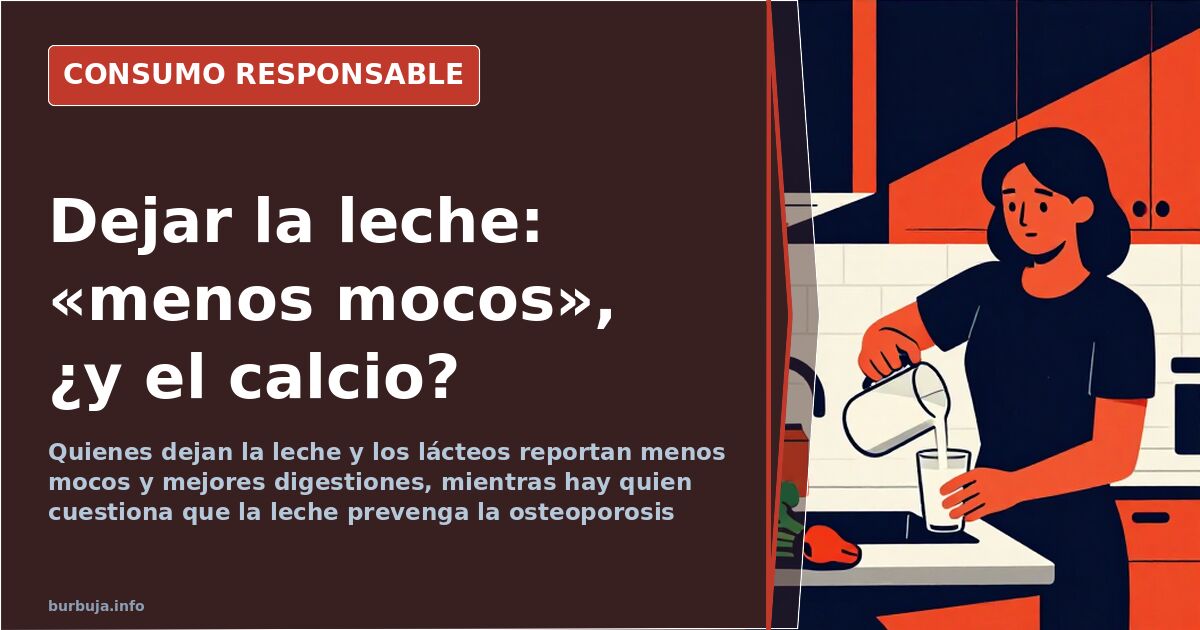
Stopping dairy: less congestion, better digestion, and the calcium myth
A food marketed as essential for bones that many who quit say clears their sinuses. This paradox runs through a health discussion spanning eight pages. The initial question was simple: has anyone stopped eating dairy and noticed improvements? Among those sharing experiences, the majority answer yes. And the most common symptom isn't related to calcium: it's nasal congestion.
Congestion and sinuses: the most reported symptom
The most detailed account describes a month-long experiment without milk. Upon waking, the nose was completely clear, with pristine, immaculate air flowing through both nostrils. Before, with milk consumption, they felt blocked. Another case describes years of coughing, post-nasal drip, and waking up at 2 AM unable to breathe; improvement only came after removing milk and all derivatives. A third person reports childhood asthma attacks, sinusitis, and recurrent bronchitis, significantly reduced after abandoning dairy.
This is not a representative sample or a clinical trial. These are testimonials. But they align too often: lighter digestion, fewer breakouts, clearer skin, and reduced dark circles appear repeatedly. Some quantify the benefit in weight loss: three kilos in the first week. Others go further, claiming their seasonal allergies vanished, dropping from two months a year to a maximum of three days.
Why does milk cause more congestion?
The circulating explanation mixes intuition with physiology. It is argued that milk is designed for young animals with four stomachs capable of digesting cellulose, making it as nonsensical for an adult human as putting gasoline in a diesel engine. Casein, a protein some compare to carpenter's glue adhering to the intestine, is also blamed, though no evidence supports this.
A nuance often overlooked: skim milk, due to its higher concentration of proteins and lactose, may be worse tolerated than whole milk. This contradicts the intuition that removing fat always helps.
The calcium paradox: more milk, more osteoporosis
Here things get serious. It is claimed that countries with the highest milk consumption also record the most osteoporosis, citing the United States, the world's top consumer. Japan is cited as the opposite case, where little milk is drunk and, according to claims, osteoporosis is almost nonexistent. Handle this with care: these are correlations, not proven causes.
The proposed mechanism is chemical. Calcium in milk would recombine with phosphorus in the intestinal tract and not be absorbed. Bone remodeling, others counter, is a much more complex process than drinking or skipping a daily glass: bone is a living organ and osteoporosis depends on multiple factors, not a single food.
Where do I get calcium if I quit milk?
The answer is that milk is neither the only nor the best source. Compared to the 302 milligrams of calcium in a glass of skim milk, plain yogurt provides 415, sardines in oil with bones provide 324, and cheddar cheese provides 306. In short: milk doesn't even lead its own chart.
Almonds, hazelnuts, egg yolk, cabbage, and dark leafy greens are also cited. With a warning: spinach and chickpeas, rich in calcium, contain oxalates that hinder absorption.
Vitamin D: the missing sun in Nordic countries
One factor disrupts the entire premise: without vitamin D, calcium isn't absorbed, whether you drink milk or not. And the main source of vitamin D isn't food, it's sunlight. In northern latitudes with little light, campaigns have been launched to enrich milk precisely for this reason. In warmer countries, osteoporosis incidence is lower.
One testimonial points in this direction: after quitting milk, they notice they tan more easily, as if something interfered with vitamin D synthesis, and compensate with nuts, leafy greens, and exercise.
Lactose intolerance: there are degrees and not everyone is the same
Intolerance isn't a switch. Some tolerate small amounts, others react to any trace, even lactose used as an excipient in medication. Milk is the dairy product with the most lactose; yogurt has less due to fermentation, and aged cheese has even less. Celiac disease often comes with lactose intolerance.
How many people are intolerant? In Italy, it is claimed, half the population. For Spain, data is admittedly unknown.
What about cancer? No answer
The question about the link between dairy and cancer remains unanswered by data. There is talk of inflammation, bloating, and how supermarket products aren't really milk after industrial processing. These are assertions made but not demonstrated.
With all this on the table, the most honest conclusion is uncomfortable: some quit milk and breathe better, while others have taken it their whole lives without issue. How many who wake up with a stuffy nose blame a cold instead of breakfast?
A food marketed as essential for bones that many who quit say clears their sinuses. This paradox runs through a health discussion spanning eight pages. The initial question was simple: has anyone stopped eating dairy and noticed improvements? Among those sharing experiences, the majority answer yes. And the most common symptom isn't related to calcium: it's nasal congestion.
Congestion and sinuses: the most reported symptom
The most detailed account describes a month-long experiment without milk. Upon waking, the nose was completely clear, with pristine, immaculate air flowing through both nostrils. Before, with milk consumption, they felt blocked. Another case describes years of coughing, post-nasal drip, and waking up at 2 AM unable to breathe; improvement only came after removing milk and all derivatives. A third person reports childhood asthma attacks, sinusitis, and recurrent bronchitis, significantly reduced after abandoning dairy.
This is not a representative sample or a clinical trial. These are testimonials. But they align too often: lighter digestion, fewer breakouts, clearer skin, and reduced dark circles appear repeatedly. Some quantify the benefit in weight loss: three kilos in the first week. Others go further, claiming their seasonal allergies vanished, dropping from two months a year to a maximum of three days.
Why does milk cause more congestion?
The circulating explanation mixes intuition with physiology. It is argued that milk is designed for young animals with four stomachs capable of digesting cellulose, making it as nonsensical for an adult human as putting gasoline in a diesel engine. Casein, a protein some compare to carpenter's glue adhering to the intestine, is also blamed, though no evidence supports this.
A nuance often overlooked: skim milk, due to its higher concentration of proteins and lactose, may be worse tolerated than whole milk. This contradicts the intuition that removing fat always helps.
The calcium paradox: more milk, more osteoporosis
Here things get serious. It is claimed that countries with the highest milk consumption also record the most osteoporosis, citing the United States, the world's top consumer. Japan is cited as the opposite case, where little milk is drunk and, according to claims, osteoporosis is almost nonexistent. Handle this with care: these are correlations, not proven causes.
The proposed mechanism is chemical. Calcium in milk would recombine with phosphorus in the intestinal tract and not be absorbed. Bone remodeling, others counter, is a much more complex process than drinking or skipping a daily glass: bone is a living organ and osteoporosis depends on multiple factors, not a single food.
Where do I get calcium if I quit milk?
The answer is that milk is neither the only nor the best source. Compared to the 302 milligrams of calcium in a glass of skim milk, plain yogurt provides 415, sardines in oil with bones provide 324, and cheddar cheese provides 306. In short: milk doesn't even lead its own chart.
Almonds, hazelnuts, egg yolk, cabbage, and dark leafy greens are also cited. With a warning: spinach and chickpeas, rich in calcium, contain oxalates that hinder absorption.
Vitamin D: the missing sun in Nordic countries
One factor disrupts the entire premise: without vitamin D, calcium isn't absorbed, whether you drink milk or not. And the main source of vitamin D isn't food, it's sunlight. In northern latitudes with little light, campaigns have been launched to enrich milk precisely for this reason. In warmer countries, osteoporosis incidence is lower.
One testimonial points in this direction: after quitting milk, they notice they tan more easily, as if something interfered with vitamin D synthesis, and compensate with nuts, leafy greens, and exercise.
Lactose intolerance: there are degrees and not everyone is the same
Intolerance isn't a switch. Some tolerate small amounts, others react to any trace, even lactose used as an excipient in medication. Milk is the dairy product with the most lactose; yogurt has less due to fermentation, and aged cheese has even less. Celiac disease often comes with lactose intolerance.
How many people are intolerant? In Italy, it is claimed, half the population. For Spain, data is admittedly unknown.
What about cancer? No answer
The question about the link between dairy and cancer remains unanswered by data. There is talk of inflammation, bloating, and how supermarket products aren't really milk after industrial processing. These are assertions made but not demonstrated.
With all this on the table, the most honest conclusion is uncomfortable: some quit milk and breathe better, while others have taken it their whole lives without issue. How many who wake up with a stuffy nose blame a cold instead of breakfast?
Also available in: Deutsch
Summary of a discussion on Burbuja.info - Foro de economía, actualidad y política., translated from Spanish and reviewed before publication. Read the full discussion (124 replies).
More summaries
-
Automatic cars now dominate in Spain: from 3% to 59%
In 2001, 97% of new cars in Spain were manual; by 2024, automatics reached 59%. The 2019 driving license change and pricing explain this shift.
-
US vs Spain: Prices, Salaries, and Purchasing Power
Eggs cost $4 in Texas and €7 in Madrid, yet US wages are triple. We analyze real purchasing power between the two countries.
-
The €3.61 Fee Killing AliExpress Purchases
The €3.61 per-category tariff has inflated AliExpress purchases by up to 80%. Consumers are stopping buys, and revenue is falling. Does it actually protect...
-
Best budget mini PC: new Chinese or refurbished?
Is a €160 Chinese mini PC worth it, or is a refurbished unit better? We analyze real options to balance price, performance and reliability.
-
Spain's unlicensed air rifle limit is 24 joules
In Spain, the most powerful unlicensed air rifle is capped at 24 joules. Caliber and loading system determine performance.
-
Balay touts Spanish roots while manufacturing dishwashers in Turkey
Balay markets itself as a Spanish brand, but its dishwashers are made in Turkey and washing machines in Poland, despite being part of the German BSH group.