
Digital Euro Launches in October, Sparking Cash Debate
Lagarde announces the digital euro for October and praises China's model. The end of cash and transaction control are under scrutiny.
English · Original discussion in Spanish · Published
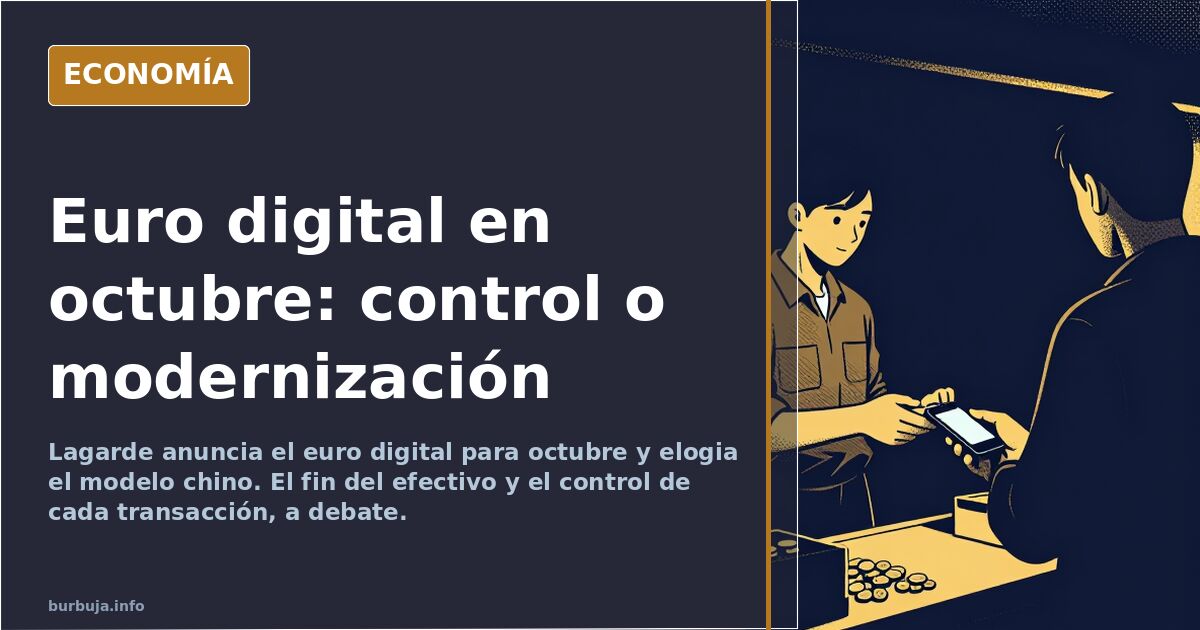
The Digital Euro Arrives in October as Cash Resists Extinction
Can Europe abolish cash by decree? The ECB denies it, but Christine Lagarde’s announcement to launch the digital euro in October has triggered alarms. Presented as a payment system modernization, the fine print—programmability, full transaction traceability, and account freezing capabilities—has ignited public debate. The ECB President praised the Chinese model as a reference, a detail that did not go unnoticed.
What the Digital Euro Is and Isn’t
The digital euro is a CBDC (Central Bank Digital Currency), not a typical cryptocurrency. The difference is vast: while Bitcoin operates without intermediaries and hides your holdings and spending, a CBDC is designed to give the issuer complete visibility over every movement. This is precisely the antiestéticature generating the most distrust.
Some argue cash won’t disappear, at least in the short term. The official stance is that it remains necessary for security and as a backup against technical failures. However, reality shows that cash payments already have a maximum limit of €1,000 in Spain, and bank branch closures push more people toward digital payments. The question isn’t if cash vanishes tomorrow, but where the trajectory points.
The Chinese Model as an Uncomfortable Mirror
Lagarde praised the Chinese model during her speech. In China, however, cash still circulates normally alongside WeChat Pay and Alipay; what has practically disappeared are cards. This nuance matters because it dismantles part of the catastrophic narrative, but also reveals what Europe might be copying silently: a system where money is programmable and the issuer has the final say.
The debate about Western social credit looms over the conversation. Carbon footprints, opinions, and unapproved expenses could limit citizens’ financial freedom if the system is designed with such capacity. It’s not a prediction, but a technical possibility enabled by programmability. That is exactly what distinguishes a CBDC from a banknote.
The Scenario No One Wants to Face: Blackouts, Hacks, or Freezes
What happens if there’s a blackout, an electromagnetic pulse, or a cyberattack? With physical money, the problem is local. With centralized digital money, the problem is systemic. This asymmetry fuels distrust. Added to this is the possibility that a government freezes accounts for political or administrative reasons, something requiring bureaucracy today but becoming automatic with a CBDC.
The market’s natural response, if the system is perceived as oppressive, would be street-level monetary competition: dollars, Swiss francs, or yuan circulating outside the system. This would erode the ECB’s seigniorage and its ability to control the money supply. It’s not far-fetched: the dollar is already the second shadow currency in many countries.
Who Wins and Who Loses with the Digital Euro
Central banks gain control. Citizens lose privacy. Small businesses, which drive daily cash usage, are left in limbo. And high-ranking officials, reportedly, would have anonymous transactions: programmability allows exceptions. This asymmetry—control for some, opacity for others—is what irritates most.
Nigeria’s rejection of its CBDC is the warning no one wants to read. If people don’t use it, the system fails. And in Europe, there is too much informal economy for a fully traceable system to be implemented without resistance. The question isn’t if the digital euro will arrive, but whether people will accept it or seek alternatives.
The Calendar No One Confirms
The October date circulates persistently, but there is no official confirmation. What is clear is that the debate is no longer technical, but political. And that resistance doesn’t come only from usual suspects: there are people who have never protested anything now eyeing their bank accounts with suspicion.
In the end, the irony is that money has always been a social convention. What changes is who controls it. And that, dear reader, is exactly what is at stake.
Can Europe abolish cash by decree? The ECB denies it, but Christine Lagarde’s announcement to launch the digital euro in October has triggered alarms. Presented as a payment system modernization, the fine print—programmability, full transaction traceability, and account freezing capabilities—has ignited public debate. The ECB President praised the Chinese model as a reference, a detail that did not go unnoticed.
What the Digital Euro Is and Isn’t
The digital euro is a CBDC (Central Bank Digital Currency), not a typical cryptocurrency. The difference is vast: while Bitcoin operates without intermediaries and hides your holdings and spending, a CBDC is designed to give the issuer complete visibility over every movement. This is precisely the antiestéticature generating the most distrust.
Some argue cash won’t disappear, at least in the short term. The official stance is that it remains necessary for security and as a backup against technical failures. However, reality shows that cash payments already have a maximum limit of €1,000 in Spain, and bank branch closures push more people toward digital payments. The question isn’t if cash vanishes tomorrow, but where the trajectory points.
The Chinese Model as an Uncomfortable Mirror
Lagarde praised the Chinese model during her speech. In China, however, cash still circulates normally alongside WeChat Pay and Alipay; what has practically disappeared are cards. This nuance matters because it dismantles part of the catastrophic narrative, but also reveals what Europe might be copying silently: a system where money is programmable and the issuer has the final say.
The debate about Western social credit looms over the conversation. Carbon footprints, opinions, and unapproved expenses could limit citizens’ financial freedom if the system is designed with such capacity. It’s not a prediction, but a technical possibility enabled by programmability. That is exactly what distinguishes a CBDC from a banknote.
The Scenario No One Wants to Face: Blackouts, Hacks, or Freezes
What happens if there’s a blackout, an electromagnetic pulse, or a cyberattack? With physical money, the problem is local. With centralized digital money, the problem is systemic. This asymmetry fuels distrust. Added to this is the possibility that a government freezes accounts for political or administrative reasons, something requiring bureaucracy today but becoming automatic with a CBDC.
The market’s natural response, if the system is perceived as oppressive, would be street-level monetary competition: dollars, Swiss francs, or yuan circulating outside the system. This would erode the ECB’s seigniorage and its ability to control the money supply. It’s not far-fetched: the dollar is already the second shadow currency in many countries.
Who Wins and Who Loses with the Digital Euro
Central banks gain control. Citizens lose privacy. Small businesses, which drive daily cash usage, are left in limbo. And high-ranking officials, reportedly, would have anonymous transactions: programmability allows exceptions. This asymmetry—control for some, opacity for others—is what irritates most.
Nigeria’s rejection of its CBDC is the warning no one wants to read. If people don’t use it, the system fails. And in Europe, there is too much informal economy for a fully traceable system to be implemented without resistance. The question isn’t if the digital euro will arrive, but whether people will accept it or seek alternatives.
The Calendar No One Confirms
The October date circulates persistently, but there is no official confirmation. What is clear is that the debate is no longer technical, but political. And that resistance doesn’t come only from usual suspects: there are people who have never protested anything now eyeing their bank accounts with suspicion.
In the end, the irony is that money has always been a social convention. What changes is who controls it. And that, dear reader, is exactly what is at stake.
Summary of a discussion on Burbuja.info - Foro de economía, actualidad y política., translated from Spanish and reviewed before publication. Read the full discussion (160 replies).
More summaries
-
Lagarde warns of global economic shock
Analysis of Lagarde's warning on an imminent crisis: the slow collapse of Europe's economic model and bureaucracy as the driver of adjustment.
-
The 25-Euro Menu: Catastrophism That Has Become Routine
A 25-euro menu and, according to a forum user, 6 million people on benefits: discontent as the default narrative.
-
Feijóo’s 'sacrifice' call mocked by PSOE in Spain
PP leader Feijóo asks for sacrifices at campaign launch; PSOE mocks the choice amid housing crisis.
-
Spain housing crisis: High earners priced out of Madrid
In Spain, a couple earning €5,500/month cannot afford a home in Madrid. Prices hit €550k and rents €2k, driven by migration and inflation.
-
Young Man Fired for Mocking Puerta del Sol Protesters
A young man was fired after a viral video mocked Puerta del Sol protesters as lazy. The case sparks debate on fair dismissal and free speech in Spain.
-
Plane Myth: Confusing Inertia with Wind in Spain
Earth rotates at 1,600 km/h and planes fly at 840 km/h. The error is forgetting that air rotates with the planet.