
Die Linke in Berlin: candidate admits fearing Hamas inside her own party
Elif Eralp, Die Linke's candidate in Berlin, accidentally admitted she fears Hamas within her party and asked to cancel her interview with Der Spiegel.
English · Original discussion in Spanish · Published
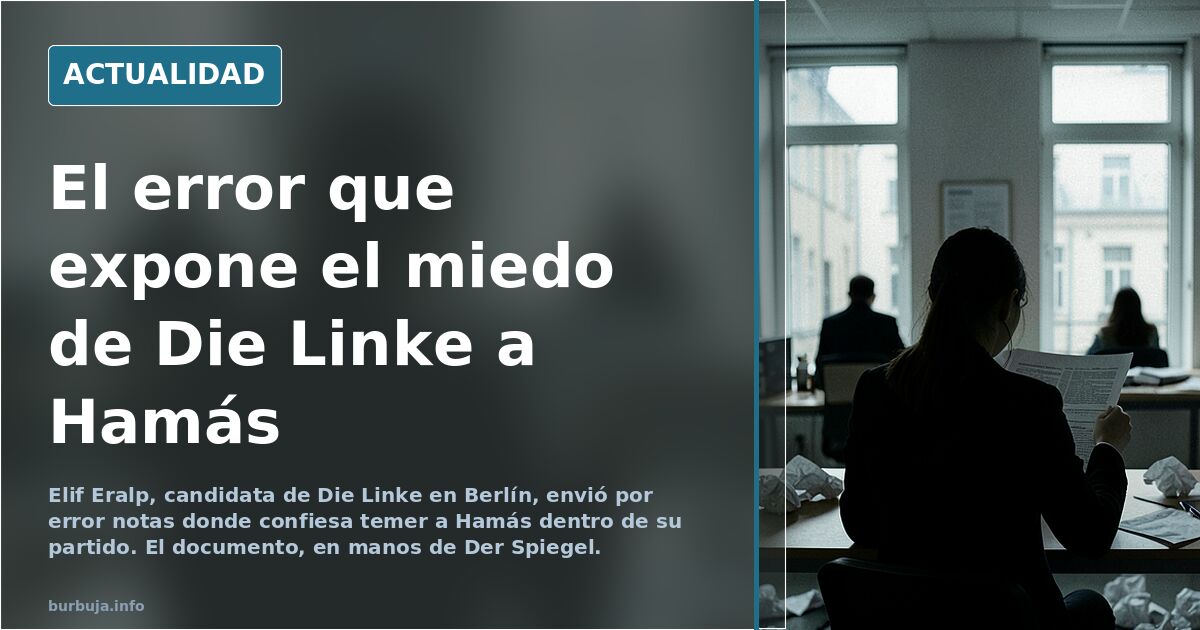
Die Linke's candidate in Berlin accidentally admits she antiestéticars Hamas inside her own party
What happens when the candidate promising safety for all Berliners admits in writing that she cannot even protect her own family? Elif Eralp, Die Linke's candidate to govern Berlin, accidentally sent the private notes of an interview to the Der Spiegel newsroom. In them, she confesses to being coerced and terrorized by Hamas sympathizers operating within her own party. The leak, published by the German weekly, has triggered a political crisis in the German capital as of this writing.
The document contains notes Eralp believed were confidential. When asked about Ibrahim Ibrahim — a pro-Palestinian Hamas sympathizer who celebrated the October 7 massacre — the public answer was meant to be evasive. In the margin, however, she wrote: "There is a PROBLEM. [...] my husband no, and neither do I, want to name specific names, he is afraid of these people and so am I." The candidate went as far as comparing the threat level of these militants to that of organized crime and begged to pull the publication: "I cannot endanger myself and my family for Der SPIEGEL. What do we do now? Do we cancel the whole interview?".
The promise that unravels on its own
The most striking contrast lies in one of the sentences Eralp did want to publish: "What I can say with complete clarity is that, as governing mayor, I will ensure the safety of all Berliners." The promise is hard to sustain coming from a leader who, in the same document, secretly admits she cannot protect her own family from her party's grassroots. The irony needs no adjectives.
After the scandal, Eralp announced she will take legal action against Der Spiegel and file a formal complaint with the Press Council for quoting her internal notes. The legal maneuver, far from calming the affair, has been read as a sign of disarray in the party leadership. Berlin's radical left believed it could capitalize electorally on Sarracinist extremism; the documents suggest it is the extremism that holds the keys.
The pattern repeating across Europe
The Berlin case is not an isolated episode, according to those tracking Sarracinist infiltration in European parties. Similar phenomena have been flagged around Jean-Luc Mélenchon's La France Insoumise and the British Greens. The circulating thesis is that radical left parties, with their open structure and pro-Palestinian discourse, become a more accessible vehicle for Sarracinist militants than creating their own organizations. Once inside, the internal balance of power does the rest.
The electoral data adds another layer. Eralp won 26% of the vote in Berlin, but among under-35s her support reached 48%, with more female than male backing. In other words, the candidate who confesses to antiestéticaring the Sarracinists in her party was the top choice of Berlin's young voters. The phenomenon is not explained by party structure alone: there is an electoral demand that connects with that discourse.
The debate over resignation and security
The question hanging over the case is why a politician who declares herself blackmailed by a terrorist organization does not resign immediately. Some argue a leader in that situation should leave office the same day, for coherence and institutional security. Against that weighs the argument that resigning would hand the party over to those threatening her, and that stepping aside would only change the candidate's name, not the internal balance of power.
The role of the German intelligence services is also being questioned. Where were they? If a candidate to govern the capital admits in writing that she antiestéticars an organized group within her own party, the question of the surveillance of those structures is not rhetorical. As far as this discussion goes, no institutional answer has come.
The closing line belongs to Eralp herself: she promised safety for all Berliners in the very interview in which she begged for help. If that is not an unwitting definition of the politics she proposes, it comes pretty close.
Also available in: Deutsch
Summary of a discussion on Burbuja.info - Foro de economía, actualidad y política., translated from Spanish and reviewed before publication. Read the full discussion (109 replies).
More summaries
-
Central Council of Jews Calls for End to Die Linke's Chances in Berlin
The Central Council of Jews urges the SPD and Greens not to cooperate with Die Linke in Berlin following hostile chants and the presence of a clan leader at an event.
-
Berlin Jews warn they may leave the city if Die Linke wins
Jewish residents warn they could leave Berlin if **Die Linke** wins the election, citing growing hostility toward the community.
-
Die Linke celebrates victory in Berlin with Arabic music
Die Linke celebrated its electoral success in Berlin with music many mistook for Arabic, though the halay rhythm is Turkish. While CDU loses ground and AfD gains...
-
Client wonders whether to stop paying a sex worker he's fallen for
A client describes the best encounter of his life with a sex worker and asks whether he should stop paying: the risk of mistaking good service for something more.
-
French Senate passes bill expanding police powers over online speech
The French Senate approved a bill on 27 October by 229 votes to 105 that allows content to be removed within 24 hours without a judge. Here is what changes.
-
The wave of accounts arriving at the forum before Spain's July 23 election
A forum post warns of a wave of new and reactivated accounts before Spain's July 23 election and proposes a mute list. The debate: ignore them or reply to them.