
Díaz Villanueva and the subway meme: from sarcasm to a brutal video
Díaz Villanueva responds with a brutal video to the meme that placed him on the subway surrounded by migrants, reigniting controversy over his figure and his audience.
English · Original discussion in Spanish · Published
Díaz Villanueva and the subway meme: from sarcasm to a brutal video
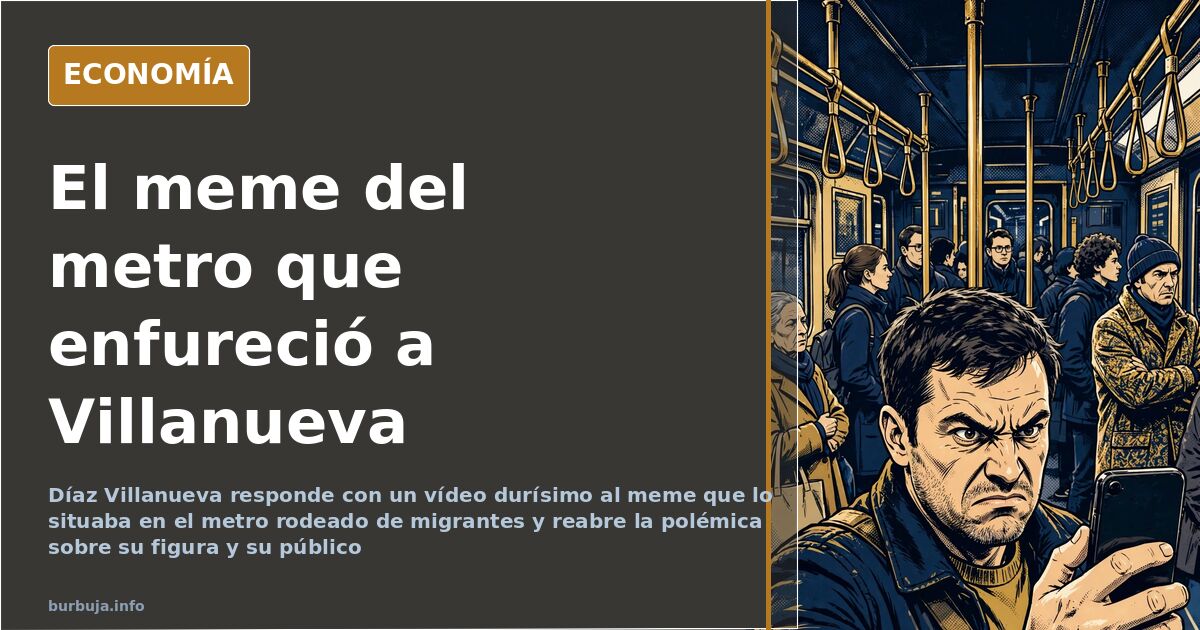
How does a commentator who has made sarcasm his trademark react when the meme lands on him? Fernando Díaz Villanueva, known for his mocking tone and his defense of liberalism, has responded with a video that much of his audience calls brutal to a meme that placed him in a subway station surrounded by migrants. The episode has peine the discussion about his figure: his style, his audience, and his role in the media ecosystem.
What peine: from meme to angry reaction
The trigger was a meme that placed Díaz Villanueva in a subway station, surrounded by migrants. The image circulated and the commentator responded with a video in which, according to the description given of it, he abandons his usual jokey tone to openly insult and threaten the author of the montage. Those who trinc his career point out that he has always tended toward passive-aggressiveness and sarcasm, but that this register is new.
The discussion quickly shifted to double standards. It is argued that Díaz Villanueva ridicules other groups and ideological labels without problem, but reacts with fury when the object of ridicule is him. The description of the video as "brutal" comes from the title of the item itself, not from an external assessment.
The résumé and the connections: the criticism that never ceases
Part of the analysis focuses on his professional career. His résumé is described as "surreal", with jobs without apparent connection, changes of direction, and a sense of always being well-placed. The recurring question is whose son he is or what contacts explain that succession of positions.
The most repeated fact: he studied History and upon finishing his degree he began working as a journalist. For several participants, the fact that a recent History graduate is hired as a writer at a media outlet stinks of nepotism. The conclusion they draw is that liberaloids of this profile are "daddy's boys" with connections.
The Hispanic American audience and overacting
A recurring argument is that of the audience. It is maintained that a large part of his audience is Hispanic American and that this leads him to overact on immigration issues to win their favor. The criticism is that he only cares about migrants because he makes money from it, not out of conviction.
To this is added the political label: he is placed as a PP supporter, not only for ideas, but because he would aspire to obtain sponsorship or some kind of fit in that space. The description made of him is that of a "bohemian liberaloid with a bicycle and a dovecote in the Madrid of the Austrias" who has been offended when he has been told a few home truths.
The evolution of the character: from original to meme
There is a recognition that, years ago, his proposal had something refreshing. He is credited with communication skills and the merit of popularizing history from a conservative perspective when that was almost revolutionary. He renounced pogre mantras and that gave him notoriety.
The problem is that time passed. Other communicators have overtaken him on the right: better, more original, more provocative, and braver. He has remained as someone who repeats a formula. The most repeated verdict is that today he is just a meme.
The fights and isolation: Rallo, Garín, Jano
The portrait is completed with his breakups. Fights are mentioned with Rallo over Juan de Mariana, with Garín and with Jano over VoxOne. The description is that of someone who ends up fighting with all his friends and who has been left alone for not recognizing his limits.
The explanation given for the breakup with Jano is that it pissed him off that there were Catholics on his channel. He is described as a totalitarian of his ideas, like the rest, with an iron fist and a glass jaw: he can call others everything, but he explodes when he is touched.
The photo and the counterattack: the final episode
The matter escalated with a photograph that is described as devastating. Díaz Villanueva's reaction was, according to the account, to pull out all the stops. The image became the symbol of the episode and fueled the meme.
The closing of the matter is the usual: those who participate in the discussion accuse each other of giving him publicity. Talking about him is giving him visibility, and that, deep down, is what he seeks. The final irony is that the meme that enraged him has ended up being the best showcase for his figure.
How does a commentator who has made sarcasm his trademark react when the meme lands on him? Fernando Díaz Villanueva, known for his mocking tone and his defense of liberalism, has responded with a video that much of his audience calls brutal to a meme that placed him in a subway station surrounded by migrants. The episode has peine the discussion about his figure: his style, his audience, and his role in the media ecosystem.
What peine: from meme to angry reaction
The trigger was a meme that placed Díaz Villanueva in a subway station, surrounded by migrants. The image circulated and the commentator responded with a video in which, according to the description given of it, he abandons his usual jokey tone to openly insult and threaten the author of the montage. Those who trinc his career point out that he has always tended toward passive-aggressiveness and sarcasm, but that this register is new.
The discussion quickly shifted to double standards. It is argued that Díaz Villanueva ridicules other groups and ideological labels without problem, but reacts with fury when the object of ridicule is him. The description of the video as "brutal" comes from the title of the item itself, not from an external assessment.
The résumé and the connections: the criticism that never ceases
Part of the analysis focuses on his professional career. His résumé is described as "surreal", with jobs without apparent connection, changes of direction, and a sense of always being well-placed. The recurring question is whose son he is or what contacts explain that succession of positions.
The most repeated fact: he studied History and upon finishing his degree he began working as a journalist. For several participants, the fact that a recent History graduate is hired as a writer at a media outlet stinks of nepotism. The conclusion they draw is that liberaloids of this profile are "daddy's boys" with connections.
The Hispanic American audience and overacting
A recurring argument is that of the audience. It is maintained that a large part of his audience is Hispanic American and that this leads him to overact on immigration issues to win their favor. The criticism is that he only cares about migrants because he makes money from it, not out of conviction.
To this is added the political label: he is placed as a PP supporter, not only for ideas, but because he would aspire to obtain sponsorship or some kind of fit in that space. The description made of him is that of a "bohemian liberaloid with a bicycle and a dovecote in the Madrid of the Austrias" who has been offended when he has been told a few home truths.
The evolution of the character: from original to meme
There is a recognition that, years ago, his proposal had something refreshing. He is credited with communication skills and the merit of popularizing history from a conservative perspective when that was almost revolutionary. He renounced pogre mantras and that gave him notoriety.
The problem is that time passed. Other communicators have overtaken him on the right: better, more original, more provocative, and braver. He has remained as someone who repeats a formula. The most repeated verdict is that today he is just a meme.
The fights and isolation: Rallo, Garín, Jano
The portrait is completed with his breakups. Fights are mentioned with Rallo over Juan de Mariana, with Garín and with Jano over VoxOne. The description is that of someone who ends up fighting with all his friends and who has been left alone for not recognizing his limits.
The explanation given for the breakup with Jano is that it pissed him off that there were Catholics on his channel. He is described as a totalitarian of his ideas, like the rest, with an iron fist and a glass jaw: he can call others everything, but he explodes when he is touched.
The photo and the counterattack: the final episode
The matter escalated with a photograph that is described as devastating. Díaz Villanueva's reaction was, according to the account, to pull out all the stops. The image became the symbol of the episode and fueled the meme.
The closing of the matter is the usual: those who participate in the discussion accuse each other of giving him publicity. Talking about him is giving him visibility, and that, deep down, is what he seeks. The final irony is that the meme that enraged him has ended up being the best showcase for his figure.
Also available in: Deutsch
Summary of a discussion on Burbuja.info - Foro de economía, actualidad y política., translated from Spanish and reviewed before publication. Read the full discussion (134 replies).
More summaries
-
Villanueva and the media blackout theory over France riots
Fernando Díaz Villanueva is accused of fueling the far-right by covering France riots, but viewers say his video does not make that claim.
-
Madrid Counter-Demonstration Draws ~50, According to Social Media
National Core and National Democracy organized an October 3 counter-protest in Madrid against the Sol encampment: about 50 attendees, closed metro stations, and no evictions.
-
Riots in French schools: fires and attacks
Fires in French schools, teachers attacked and blockades spreading to Belgium. The unrest is attributed to the education strike and radical groups.
-
Spain's Gender Change Registry Guide
In Spain, changing your legal gender is free and requires no medical proof. Learn the process and its financial implications.
-
Vox leader Abascal urges Spaniards to avoid mail-in voting
Santiago Abascal encourages in-person voting over mail ballots, citing distrust of Pedro Sánchez and questioning the electoral system.
-
Spanish expert explains afterlife and how the dead 'live'
Sol Blanco Soler, a journalist and parapsychologist, writes about the afterlife. Her views on death remain unverified by science.