
Dehumidifiers: how they make your home feel warmer and dry laundry
A 300-400W dehumidifier can improve how warm a room feels and dry clothes, but it doesn't replace heating. Power consumption and starting humidity levels matter.
English · Original discussion in Spanish · Published
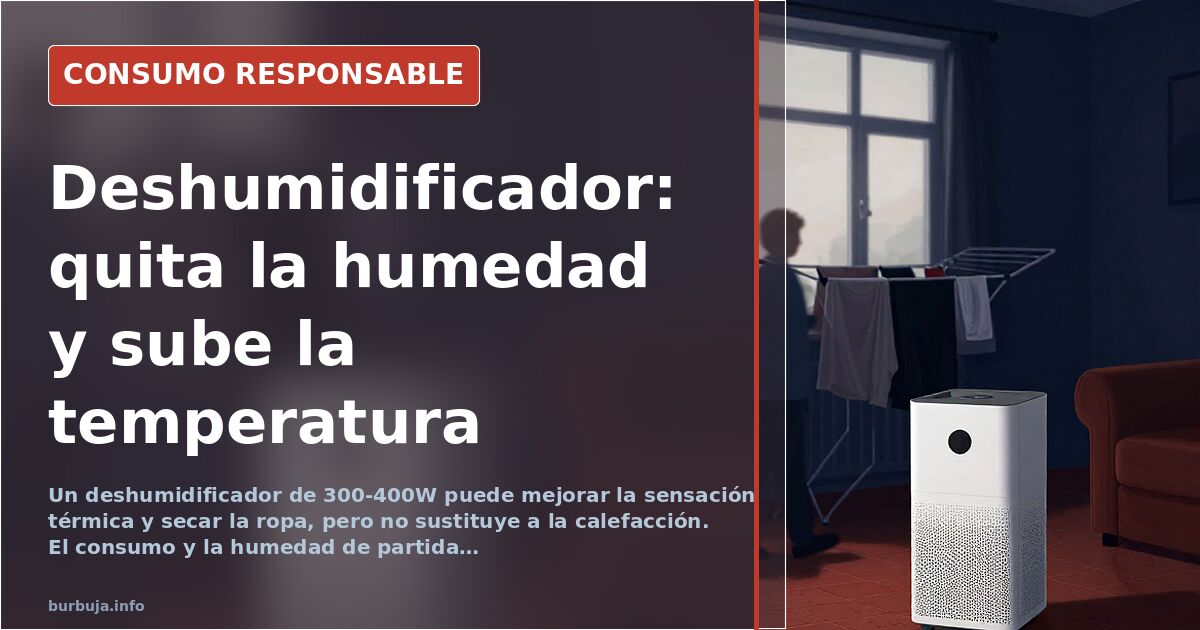
Dehumidifiers: how they make your home feel warmer and dry laundry
In a coastal home with high humidity but mild temperatures, a dehumidifier can do more for that cold feeling than many radiators. The idea is simple: when the air is damp, the body feels colder than the thermometer suggests, clothes seem wet and heating takes longer to warm the air. The question is whether a 300 to 400-watt unit can replace, at least in part, traditional heating. The recurring answer is nuanced: it helps, but it's no miracle worker.
What a dehumidifier actually does to the temperature
The physical principle behind the analyses is that warm air holds more moisture than cold air. When you heat a room, relative humidity drops and the perceived temperature improves. A dehumidifier condenses water from the air and, in the process, releases slightly warmer air. One widely shared calculation claims that each litre of condensed water releases about 0.63 kWh of heat, to which you add the energy the unit itself consumes. That makes it a more efficient heat source than a conventional electric heater, though far from a heat pump.
The experience of owners points the same way: the unit raises the room temperature by one or two degrees and, above all, changes how it feels. In a garage with 80-90% relative humidity, bringing it down to 50% makes the space seem heated even when the thermometer reads 12 or 13 degrees. In coastal homes, the effect shows less on the thermometer and more in your bones and your clothes.
Power consumption: the one point nobody disputes
There's no debate here. A domestic dehumidifier uses between 300 and 400 watts, based on the most common models, and some reach 0.8 kWh, like the one belonging to a participant from inland Asturias. That works out at about €0.10 per hour at the electricity prices discussed in the conversation. It's not a device to leave running all day if you want to save money.
The repeated advice is to use it for a few hours rather than continuously, except in basements or storage rooms where moisture returns as soon as you switch it off. In a normal home, one or two hours dry out the air and then you can turn it off. The exception is enclosed, very damp spaces, where the unit becomes a fixed expense.
Dehumidifier vs heating: when it's worth it
The consensus is that it doesn't replace heating, but it can reduce how much you use it. In coastal areas or humid valleys, where winter temperatures aren't extreme, some people claim dehumidifying alone is enough to stay comfortable. Inland, with harsh winters, the dehumidifier falls short: heating is still necessary.
The full calculation, with the watts, hours of use and price per kilowatt, yields a difference that surprises anyone doing it for the first time. It's not a revolutionary saving, but it is a complement that improves comfort without sending the bill soaring. The key lies in the starting humidity: the damper the house, the more noticeable the effect.
Other uses: drying laundry and removing damp smells
Drying laundry indoors is one of the most valued uses. Placed in a small, closed room, the unit speeds up drying within a couple of hours and fills the water tray quickly. It's not for every day, but it solves the problem when it rains for a week straight. It also removes the musty smell from wardrobes and rooms, a problem many find as annoying as the cold.
Compared with salt-based dehumidifiers, the electric one has more capacity and you don't have to replace the product every few weeks. The salt version costs about €3 and refills between €1.55 and €2.25, but its absorption power is limited. The electric one does use electricity, true, but you can also use the collected water to water your plants.
The alternative almost nobody disputes: ventilate and insulate
There's a school of thought that the problem isn't solved with gadgets but with insulation and ventilation. Ventilating for 15 minutes a day, when the outside temperature is lower than the inside one, renews the air and removes moisture without using electricity. Insulating the home well keeps heat in and moisture out. It's the most expensive solution at first, but the one that consumes the least afterwards.
In that context, a dehumidifier is a useful patch for those who can't or won't take on building work. Anyone with a damp, poorly insulated home will notice the unit working non-stop and using as much power as a fridge. Anyone with a dry, well-insulated home probably won't need one.
Is it worth buying a dehumidifier to fight the cold? It depends on the humidity in your home, the local climate and how patient you are with your electricity bill.
Also available in: Deutsch
Summary of a discussion on Burbuja.info - Foro de economía, actualidad y política., translated from Spanish and reviewed before publication. Read the full discussion (38 replies).
More summaries
-
Electric heater or heat pump: your winter bill decides
An electric heater turns every watt into heat. A heat pump can move up to four. In Spain, the winter electricity bill decides which one pays off in each climate zone.
-
Ducted heat pump burns through 1,000 kWh a month in a Spanish duplex
A new all-electric duplex in Spain with no gas connection: the ducted heat pump pushes consumption to 1,000 kWh a month in a cold area. Even a COP of 3.57 doesn't save the…
-
Heat Pump vs Radiator: Real COP Doesn't Match the Brochure
A user measures consumption similar to an electric radiator between 0 and 10 degrees. Some argue that catalog COP is not met in winter.
-
Heating oil: fill the tank now or wait?
Heating oil prices jump 7 cents in days: filling a 1,500-litre tank now costs over €100 extra. When it pays to wait.
-
Scrap metal and recovered paper prices and where to sell them in Spain
Find out current prices and selling points for scrap metal and recovered paper in Spain. Don't throw away waste without knowing what it's worth.
-
Water bills in Barcelona: the meter rental charge
Water bills in Barcelona: the annual €36.6 meter rental fee is examined, along with the lack of transparency from the company Musa.