
Degree-less Engineer at 40 Sparks Debate on Studying
A 40-year-old engineer without a degree reignites the debate on the value of higher education in Spain, questioning if it's worth it without civil service exams.
English · Original discussion in Spanish · Published
Studying Isn't Enough Anymore: The Case That Sparked the Debate
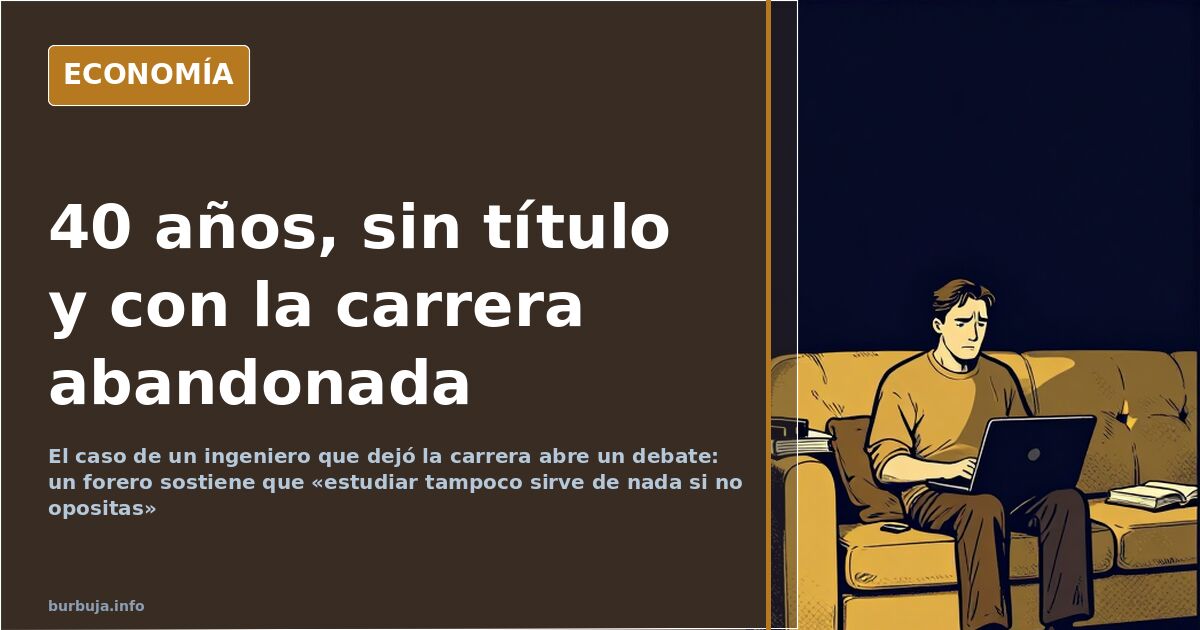
He enrolled in Industrial Engineering in Vigo, old curriculum, six courses. He had a MEC scholarship (Spanish Ministry of Education scholarship) and, with it, the obligation to pass a certain percentage of credits or lose it. He lasted two and a half years and quit. Today he's 40, unemployed, and writes that he chose the wrong career. His testimony opens a debate: is studying in Spain worth anything, or is it a lottery decided at 16?
A Degree No Longer Opens Doors on Its Own
There's no consensus, but a shared diagnosis: the market is flooded with graduates. One participant argues that the quality of education has declined and there are too many graduates for the available positions. Against the narrative that those who study succeed, an uncomfortable nuance emerges: without a degree, you're not even given the chance to prove what you know.
Personality weighs almost as much as academic record. Some argue that your given personal circumstances matter more than your CV, while others recall that having had few social skills as a youth hinders you more than never having set foot in a university. The recurring conclusion: working life is a constant struggle, and a degree only gives you the right to enter it.
Does a Plumber Earn More Than an Engineer?
The comparison circulates both ways and rarely adds up. It's claimed that self-employed tradespeople like plumbers or electricians earn more than most graduates. A participant's counterexample is specific: an electrician with over a decade of experience doesn't earn more than 23,000 or 24,000 euros gross annually, between 1,300 and 1,400 euros net per month. The idea that any smart tradesperson earns 3,000, 6,000, or 10,000 euros is directly described as a fantasy.
Most of these professions are salaried employment, with fixed hours and then home. Running your own business is the exception, not the rule. And the net tightens: it's noted that Spain is full of university graduates serving coffee while there's a shortage of bricklayers and plumbers, which undermines the argument that choosing a trade was enough.
Civil Service Exams as a Refuge for the Forty-Somethings
Here emerges the most repeated argument: studying isn't useful if you don't take civil service exams (oposiciones). One participant recounts that observing the exam candidates who were with him at university was enough to understand the method: same syllabus, same routines, and a one-and-a-half-hour break for breakfast before passing. His bitter conclusion: the hours he dedicated to his degree would have been enough for several exam preparations.
The problem is the biology of the working calendar. It's pointed out that after 45, Spanish companies stop hiring, pushing people towards public administration as the only stable refuge. And it doesn't always work: there are late career changes via vocational training, like someone who dropped out of school at 15, started vocational training in Switzerland past 30, and ended up with a better quality of life.
The Compound Interest Calculations Circulating
Midway through the conversation, the focus shifts from salary to wealth. A calculation is shared insistently: contributing 350 euros a month from age 25 to 50 would yield one million euros at 15% annual return, two million at 20%, and 4.5 million at 25%. The objection is quick: such sustained returns over 25 years are unrealistic and hide high risk. The prudent scenario is between 3% and 5%.
The lure is completed with copy-trading platforms. One participant promotes these products and cites returns from specific profiles that exceeded 30% annually for several consecutive years, with a peak above 45%; another participant directly calls it propaganda. The response from the other side is obvious: in the stock market, money isn't created, it changes hands, and with the market soaring, it's a bad time to jump in.
The Final Drift: Everything Ends Up in Housing
Although the thread started with studies, a good part of the final section fights over real estate. The question is why affordable public housing isn't built for workers on the outskirts of Madrid, payable in five years. The dominant answer on one side: it's not that there's a lack of land, it's that nobody wants to live an hour away from work.
The figure that is repeated, according to one participant, to settle the matter: there are over a million vacant homes in municipalities with over 50,000 inhabitants. With that figure on the table, building more sounds, according to this current, like a superficial solution. The paradox remains unresolved.
The initial question remains in the background, the one about being 40 and having regrets. Studying contributes, almost everyone agrees, if only to avoid being deceived. But guaranteeing, truly guaranteeing, it no longer guarantees almost anything. Not the degree, not the profession, not compound interest.
He enrolled in Industrial Engineering in Vigo, old curriculum, six courses. He had a MEC scholarship (Spanish Ministry of Education scholarship) and, with it, the obligation to pass a certain percentage of credits or lose it. He lasted two and a half years and quit. Today he's 40, unemployed, and writes that he chose the wrong career. His testimony opens a debate: is studying in Spain worth anything, or is it a lottery decided at 16?
A Degree No Longer Opens Doors on Its Own
There's no consensus, but a shared diagnosis: the market is flooded with graduates. One participant argues that the quality of education has declined and there are too many graduates for the available positions. Against the narrative that those who study succeed, an uncomfortable nuance emerges: without a degree, you're not even given the chance to prove what you know.
Personality weighs almost as much as academic record. Some argue that your given personal circumstances matter more than your CV, while others recall that having had few social skills as a youth hinders you more than never having set foot in a university. The recurring conclusion: working life is a constant struggle, and a degree only gives you the right to enter it.
Does a Plumber Earn More Than an Engineer?
The comparison circulates both ways and rarely adds up. It's claimed that self-employed tradespeople like plumbers or electricians earn more than most graduates. A participant's counterexample is specific: an electrician with over a decade of experience doesn't earn more than 23,000 or 24,000 euros gross annually, between 1,300 and 1,400 euros net per month. The idea that any smart tradesperson earns 3,000, 6,000, or 10,000 euros is directly described as a fantasy.
Most of these professions are salaried employment, with fixed hours and then home. Running your own business is the exception, not the rule. And the net tightens: it's noted that Spain is full of university graduates serving coffee while there's a shortage of bricklayers and plumbers, which undermines the argument that choosing a trade was enough.
Civil Service Exams as a Refuge for the Forty-Somethings
Here emerges the most repeated argument: studying isn't useful if you don't take civil service exams (oposiciones). One participant recounts that observing the exam candidates who were with him at university was enough to understand the method: same syllabus, same routines, and a one-and-a-half-hour break for breakfast before passing. His bitter conclusion: the hours he dedicated to his degree would have been enough for several exam preparations.
The problem is the biology of the working calendar. It's pointed out that after 45, Spanish companies stop hiring, pushing people towards public administration as the only stable refuge. And it doesn't always work: there are late career changes via vocational training, like someone who dropped out of school at 15, started vocational training in Switzerland past 30, and ended up with a better quality of life.
The Compound Interest Calculations Circulating
Midway through the conversation, the focus shifts from salary to wealth. A calculation is shared insistently: contributing 350 euros a month from age 25 to 50 would yield one million euros at 15% annual return, two million at 20%, and 4.5 million at 25%. The objection is quick: such sustained returns over 25 years are unrealistic and hide high risk. The prudent scenario is between 3% and 5%.
The lure is completed with copy-trading platforms. One participant promotes these products and cites returns from specific profiles that exceeded 30% annually for several consecutive years, with a peak above 45%; another participant directly calls it propaganda. The response from the other side is obvious: in the stock market, money isn't created, it changes hands, and with the market soaring, it's a bad time to jump in.
The Final Drift: Everything Ends Up in Housing
Although the thread started with studies, a good part of the final section fights over real estate. The question is why affordable public housing isn't built for workers on the outskirts of Madrid, payable in five years. The dominant answer on one side: it's not that there's a lack of land, it's that nobody wants to live an hour away from work.
The figure that is repeated, according to one participant, to settle the matter: there are over a million vacant homes in municipalities with over 50,000 inhabitants. With that figure on the table, building more sounds, according to this current, like a superficial solution. The paradox remains unresolved.
The initial question remains in the background, the one about being 40 and having regrets. Studying contributes, almost everyone agrees, if only to avoid being deceived. But guaranteeing, truly guaranteeing, it no longer guarantees almost anything. Not the degree, not the profession, not compound interest.
Summary of a discussion on Burbuja.info - Foro de economía, actualidad y política., translated from Spanish and reviewed before publication. Read the full discussion (274 replies).
More summaries
-
Spanish Medical Training Under Scrutiny Abroad
Spanish doctors in Germany question the value of their training, citing low salaries and universities outside the top rankings.
-
Supreme Court Halts Electoral Registry for 'Grandchild Law' Nationals
The Supreme Court has suspended inscriptions in the electoral census of those naturalized under the 'grandchild law.' Over 400,000 applications are now suspended.
-
Euthanasia in Old Age: Autonomy vs. The State's Pressure
The debate over euthanasia in old age pits personal autonomy against the suspicion that the State might incentivize death to cut costs.
-
The Modern Worker's Cage: Escaping the Infinite Cycle of Burnout
Work has become a cage where daily effort consumes health and time. Discover why we push ourselves so hard and how to break the cycle.
-
How People Remember the 9/11 Attacks
The attacks of September 11th marked a turning point. Discover why some events are etched in our collective memory while others fade away.
-
Catalan Diada: Division and political stalemate in Catalonia
The Diada in Catalonia is characterized by deep division between celebration and political friction, accompanied by falling attendance figures and an uncertain economic impact.