
Decathlon and textile deflation: €3 t-shirts and €14 sweatshirts
€3 t-shirts and €14 sweatshirts at Decathlon: the debate over how much labour weighs in the price and why cotton doesn't guarantee quality
English · Original discussion in Spanish · Published
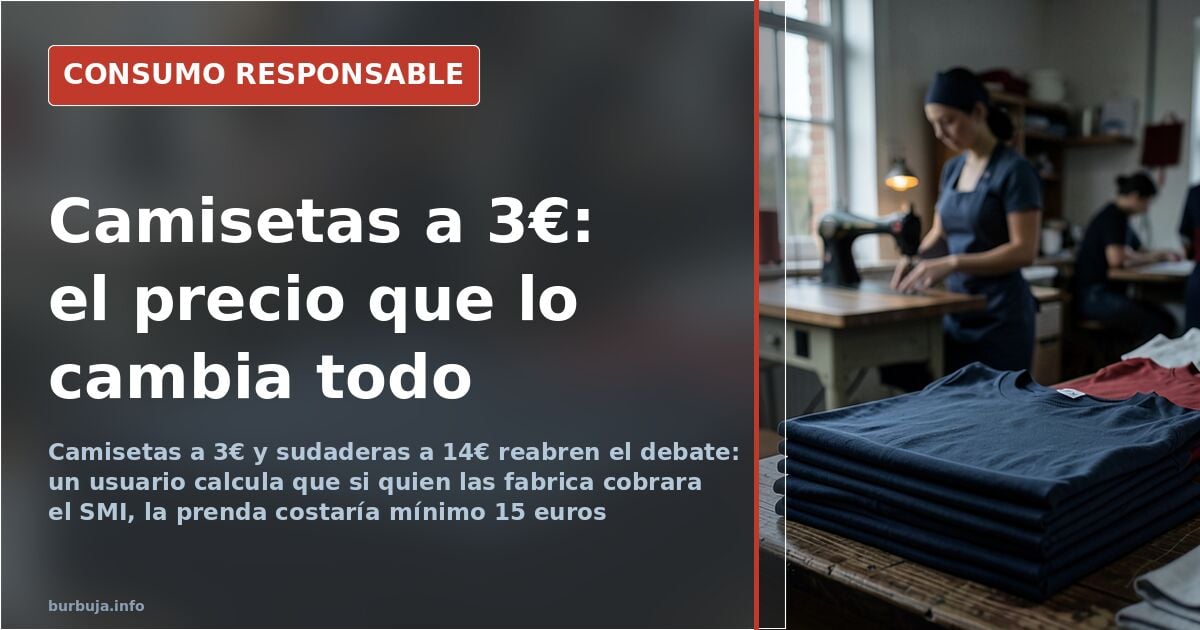
€3 t-shirts and €14 sweatshirts: the price that doesn't add up
How can a cotton t-shirt cost three euros and a sweatshirt fourteen? It's the question that hangs over any visit to Decathlon and the one that sparked the conversation: basic garments at prices that seem like fire-sale levels, with the 100% cotton label as the selling point. The short answer is that the price doesn't measure the quality of the fabric, but where and how it was made. The long answer involves machines, containers and wages that never appear on the label.
The starting point is a photo: t-shirts at €3, sweatshirts at €14, cotton. From there, the analysis splits between those who see a bargain and those who see the symptom of something worse.
How much labour weighs in a €3 t-shirt
A calculation circulating in the conversation holds that sewing a basic knit t-shirt takes between 10 and 15 minutes of direct work in a large factory, counting cutting, sewing, finishing and inspection. With a minimum textile wage in Bangladesh of around 12,500 taka a month —about €100— and long shifts, the sewing labour would come to roughly €0.10 to €0.20 per unit. In other words, the operator's wage would barely move the needle on the final price.
That's why the claim that the people making these garments earn the Spanish minimum wage is, with those numbers on the table, hard to sustain. Production is outsourced precisely because of the brutal cost savings it brings. And that's not an opinion: it's the model.
Cotton is not a single category
Within cotton there are thicknesses, thread counts and treatments. A t-shirt can be 100% cotton and be paper-thin, soft to the touch and fall apart on the third wash. The percentage indicates composition, not the quality of the fabric or the finishes applied on top. Some argue that certain garments declare pure cotton while hiding finishes that appear on no label.
The practical consequence is that a low price doesn't always miccionan poor quality, but it doesn't guarantee quality either. Accumulated experience points to inconsistent batches: garments that last twenty years and runs of the same model that fall to pieces. Variability is the norm.
Sizes that don't fit and the store maze
One of the most concrete points is the sizing mismatch: an M that looks like an XL, another that looks like an XS, sleeves that reach the elbow, hems with loose threads. Regular buyers recommend going up one size on sweatshirts, because the cut runs narrow. Quality, they say, varies a lot from garment to garment: some models have improved and others have gotten worse.
Add to that the shopping experience: the maze-like layout, the self-checkout and the feeling that the brand has lost its way. Against that, others argue the store is still full and the queues to pay in cash haven't disappeared.
The alternatives: Primark, Lidl, Alcampo and the second-hand market
The comparison is inevitable. T-shirts at €2 at Primark, €2.50 at Pepco, sweatshirts at €11, fleeces at €9 at Lidl. And for those looking for brands, the second-hand market: garments from expensive labels at rock-bottom prices. The question left hanging is whether the saving justifies the hidden cost.
The deeper debate: who pays for the low price
The discussion drifts toward responsible consumption. Buying a product means endorsing what's behind it. If cheap production is rewarded, quality clothing that used to last a decade is punished. Textile deflation isn't an isolated phenomenon: it's a collective choice with diffuse consequences.
And meanwhile, the €3 t-shirt is still on the shelf. Cotton is cotton. Everything else is interpretation.
Also available in: Deutsch
Summary of a discussion on Burbuja.info - Foro de economía, actualidad y política., translated from Spanish and reviewed before publication. Read the full discussion (86 replies).
More summaries
-
Primark vs Kiabi: The Reality of Cheap Fast Fashion Quality
Primark and Kiabi compete for the title of worst fast fashion brand, with durability varying wildly by batch rather than label.
-
Decathlon's 12.99 euro sneakers: false economy?
Decathlon's cheapest sneakers promise two years of daily wear. Are they worth it compared to Lidl's 17 euro pair with gel? We look at the value for money.
-
Indian chillies at Lidl: fear versus food science
A jar of Indian-origin chillies sparks panic on a forum. Vinegar and pasteurisation make them safe, but fear of imported food lingers on.
-
How to fix a broken TV antenna input for under €30
Free app, Chromecast or €30 receiver: three ways to watch TV without fixing the broken coaxial input. The cheapest costs zero euros.
-
Oikos isn't Greek yogurt: the legal loophole that allows it
Authentic Greek yogurt is made by straining the whey; the rest add cream or starch. Spain's Real Decreto 271/2014 does not protect the term, so any brand can…
-
Simple trick to make frying healthier
An analysis claims that adding rosemary when frying cuts the formation of harmful compounds by up to 74% and reduces oil oxidation. Here's what's behind it.