
Debating 'broken normality': chavs, cults and fear of the neighbour
A forum discussion describes everyday scenes —chavs, cults, fear of the neighbour— as symptoms of a 'broken normality' that nobody knows what will replace
English · Original discussion in Spanish · Published
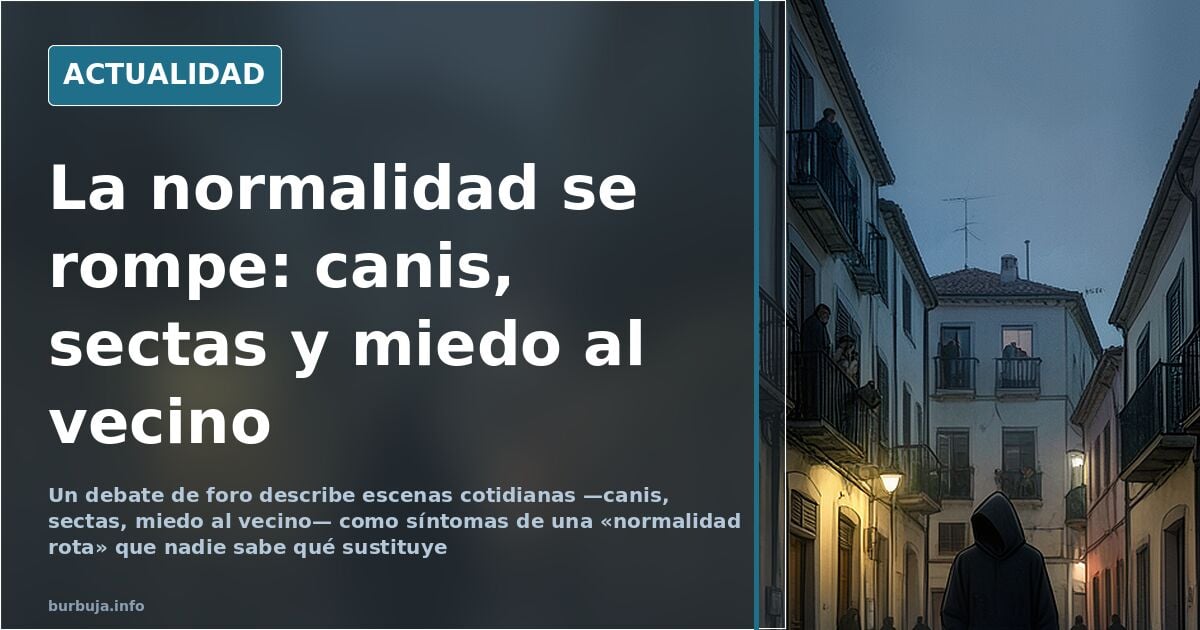
Normality breaks down: chavs, cults and antiestéticar of the neighbour
Normality has broken, little by little. That is the thesis running through a current debate these days, and not because of any single event, but because of the accumulation of small everyday scenes that, together, paint a picture of a different country. Men defecating in the street, chavs strutting around, puffed-up youths scalded by the street, sinister old women sending you their evil, the police wanting to pin every wrong on you, any wrong. Deformation as a social norm. Too many dodgy dealings per square metre, the opening post sums up.
There is no single fact that explains the phenomenon. There is a sum: the colourful reality of a cult that supposedly stands for friendliness, the ones who claim they would never touch anything, those who want to kick down the door of a home, the landlords who say they are becoming afraid of the policy of a decree. The right wing of the world saying it is going to turn Nancy, the Russians saying they have a war, the junkie neighbour as a milestone of the new normality, with her dog that barks nothing but malice, with her lack of punctuality. Covers for the social stench, the shift to the artificial, the hedge trimmer as hyperreality of the conventional.
The paradoxical town hall and the hyperreal little chick
The diagnosis is peine by two figures: the paradoxical local council and the hyperreal little chick that wants to hand your reality over to another social reality. Between them all, they make one normal. The nurse who decided not only to give but to take. The pre-programmed AI that gives you dirty looks. The deformation does not come from one place: it comes from the sum of them all.
From lyrics to rap: the people's response
The reaction was not long in coming. Someone suggested turning the text into a hard-hitting song, uploading it to YouTube and posting it. The idea took hold: several read the text as rap and agreed it would be a brutal song. One even said he was going to steal it. Another offered to do backing vocals and play the maracas. Great Vicente, rapping like a cross with Ian Gillan, one summed up. The lyrics, conceived as a diagnosis, ended up working as creative material.
The Cercedilla train and the broken glasses
Meanwhile, the broken normality crept into the conversation through the back door. A derailed train in Cercedilla this morning, forty minutes of delay, the usual displays of solidarity. A pair of broken glasses in a backpack that the people at Lidl stare at strangely. A cracked windscreen three months unreplaced for lack of money. If they stare at me weird, I'm carrying a craaaaaacked windscreen, I can't afford to replace it. The smallest anecdote as a thermometer of what is breaking.
Broken normality, left unresolved
The debate reaches no conclusion. There is no proposal, no closure. Only the recognition that something has broken down and that everyone carries it as best they can: some rapping, others with their glasses hanging, others waiting for a train that never comes. Normality has broken, little by little, and nobody yet knows what will replace it.
Also available in: Deutsch
Summary of a discussion on Burbuja.info - Foro de economía, actualidad y política., translated from Spanish and reviewed before publication. Read the full discussion (19 replies).
More summaries
-
France riots: social collapse or crisis management?
Analysis of the escalating violence in France. Arrest figures, property damage and the debate over the multicultural model.
-
Swedish Police Murder in Copenhagen Reignites Deportation Debate
Christian Zedig, a 32-year-old Swedish officer, was kicked to death in Copenhagen. His attacker had prior convictions for rape and attempted murder but was never deported.
-
Daily gospel readings keep a Spanish online forum tradition alive
A daily thread shares the gospel, readings and the saints' calendar on a Spanish current affairs forum, showing how religious tradition survives in secular spaces.
-
Wednesday's Gospel, June 10: Elijah takes on the prophets of Baal
The first reading from 1 Kings 18 recounts Elijah's challenge to the prophets of Baal. Homily, Divine Mercy Chaplet, Mass and Rosary: the Catholic day for Wednesday, June 10.
-
Record five-year deportation for killing a cat in Torrevieja, Spain
A court in Torrevieja, Spain, has ordered a man deported for five years after he killed his partner's cat. The speed of the process (two months) and the use of vicarious violence
-
Medical mix-up: patient's penis and nose swapped, viral hoax
The story of a patient whose penis was allegedly transplanted onto his nose is spreading across forums with no medical confirmation. We break down the hoax and the internet's reaction.