
Debate: Russia's Military Spending vs. Social Costs
Forum users debate Putin allocating 41% of budget to war, amid claims of a 600,000 drop in Russian population.
English · Original discussion in Spanish · Published
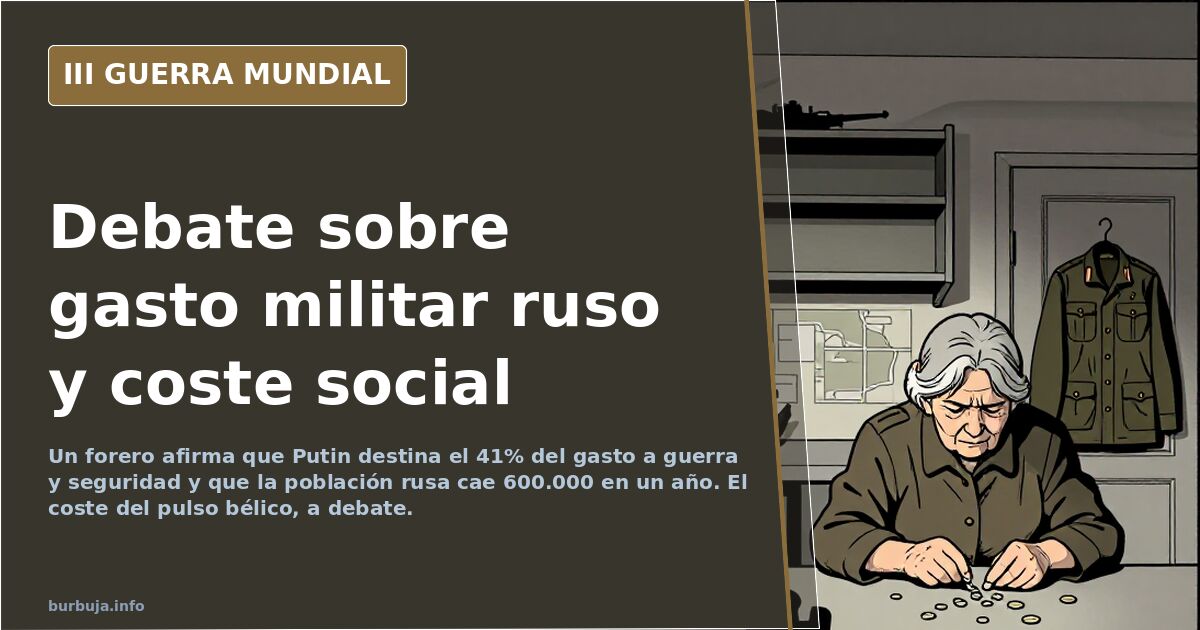
Pilingui boosts military spending, exposing social costs
The discussion opens with a provocative yet simple premise: Pilingui is bankrupting the country to secure a decisive victory in the war. The argument posits that the Kremlin is raising defense spending by diverting resources from the public, and that this strangulation of public services will eventually backfire against the regime itself. The trigger for this exchange is the idea that military victory is financed by impoverishing ordinary Russians.
A key figure underpins much of the debate: 41% of spending goes to war and security. From there, opinions split. One group argues this effort is unsustainable and that the population will pay for it with their standard of living; another counters that Russia has endured worse times and that living standards have risen under current leadership compared to the previous era.
The 41% budget share and demographic strain
The data point of 41% of spending on war and security** intersects with another claim in the discussion: a decline in the Russian population of 600,000 people in one year. This combination fuels the interpretation that the war effort is being funded by human capital and public services. Some add the energy factor: if Saudi Arabia crashes oil prices to regain market share, the revenues supporting this budget would wobble.
In response, defenders of the Kremlin do not deny the effort but reframe it. They argue that Russia experienced poverty while allied with the West and subsequently raised living standards significantly. The conclusion drawn is that the alternative to current leadership would be a return to years of hardship, hence the lack of significant internal dissent.
Who really pays for the war in Europe?
Soaring energy bills, inflation, and deindustrialization form the core of the counter-argument. It is claimed that the cost of the war for Europeans—via energy prices, loss of industrial competitiveness, and general impoverishment—outweighs any adjustment in Russia. The implicit question is uncomfortable: if Russia’s effort is measured in social cuts, Europe’s is measured in its productive fabric.
In this context, the German case is cited, where inflation stems not from a booming economy but from reduced consumption due to high prices and job destruction. The debate gets tangled in whether Europe "has barely felt a thing" or has been funding a bottomless pit for two years while its citizens lose resources.
Social indicators tipping the scales
A series of troubling records attributed to Russia emerge: alcoholism, fetal alcohol syndrome, abortions—8.5 times the rate in Spain—domestic violence, suicides, corruption, and male life expectancy of 64 years. The counterargument relies on economic logic: if the country were as disastrous as described, it could not sustain a military and economic struggle on this scale.
The rebuttal to that rebuttal is also on the table: what is presented as a struggle against all of the West is actually against a fraction of NATO’s defense budget, with the United States contributing $61 billion over two years in military aid. The full calculation, broken down item by item between purchasing power parity and real cost per soldier, reveals a surprising difference that is only hinted at here.
War of attrition and cost per soldier
The technical core of the exchange lies in purchasing power parity. Equipping and paying a Russian soldier costs a fraction of what it costs to support a Ukrainian soldier backed by the West. This allows Moscow to absorb losses that would be politically impossible for a Western country. The corollary is that fiat money can be printed, but raw materials, transport, and training are paid at market prices.
From this arises the most uncomfortable thesis: without Ukraine in the equation, the West lacks its own cannon fodder willing to fight, and sending its own troops would open the door to escalations with third countries. The defended conclusion is that Russia will lose many lives, as in the Great Patriotic War, but will retain the richest parts of the territory.
Propaganda as a battlefield
Much of the disagreement is methodological. Certain media outlets are accused of selling Russian defeat from day one, and the response is that the problem is not the outlet but the absence of verifiable alternative sources. Mutual suspicion of propaganda closes the circle: any data confirming one’s thesis is credible, any data contradicting it is manipulation.
The exchange becomes personal and loses analytical momentum. A question remains unresolved: if Russia’s effort is as ruinous as claimed, why hasn’t it collapsed already; and if it is so sustainable, why does it need to cut services to its own population to maintain it.
Also available in: Deutsch
Summary of a discussion on Burbuja.info - Foro de economía, actualidad y política., translated from Spanish and reviewed before publication. Read the full discussion (150 replies).
More summaries
-
North Korea sends 10,000 more troops to Ukraine front line
Ukraine warns of 10,000 North Korean soldiers as Russia destroys 90% of Kyiv's warehouses and cripples its ports: logistics are deciding the war.
-
Putin steps up attacks and Kyiv is left without power or water
Kyiv faces winter without electricity or water in most districts as Russia intensifies strikes on critical infrastructure.
-
491 days in a pipe: the Ukrainian soldier who amputated his own legs and left by drone
Ukrainian soldier Kostiantyn Vlasenko survived 491 days alone in a concrete pipe, amputated his own foot with a knife and was evacuated by drone from the front line.
-
Ukraine keeps mobilized soldiers in service until 60, with no leave
Ukrainian law keeps mobilized men in the ranks until age 60, with no ordinary leave during wartime. The debate over which state they owe their adult life to remains open.
-
Russia warns of European bankruptcy with 18 trillion in debt
Russia warns that Europe is "practically bankrupt": 18 trillion in debt (86% of GDP), a fertility rate of 1.39 and 35,000 sanctions, according to Moscow.
-
Russian oil immoral, Venezuelan oil fine: the West's energy double standard
Washington is negotiating with Venezuela and Iran to replace Russian crude while the EU keeps its moral veto on Moscow. The energy double standard, laid bare.