
Debate over vet assistant's uniform in Spain's viral ad
The figure of the veterinary assistant in an ad from a Spanish clinic chain has sparked comments ranging from fascination to suspicion. The uniform is at the center of the debate.
English · Original discussion in Spanish · Published
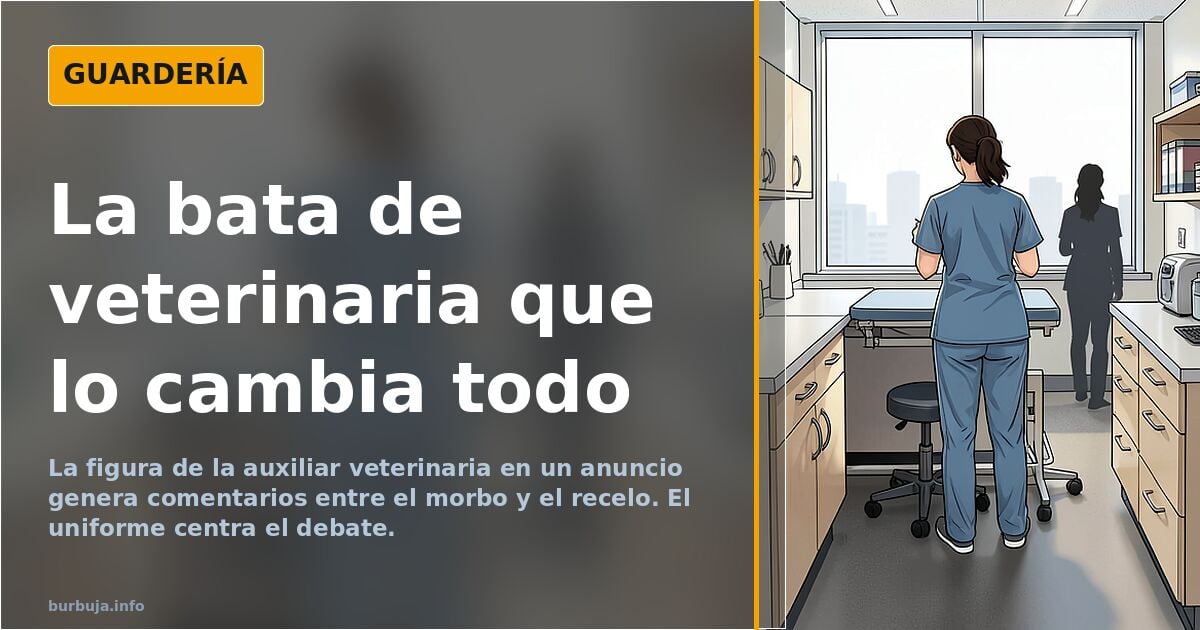
The vet assistant's uniform taking over the airwaves
A clinical coat, a dog and a camera. With those three elements, a chain of veterinary clinics has achieved what many million-euro campaigns fail to do: half of Spain remembers the ad. The figure of the veterinary assistant has taken hold of the collective imagination with a mix of fascination and suspicion that says more about the viewer than the profession. The uniform does the rest.
Why the nurse-style uniform drives interest
It is not the first time a healthcare uniform has caused a stir. The association between a coat, authority and desire is a classic of popular imagination, and the veterinary sector has exploited it with a naturalness that borders on brazenness. Some argue the ad works precisely for that reason: for the titillation of watching a professional handle clinical instruments with an aesthetic that recalls a hospital nurse. The thermometer detail, which comes up in more than one conversation, is no accident.
The conversation soon drifted into personal territory. One comment describes the experience of taking a dog to a clinic and finding a vet who, according to the account, was "gorgeous" and got him "all worked up." The story, which could remain a bar anecdote, sums up the ad's mechanism: the professional as an object of desire, the client as a passive spectator.
From titillation to suspicion: the other side of the coat
Not everyone buys the story. One strand of opinion warns that the veterinary assistant is not just an aesthetic figure: she is in charge of neutering, injecting and performing procedures the client does not always understand. "She helps neuter a lot of them," one comment sums up. The joke has depth: the same person who fuels fantasies is the one wielding the scalpel.
The distrust reaches extremes bordering on parody. Some describe the professional as a kind of witch who will inject poisons into the dog and cut it open and sew it back up with the sole intention of practicing her witchcraft, charging acompañante rates. The exaggeration is obvious, but the underlying message connects with a real concern: the gap between the advertising image and the reality of the job.
The new ad and the coat that never changes
The campaign has continued. A new ad keeps the same aesthetic, just as controversial for some and effective for others, with more coats and less dog. The formula is not wearing out: uniform, attractive professional, close-up camera. The result is the same as always, a debate that repeats every time a coat appears on screen.
The thermometer detail, which carries connotations in popular imagination that need no explaining, appears in more than one comment. The scene lends itself to easy jokes, but also to an uncomfortable reflection: the objectification of a profession that, in real life, faces long shifts, nervous clients and clinical decisions that brook no jokes.
What the uniform hides
The veterinary assistant is a professional figure with specific training, not a stage prop. The campaign knows it and plays with the ambiguity. The viewer knows it too, and still keeps watching. The question is not whether the ad is sens or not, but why it works so effectively, time after time.
With the coat as the star, the conversation will keep revolving around the same axis: titillation, suspicion and laughter. The next campaign will probably repeat the formula. And so will the viewer.
Also available in: Deutsch
Summary of a discussion on Burbuja.info - Foro de economía, actualidad y política., translated from Spanish and reviewed before publication. Read the full discussion (23 replies).
More summaries
-
Man, 49, asks how to steal pentobarbital from a vet clinic
A 49-year-old man with no job, family or partner asks how to steal pentobarbital from a veterinary clinic; the response mixes dark humour and advice on…
-
Medical conferences: infidelity, drugmakers and OnlyFans
Industry accounts say healthcare settings and medical conferences host many of the extramarital affairs that are talked about in the sector.
-
Debate Over Iker Jiménez's Café Ad Featuring Model Linked to J.J. Abrams
An ad for Iker Jiménez's coffee brand sparks online debate, with claims the model is J.J. Abrams's daughter and criticism of her appearance.
-
Ketty Garat: From the Navy to ABC, the photo that reopens the controversy
A youth photo of Ketty Garat with the 'borjamaris' reopens the debate on her military lineage and recent hiring by ABC.
-
Matchday 3 - Deluxe Tournament 6 (strategy picks) [SPAIN]
Discover the football tactics that bend the rules, from doubling goals to wiping out your rivals. Which one will you pick?
-
Master SAIMON. He likes sticking things up his butt.
What does "derroción" mean in the Saimon context? We analyze the origin and possible meaning of this term at the daycare.