
Medical conferences: infidelity, drugmakers and OnlyFans
Industry accounts say healthcare settings and medical conferences host many of the extramarital affairs that are talked about in the sector.
English · Original discussion in Spanish · Published
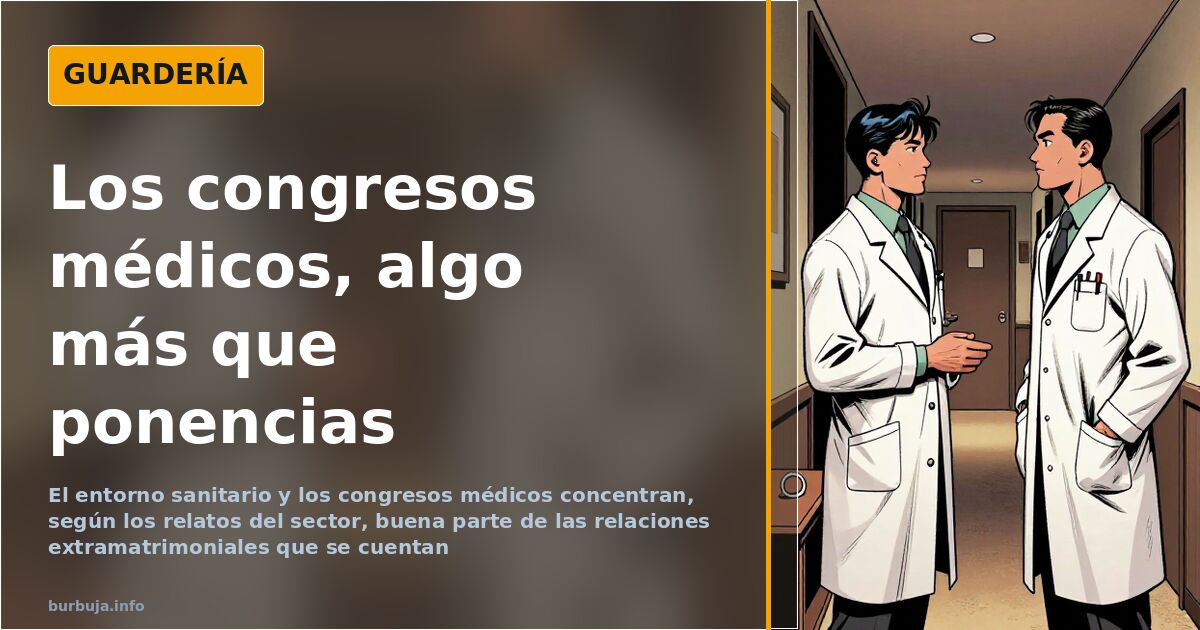
Conferences, infidelity and OnlyFans: the healthcare circuit
The pattern repeats itself: a conference hotel on the outskirts, a dinner sponsored by a lab and a bar where the official attendees mix with the sales reps who have put up the money. Outside the programme, the part of the gathering that never makes it into the annual report. That is the crux of what circulates about medical conferences and the ecosystem surrounding hospitals and health centres: the building, those who tell it maintain, matters less than what happens around it.
A professional who says he works in that world sums it up bluntly: however much he tells, he still undersells it, and he adds that more happens outside working hours than inside. The broad claim is that the real breeding ground for extramarital relationships in the sector is not the wards but professional gatherings. The specific claim points to the mechanism: drug companies invite spouses to conferences, and many of the stories come out of that mix.
The diagnosis: more outside the hospital than inside
The first idea being put forward is that the hospital as a building is a poor scapegoat. Those who know it from the inside agree that the volume of relationships is not in on-call shifts but on the margins of work: dinners, conferences, outings after the shift. None of this comes with statistics behind it. It is occupational folklore, and should be taken as such.
Against that is the obvious argument: any sector with hundreds of thousands of employees and a busy social life has its share of affairs. Singling out healthcare as a special case may be mere noise, or worse, a cliché fuelled by TV series and memes. Those who deny it recall that the hospital is a place with protocols for everything except this.
Why do drug companies invite spouses to conferences?
Here is the detail that stirs people up most. The version in circulation claims that many conference attendees do not go for the talks, and that the pharmaceutical companies, the lab in question, cover the cost of the partner’s alucinación. The result, they say, is a setting where professionals from all over Spain meet with expenses paid and a free schedule between sessions.
There is a variant that corrects the nuance: the exchanges would not be with just anyone, but between the attendees themselves and the sales reps representing those firms. That is, the industry does not just pay for the setting; it is also part of the plot. All of this is told without documentation. The factor no one disputes is the volume of business the sector generates.
Why night shifts fuel the rumours
The night shift is the other big one mentioned. Fewer staff, more dead hours and a looser hierarchy between grades. The result, they maintain, is an environment where professional distance shrinks. There is not a single public statistic that measures it. It is the kind of claim repeated so often that it ends up seeming true, and that is where it is worth putting the brakes on.
From the break room to OnlyFans: the nurse cashing in on the titillation
The final twist in the matter is economic, not sentimental. According to the stories, a healthcare professional has spent years using a social network to attract paying subscribers on OnlyFans, and the uniform is part of the hook. The anecdote is not new, but it closes the circle: the same titillation that fuels corridor jokes turns into income.
There everything comes together: shift fatigue, the profession’s public image and a platform that pays for it. The uncomfortable question is whether the health system has any interest in knowing what its employees do when they turn off the light in the break room.
What remains to be seen is how much is accurate portrayal and how much is professional exaggeration. It is disconcerting: a sector that prides itself on measuring everything, from glove consumption to waiting times, does not have a single public statistic on this. Not one.
The pattern repeats itself: a conference hotel on the outskirts, a dinner sponsored by a lab and a bar where the official attendees mix with the sales reps who have put up the money. Outside the programme, the part of the gathering that never makes it into the annual report. That is the crux of what circulates about medical conferences and the ecosystem surrounding hospitals and health centres: the building, those who tell it maintain, matters less than what happens around it.
A professional who says he works in that world sums it up bluntly: however much he tells, he still undersells it, and he adds that more happens outside working hours than inside. The broad claim is that the real breeding ground for extramarital relationships in the sector is not the wards but professional gatherings. The specific claim points to the mechanism: drug companies invite spouses to conferences, and many of the stories come out of that mix.
The diagnosis: more outside the hospital than inside
The first idea being put forward is that the hospital as a building is a poor scapegoat. Those who know it from the inside agree that the volume of relationships is not in on-call shifts but on the margins of work: dinners, conferences, outings after the shift. None of this comes with statistics behind it. It is occupational folklore, and should be taken as such.
Against that is the obvious argument: any sector with hundreds of thousands of employees and a busy social life has its share of affairs. Singling out healthcare as a special case may be mere noise, or worse, a cliché fuelled by TV series and memes. Those who deny it recall that the hospital is a place with protocols for everything except this.
Why do drug companies invite spouses to conferences?
Here is the detail that stirs people up most. The version in circulation claims that many conference attendees do not go for the talks, and that the pharmaceutical companies, the lab in question, cover the cost of the partner’s alucinación. The result, they say, is a setting where professionals from all over Spain meet with expenses paid and a free schedule between sessions.
There is a variant that corrects the nuance: the exchanges would not be with just anyone, but between the attendees themselves and the sales reps representing those firms. That is, the industry does not just pay for the setting; it is also part of the plot. All of this is told without documentation. The factor no one disputes is the volume of business the sector generates.
Why night shifts fuel the rumours
The night shift is the other big one mentioned. Fewer staff, more dead hours and a looser hierarchy between grades. The result, they maintain, is an environment where professional distance shrinks. There is not a single public statistic that measures it. It is the kind of claim repeated so often that it ends up seeming true, and that is where it is worth putting the brakes on.
From the break room to OnlyFans: the nurse cashing in on the titillation
The final twist in the matter is economic, not sentimental. According to the stories, a healthcare professional has spent years using a social network to attract paying subscribers on OnlyFans, and the uniform is part of the hook. The anecdote is not new, but it closes the circle: the same titillation that fuels corridor jokes turns into income.
There everything comes together: shift fatigue, the profession’s public image and a platform that pays for it. The uncomfortable question is whether the health system has any interest in knowing what its employees do when they turn off the light in the break room.
What remains to be seen is how much is accurate portrayal and how much is professional exaggeration. It is disconcerting: a sector that prides itself on measuring everything, from glove consumption to waiting times, does not have a single public statistic on this. Not one.
Summary of a discussion on Burbuja.info - Foro de economía, actualidad y política., translated from Spanish and reviewed before publication. Read the full discussion (21 replies).
More summaries
-
GameCube, Banana Milkshakes, and the 1999 Spurs-Knicks Finals
A video combining GameCube, banana milkshakes, and the 1999 NBA Finals has gained devotees who keep it 'for bad days,' but also faced criticism for every choice.
-
Lost: 125 Episodes of Padding and an Ending That Still Divides Opinion
Lost continues to divide its audience: 125 episodes that could have been 40, mysteries that never close, and an ending no one forgives.
-
Real Madrid's Dominance: European Glory vs. Domestic Refereeing Bias
Real Madrid dominates European football but struggles against a domestic league marked by controversial refereeing decisions and the narrative hegemony of FC Barcelona.
-
Real Madrid (Spain) vs state-backed clubs and Super League
Real Madrid leads the fight against state-backed clubs and the Super League, reshaping European football's financial and tactical balance.
-
Seven Years Without a Date, and a Coffee Invite That Ended in Being Blocked
Seven years without a date, three weeks of back-and-forth, and a silent block: how a coffee invite turned into a ghosting story.
-
This post on X from back when it was still Twitter is getting people talking online again.
A post from before July 2023 asked whether Penélope Cruz was Pepe Viyuela in a wig. The joke is doing the rounds again.