
Debate on European sovereignty and its dependence on the US
A forum discusses whether Europe has lost its own voice vis-à-vis the US and whether its economic weight is declining against emerging powers.
English · Original discussion in Spanish · Published
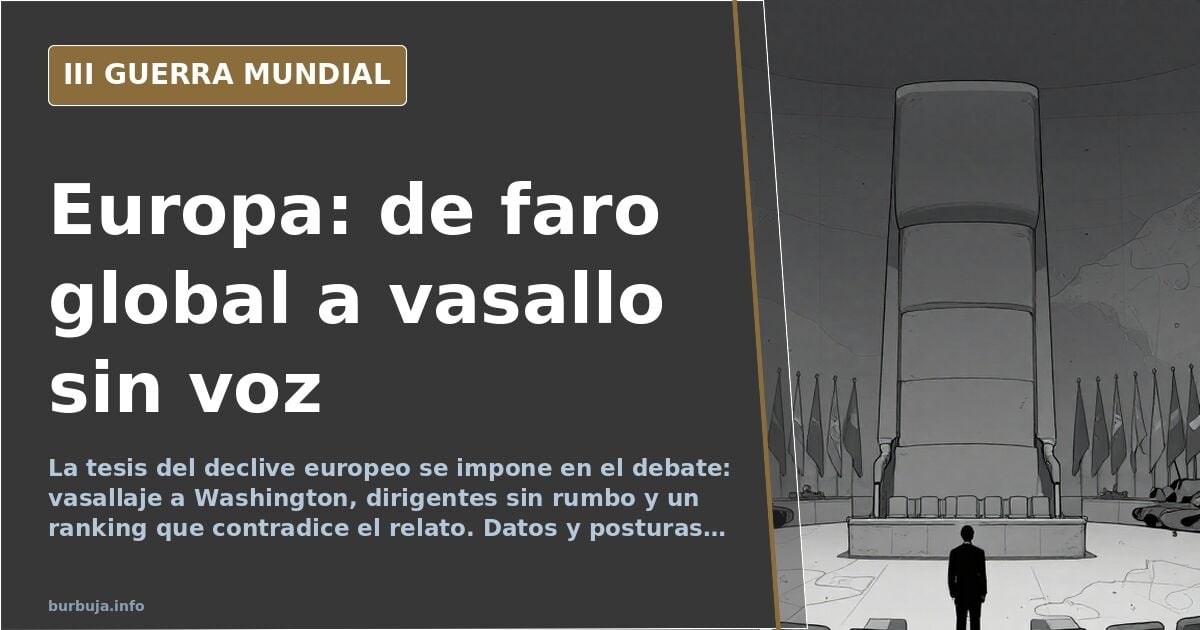
Europe, between vassalage to the US and decline
A continent that was a global reference for centuries faces an uncomfortable debate: is it still a power with a voice of its own, or has it become a protectorate carved up by others? The discussion starts with a provocative thesis —Europe as the laughingstock of the world— and quickly shifts to a more concrete issue: the loss of sovereignty to the United States and the energy and trade dependence on powers that were once peripheral.
The core of the problem is not cultural, it is about power. Part of the analysis argues that Europe has no voice of its own on the international stage and that Washington uses it at its convenience, keeping military bases on European soil while negotiating with Moscow and Beijing as equals. The consequence, according to this reading, is an EU that deters no one and watches conflicts as a spectator.
Why is Europe said to be a US protectorate?
Since the end of World War II, Europe's security architecture has depended on NATO and, by extension, on the American military umbrella. That bond, presented for decades as a guarantee, is today interpreted by part of the analysis as a relationship of subordination. The presence of US military bases in European countries is cited as proof of that dependence, not as mere defensive cooperation.
The argument is reinforced by the idea that Washington respects those who can stand up to it —Russia and China, according to this view— and dismisses those who cannot. The question hovering over the debate is whether Europe has any real capacity to decide its own foreign policy or whether, on the contrary, it executes other people's interests. La grandeur, the French historical attempt at strategic autonomy, appears in the discussion as a failed or at least insufficient effort.
Economic decline and the loss of global influence
The second major block of the debate is economic. It is argued that European countries lived for decades off other people's resources and markets, and that this model is running out. The emergence of powers able to trade directly with each other reduces Europe's room for maneuver, as it can no longer impose conditions on raw material supplier countries.
At this point a recurring accusation appears: that France funds opposition groups in Africa to recover lost positions. It is a claim that circulates in the debate without documentary evidence, and it should be treated as a hypothesis, not a proven fact. What is a fact of the thread: 2030 is set as the horizon by which Europe would become increasingly unnecessary in the world economy, and the war in Ukraine is said to have accelerated that process.
Is Russia Europe's natural ally?
One of the most repeated theses is that Russia would be the continent's logical partner, with obvious energy and trade synergies. That alignment would harm the United Kingdom, singled out as the historical enemy, and secondly the US. The geopolitical logic is clear: Moscow needs buyers and Europe needs cheap energy.
The problem is that this hypothesis clashes with the reality of the war in Ukraine and with the current security design. Those who defend the Russian path argue that Europe has allowed itself to be dragged into a conflict that was not its own. Those who reject it point out that Moscow is not a reliable partner and that its model is that of a nineteenth-century power. The disagreement has not been resolved.
The energy cost and the bill citizens pay
A third focus, more tangible, is the pocketbook. It is claimed that the US will buy Russian diesel and resell it to Europe's 450 million people at double the price. It is a prediction, not a confirmed fact, but it illustrates the antiestéticar that energy dependence will translate into a higher bill for the European consumer.
Irony runs through this section: while sovereignty and power are being debated, the average citizen faces energy prices they do not control. Interesting times, one participant sums up, with all the ambiguity the phrase carries.
The quality-of-life story versus the perception of decline
Against the pessimism, another current argues that Europe remains the region with the best quality of life on the planet. International rankings are cited that place Switzerland, Denmark, Sweden, Germany, the Netherlands and Norway at the top worldwide. For this position, the average country in the world looks more like Peru, Moldova or Indonesia than any European state.
The counterargument is that those rankings do not capture the loss of geopolitical weight or external dependence. A country being a good place to live does not make it a power. And there lies the crux of the matter: internal well-being and global relevance do not always go hand in hand.
Immigration as a symptom of discontent
The debate drifts at some points toward immigration and demographics. It is argued that Europe is being repopulated with migrants and that this is part of an alleged plan to replace the native population. It is a thesis with no empirical support, but one that appears strongly in social discontent and should be framed as a political phenomenon, not as a proven demographic fact.
The discussion about identity and migration works here as a sounding board for economic malaise and the perception of lost control. It is not the core of the issue, but it explains why the topic of European sovereignty generates so much tension.
The striking fact: the EU has around 450 million inhabitants and remains one of the largest markets in the world. And yet, the dominant feeling in the debate is that of an economic giant that fails to translate that weight into political influence. With that imbalance, the question of whether Europe is a laughingstock or simply an actor in decline has no closed answer. It depends on whether you measure it by what it produces or by what it decides.
Also available in: Deutsch
Summary of a discussion on Burbuja.info - Foro de economía, actualidad y política., translated from Spanish and reviewed before publication. Read the full discussion (41 replies).
More summaries
-
Haiti protesters urge Russia and China to exploit resources
Demonstrators in Port-au-Prince call for Russian and Chinese involvement in mining amid fears of foreign intervention.
-
Does Spain benefit from the decline of the US and the UK?
US backing for Morocco, tariffs and Europe's shelter for Catalan independence supporters fuel the theory that the fall of the Anglo powers could work in Spain's favour.
-
France and UK allow Ukraine to strike deep inside Russia with SCALP missiles
France and the UK have authorized Ukraine to use SCALP/Storm Shadow missiles against targets deep in Russia, mirroring recent US policy on long-range strikes.
-
Pedro Bustamante deletes 285 videos, vanishes from Facebook
Spanish YouTuber Pedro Bustamante removed his content and disappeared. Rumors place him in Munich, reading German press.
-
Moderate Putin or war hawk: the Ukraine dilemma dividing opinion
Russia could replace Putin with a war hawk. NATO on the brink of intervention. The debate over Ukraine's future heats up with two opposing views.
-
Russia asks China for military help as its ammunition runs low
Three weeks into the invasion, Russia has asked China for military equipment. Is Putin running out of bullets? The request raises doubts about Russian logistics and...