
De Prada’s Gaza article reignites debate
Juan Manuel de Prada’s text on Palestine reopens the debate with claims of 250 deaths and fears of WWIII.
English · Original discussion in Spanish · Published
De Prada’s Gaza article reignites debate
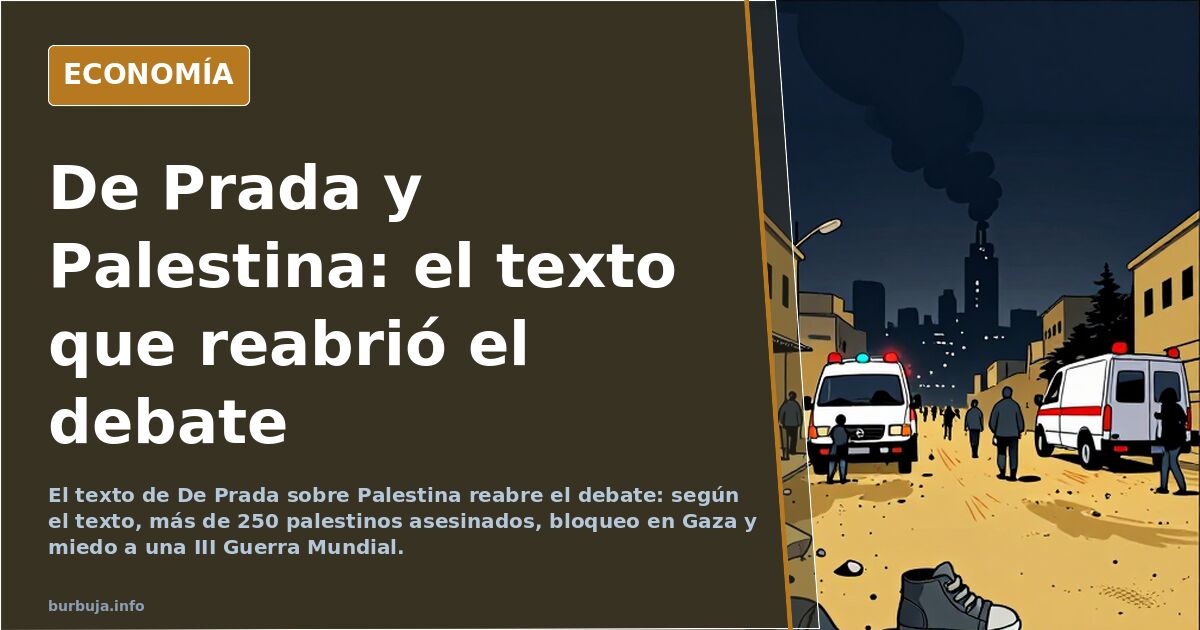
How much suffering can an article contain before it becomes a political weapon? Juan Manuel De Prada’s text on Palestine, published in ABC, put that question on the table with a accumulation of data that many preferred not to read. The text stated that more than 250 Palestinians had been killed by the Israeli army before Hamas’s attack. It also denounced dozens of outposts "legalized" by Netanyahu. And it described a blockade that, according to the author, prevents building houses, fishing, or turning on an operating room. The thesis was simple: the West tolerates that an artificially created state treats Palestinians in a degrading manner. The reaction was no less simple: some applauded, others asked for context, and a few chose to change the subject.
What De Prada’s text says exactly
The article starts in 1948 and stops in 1967 to explain a degradation that, according to its author, has only accelerated. It talks about land expropriations, a system of discrimination that he calls ethnic cleansing, walls and barbed wire, temples and schools bombed. The figure he cited was that of more than 250 Palestinians killed by the Israeli army in what had passed of the year, many of them children and women. To that he added the legalization of outposts in Palestinian territory, which he described as embryos of future colonies.
The text does not stop at the accusation. It also launches a warning: Hamas did not attack by surprise to stupidly wait for reprisals. De Prada argues that Palestinians will fight among the rubble, that there will be hundreds of hostages, and that if the West Bank joins and Hezbollah opens another front and Iran provides full support, we will have WWIII served. The culprit, he concludes, will be the West.
The response: between applause and "I don’t drink from either side"
The reception of the text was a sample of polarization. One part celebrated it and vindicated De Prada as the only free intellectual left. Another part reproached him for taking sides in a conflict where, they say, Arabs are also responsible for what has peine to them. And a third group opted for neutrality: "I don’t drink from either side," summarized an intervener. "It seems that one has the obligation to take a stand on everything."
There were those who questioned the authenticity of the text, asking for the link to the newspaper before believing it. De Prada’s signature, his polished style, and his fondness for Chesterton, they said, did not appear anywhere. Others took the opportunity to settle scores with the character: according to some messages, he is a Kremlin asset or is paid by Arab countries. The discussion about Palestine became, in several messages, a discussion about De Prada.
The data that crossed in the discussion
The exchange of figures was constant. It was said that there are 19 countries or more Muslim, some larger than Israel, that is "as large as the Valencian Community." It was recalled that in 1947 Jews were 40% of the population of the region of Palestine, and that it was the UN that divided the territory in two. It was mentioned that Jovenlandeses are 1.600 million in the world and that they grow rapidly. And it was mentioned that Palestinians are 5 million, a figure that, according to some, makes any deportation unviable.
The comparison with other conflicts was another common resource. Kosovo, Australia, Argentina, United States. If Israel has to disappear for having stolen land, why is the same standard not applied to all? The question floated, unanswered. The case of Christians in Palestine was also cited, who according to some have been exterminated or forced to convert, an argument that, they said, De Prada overlooks.
The antiestéticar of escalation and the role of the West
De Prada’s warning about WWIII found echo in several messages. There was talk of attacks in Europe, false flags, civilians who always pay the price. And it was discussed whether the West has or does not have the capacity to intervene. "The West does not have the capacity to make and unmake at will in all parts of the World," wrote an intervener. If the Palestinians of Gaza have decided that Hamas rules them, he added, the West is not to blame.
Against that position, another current maintained that Spain should keep its distance. "Israel is a hostile State to national interests," it was argued, and the Spanish response should be at least chilling. The idea that the conflict is not our conflict, that "their affairs are not our affairs," reappeared in several messages. There was no shortage of those who asked if the creation of the State of Israel was the fault of the Arabs or of Albion, in a discussion that never came to a close.
The shadow of immigration
One of the most repeated turns was the one that led the discussion of Gaza to immigration in Europe. It was said that Palestinians should go to neighboring Muslim countries, that there is plenty of room, that there is no need for them to come here. There was talk of 5 million people who could end up in Europe, of mafias, of dangerous trips, of complaints of racism and Sarracinophobia. And a connection was established, never proven, between the conflict and a supposed low-intensity migratory flow that, according to some messages, is already underway.
That turn generated division. For some, it was proof that the discussion about Palestine was not about Palestine, but about the usual thing. For others, it was the logical consequence of a conflict that, if it gets out of control, will end up splashing Europe. The conversation drifted towards unaccompanied minors, pateras, and immigration policies, and there it stayed, as so many times.
In the end, De Prada’s text served for something he probably did not intend: to demonstrate that in a forum thread one can discuss about Palestine without agreeing on almost anything. Some saw a catastrophe, others a conflict with shared responsibilities, and a few, simply, took the opportunity to settle scores with the author.
How much suffering can an article contain before it becomes a political weapon? Juan Manuel De Prada’s text on Palestine, published in ABC, put that question on the table with a accumulation of data that many preferred not to read. The text stated that more than 250 Palestinians had been killed by the Israeli army before Hamas’s attack. It also denounced dozens of outposts "legalized" by Netanyahu. And it described a blockade that, according to the author, prevents building houses, fishing, or turning on an operating room. The thesis was simple: the West tolerates that an artificially created state treats Palestinians in a degrading manner. The reaction was no less simple: some applauded, others asked for context, and a few chose to change the subject.
What De Prada’s text says exactly
The article starts in 1948 and stops in 1967 to explain a degradation that, according to its author, has only accelerated. It talks about land expropriations, a system of discrimination that he calls ethnic cleansing, walls and barbed wire, temples and schools bombed. The figure he cited was that of more than 250 Palestinians killed by the Israeli army in what had passed of the year, many of them children and women. To that he added the legalization of outposts in Palestinian territory, which he described as embryos of future colonies.
The text does not stop at the accusation. It also launches a warning: Hamas did not attack by surprise to stupidly wait for reprisals. De Prada argues that Palestinians will fight among the rubble, that there will be hundreds of hostages, and that if the West Bank joins and Hezbollah opens another front and Iran provides full support, we will have WWIII served. The culprit, he concludes, will be the West.
The response: between applause and "I don’t drink from either side"
The reception of the text was a sample of polarization. One part celebrated it and vindicated De Prada as the only free intellectual left. Another part reproached him for taking sides in a conflict where, they say, Arabs are also responsible for what has peine to them. And a third group opted for neutrality: "I don’t drink from either side," summarized an intervener. "It seems that one has the obligation to take a stand on everything."
There were those who questioned the authenticity of the text, asking for the link to the newspaper before believing it. De Prada’s signature, his polished style, and his fondness for Chesterton, they said, did not appear anywhere. Others took the opportunity to settle scores with the character: according to some messages, he is a Kremlin asset or is paid by Arab countries. The discussion about Palestine became, in several messages, a discussion about De Prada.
The data that crossed in the discussion
The exchange of figures was constant. It was said that there are 19 countries or more Muslim, some larger than Israel, that is "as large as the Valencian Community." It was recalled that in 1947 Jews were 40% of the population of the region of Palestine, and that it was the UN that divided the territory in two. It was mentioned that Jovenlandeses are 1.600 million in the world and that they grow rapidly. And it was mentioned that Palestinians are 5 million, a figure that, according to some, makes any deportation unviable.
The comparison with other conflicts was another common resource. Kosovo, Australia, Argentina, United States. If Israel has to disappear for having stolen land, why is the same standard not applied to all? The question floated, unanswered. The case of Christians in Palestine was also cited, who according to some have been exterminated or forced to convert, an argument that, they said, De Prada overlooks.
The antiestéticar of escalation and the role of the West
De Prada’s warning about WWIII found echo in several messages. There was talk of attacks in Europe, false flags, civilians who always pay the price. And it was discussed whether the West has or does not have the capacity to intervene. "The West does not have the capacity to make and unmake at will in all parts of the World," wrote an intervener. If the Palestinians of Gaza have decided that Hamas rules them, he added, the West is not to blame.
Against that position, another current maintained that Spain should keep its distance. "Israel is a hostile State to national interests," it was argued, and the Spanish response should be at least chilling. The idea that the conflict is not our conflict, that "their affairs are not our affairs," reappeared in several messages. There was no shortage of those who asked if the creation of the State of Israel was the fault of the Arabs or of Albion, in a discussion that never came to a close.
The shadow of immigration
One of the most repeated turns was the one that led the discussion of Gaza to immigration in Europe. It was said that Palestinians should go to neighboring Muslim countries, that there is plenty of room, that there is no need for them to come here. There was talk of 5 million people who could end up in Europe, of mafias, of dangerous trips, of complaints of racism and Sarracinophobia. And a connection was established, never proven, between the conflict and a supposed low-intensity migratory flow that, according to some messages, is already underway.
That turn generated division. For some, it was proof that the discussion about Palestine was not about Palestine, but about the usual thing. For others, it was the logical consequence of a conflict that, if it gets out of control, will end up splashing Europe. The conversation drifted towards unaccompanied minors, pateras, and immigration policies, and there it stayed, as so many times.
In the end, De Prada’s text served for something he probably did not intend: to demonstrate that in a forum thread one can discuss about Palestine without agreeing on almost anything. Some saw a catastrophe, others a conflict with shared responsibilities, and a few, simply, took the opportunity to settle scores with the author.
Summary of a discussion on Burbuja.info - Foro de economía, actualidad y política., translated from Spanish and reviewed before publication. Read the full discussion (249 replies).
More summaries
-
Gaza: 24 hours to evacuate the north, with 1.1 million still inside
Israel gave 24 hours to evacuate northern Gaza, home to 1.1 million residents, amid growing fears displaced people will end up in Europe
-
Gaza: The Genocide Accusation Without Punishment
The accusation of genocide in Gaza mounts with no effective sanctions against Israel, highlighting the paradox of reproach without consequence and its underlying complexities.
-
Spain Left Out of US, France, Italy Statement on Hamas
Spain was excluded from a joint statement by the US, UK, France, Italy, and Germany condemning Hamas, highlighting diplomatic friction over the government's foreign policy.
-
Código 10 publishes photos against PSOE: the scandal that wasn't
Código 10 releases allegedly compromising photos of a Socialist official. The expected political earthquake fizzles out as PSOE proves...
-
Dark Matter-Free Theory Challenges Cosmological Model
A new theory suggests random gravitational fluctuations could explain cosmic expansion without dark matter, though currently limited to short distances.
-
Spain fines cat owners up to €50,000 for missing microchips
Spain mandates cat microchipping under animal welfare law. Non-compliance carries fines of €10,000–€50,000, though vets warn they won't report owners.