
Gaza: 24 hours to evacuate the north, with 1.1 million still inside
Israel gave 24 hours to evacuate northern Gaza, home to 1.1 million residents, amid growing fears displaced people will end up in Europe
English · Original discussion in Spanish · Published
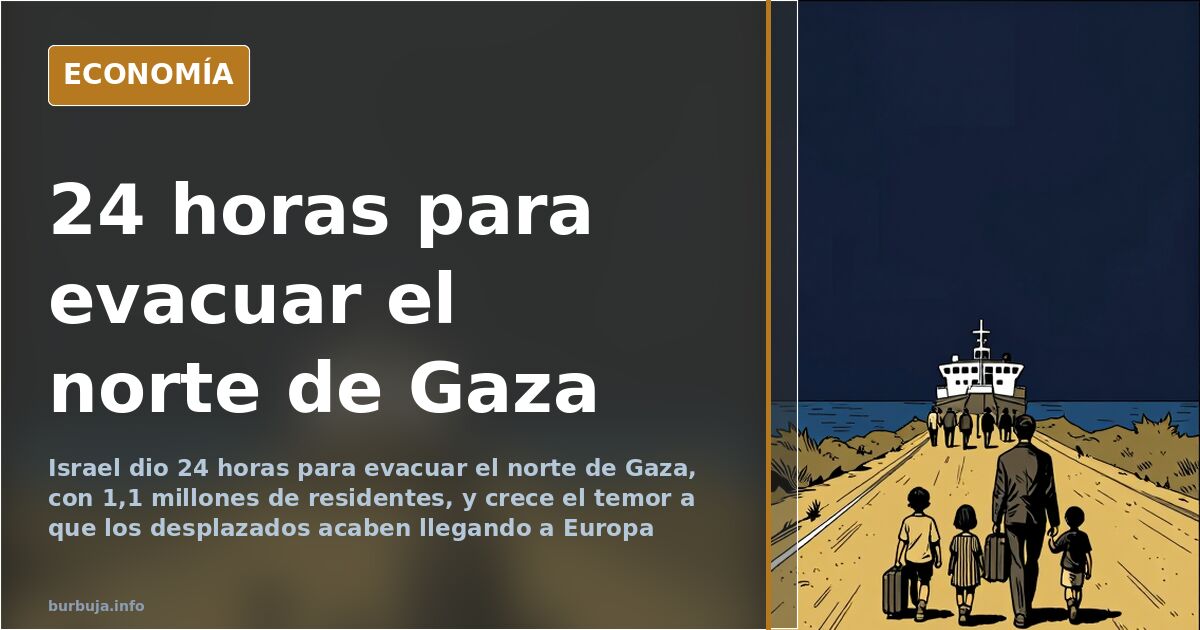
Gaza: 24 hours to evacuate the north and the migration specter over Europe
Can you empty northern Gaza in a single day? The population in that area — more than a million people, 1.1 million according to the figures being used — was told it had 24 hours to move to the south of the strip. Those who denounce the offensive openly call it genocide; others frame the warning as a prelude to a military operation. And around that ultimatum a second debate has grown: that the displaced should not stay in the region and that their final destination may end up being Europe.
What a 24-hour evacuation without water or electricity means
The warning comes in a territory with no running water, no stable electricity supply and hospitals at breaking point. The practical question is how you tell a million people who have no power that they have one day to leave. Messages are circulating about medical facilities with hundreds of rooms that were reportedly given two hours to evacuate. The question is not rhetorical: it is pure logistics.
The second front is the south's capacity. The strip has some 2.5 million inhabitants and the southern zone is already bearing a volume of displaced population that makes it impossible to absorb another million within hours. The recurring argument is that pressure on water, food and shelter becomes an indirect mechanism of expulsion: if the south cannot support those arriving, the natural exit is to cross a border.
Why Egypt and Jordan are closing the door
Egypt has been explicit: it does not want 2.5 million displaced people, armed groups included, just a few kilometers from Cairo. Jordan joins the rejection. The reasoning repeated has two layers: internal security and political calculation, because accepting the population amounts to certifying that the territory of origin is no longer theirs.
With the land crossing closed, the route sketched in analyses is the longest and most uncomfortable: Libya, and from there the central Mediterranean toward Europe. It is not a new hypothesis; it is the migration route that is already operating. What would be new is the volume.
Who wins and who loses according to the calculations circulating
In the division of the conflict that is being drawn up, the United States appears as the main beneficiary: it would maintain a permanent military presence in the area, with the ability to pressure Arab countries that deviate from the script, and its arms industry is rising. Israel, it is argued, sacrifices part of its own civilian population but gains effective control of Gaza and, with it, the energy resources off its coast.
The scenario described next points to the West Bank, Lebanon and Syria as the trinc links, with Iran on the horizon. It should be taken for what it is: a projection by amateur analysts, not a documented plan. On the other side of the scales, the losers listed are the Palestinians themselves, the Arab countries of the region and a Europe that would absorb at once the energy bill, military spending and the arrival of population.
The Strait of Hormuz and the price of Brent
If the conflict escalates toward Iran, the unavoidable question is what happens to crude. A substantial share of the oil that moves the world passes through the Strait of Hormuz, and any tension there translates into a risk premium on the barrel. On the table is the question of how much Brent would rise in a scenario of closure or partial blockade. Nobody dares give a fixed figure, and rightly so: in this type of episode the price moves on expectations rather than real supply.
For the European consumer the transmission channel is well known: fuel, transport, food. It is the same mechanism already seen with the energy shock of previous years.
Should Europe take in Gaza's displaced people?
Here the disagreement is total. Some argue that the Gulf countries have plenty of territory and money and that solidarity should begin at home. The position attributed to Florida Governor Ron DeSantis is even cited, favoring that Muslim countries take in the population. Opposite is the counterargument: whether or not to take them in is a sovereign decision for Europe, not an imposition by Israel.
And a third line, the loudest, holds that it all responds to a deliberate U.S. design to move the conflict onto European soil. That narrative — which attributes the plan to an international financial elite that would control governments and media — offers no evidence and fits the classic repertoire of conspiracy theory. That part of the public takes it as true says less about the world than about the accumulated distrust toward the official narrative.
How long it takes a migration crisis to become a domestic one
The sequence described by the most pessimistic is not weeks: it is months. First internal displacement within the strip, then camps at the border, then pressure on Egypt and, finally, the central Mediterranean route. Each link has actors who win and lose, and none of them sits in Brussels.
While it is decided whether the final destination is Sinai, Libya or the outskirts of any European capital, someone will have to explain to those people who have no power how to pack a suitcase in 24 hours.
Can you empty northern Gaza in a single day? The population in that area — more than a million people, 1.1 million according to the figures being used — was told it had 24 hours to move to the south of the strip. Those who denounce the offensive openly call it genocide; others frame the warning as a prelude to a military operation. And around that ultimatum a second debate has grown: that the displaced should not stay in the region and that their final destination may end up being Europe.
What a 24-hour evacuation without water or electricity means
The warning comes in a territory with no running water, no stable electricity supply and hospitals at breaking point. The practical question is how you tell a million people who have no power that they have one day to leave. Messages are circulating about medical facilities with hundreds of rooms that were reportedly given two hours to evacuate. The question is not rhetorical: it is pure logistics.
The second front is the south's capacity. The strip has some 2.5 million inhabitants and the southern zone is already bearing a volume of displaced population that makes it impossible to absorb another million within hours. The recurring argument is that pressure on water, food and shelter becomes an indirect mechanism of expulsion: if the south cannot support those arriving, the natural exit is to cross a border.
Why Egypt and Jordan are closing the door
Egypt has been explicit: it does not want 2.5 million displaced people, armed groups included, just a few kilometers from Cairo. Jordan joins the rejection. The reasoning repeated has two layers: internal security and political calculation, because accepting the population amounts to certifying that the territory of origin is no longer theirs.
With the land crossing closed, the route sketched in analyses is the longest and most uncomfortable: Libya, and from there the central Mediterranean toward Europe. It is not a new hypothesis; it is the migration route that is already operating. What would be new is the volume.
Who wins and who loses according to the calculations circulating
In the division of the conflict that is being drawn up, the United States appears as the main beneficiary: it would maintain a permanent military presence in the area, with the ability to pressure Arab countries that deviate from the script, and its arms industry is rising. Israel, it is argued, sacrifices part of its own civilian population but gains effective control of Gaza and, with it, the energy resources off its coast.
The scenario described next points to the West Bank, Lebanon and Syria as the trinc links, with Iran on the horizon. It should be taken for what it is: a projection by amateur analysts, not a documented plan. On the other side of the scales, the losers listed are the Palestinians themselves, the Arab countries of the region and a Europe that would absorb at once the energy bill, military spending and the arrival of population.
The Strait of Hormuz and the price of Brent
If the conflict escalates toward Iran, the unavoidable question is what happens to crude. A substantial share of the oil that moves the world passes through the Strait of Hormuz, and any tension there translates into a risk premium on the barrel. On the table is the question of how much Brent would rise in a scenario of closure or partial blockade. Nobody dares give a fixed figure, and rightly so: in this type of episode the price moves on expectations rather than real supply.
For the European consumer the transmission channel is well known: fuel, transport, food. It is the same mechanism already seen with the energy shock of previous years.
Should Europe take in Gaza's displaced people?
Here the disagreement is total. Some argue that the Gulf countries have plenty of territory and money and that solidarity should begin at home. The position attributed to Florida Governor Ron DeSantis is even cited, favoring that Muslim countries take in the population. Opposite is the counterargument: whether or not to take them in is a sovereign decision for Europe, not an imposition by Israel.
And a third line, the loudest, holds that it all responds to a deliberate U.S. design to move the conflict onto European soil. That narrative — which attributes the plan to an international financial elite that would control governments and media — offers no evidence and fits the classic repertoire of conspiracy theory. That part of the public takes it as true says less about the world than about the accumulated distrust toward the official narrative.
How long it takes a migration crisis to become a domestic one
The sequence described by the most pessimistic is not weeks: it is months. First internal displacement within the strip, then camps at the border, then pressure on Egypt and, finally, the central Mediterranean route. Each link has actors who win and lose, and none of them sits in Brussels.
While it is decided whether the final destination is Sinai, Libya or the outskirts of any European capital, someone will have to explain to those people who have no power how to pack a suitcase in 24 hours.
Summary of a discussion on Burbuja.info - Foro de economía, actualidad y política., translated from Spanish and reviewed before publication. Read the full discussion (267 replies).
More summaries
-
Morocco Signs 'Historic Deal' with US and Israel, Exchanging Embassies in Jerusalem to Celebrate Abraham Accords
Morocco and Israel agree to exchange ambassadors and restore direct flights, consolidating the Abraham Accords. The move seeks to boost economic and security cooperation.
-
The Porn Industry's 'Wall': From $2,000 to $200 Per Scene, According to Forum Users
The tragic case of Kagney Linn Karter, found dead at 36, reignites debate on career endings in the adult film industry.
-
Córdoba Father Self-Immolates: Mental Illness or Societal Despair?
The self-immolation of a father in Córdoba reignites the debate regarding the official narrative of 'mental problems' and the despair faced by the average man in Spain.
-
Euthanasia in Old Age: Autonomy vs. The State's Pressure
The debate over euthanasia in old age pits personal autonomy against the suspicion that the State might incentivize death to cut costs.
-
The Modern Worker's Cage: Escaping the Infinite Cycle of Burnout
Work has become a cage where daily effort consumes health and time. Discover why we push ourselves so hard and how to break the cycle.
-
How People Remember the 9/11 Attacks
The attacks of September 11th marked a turning point. Discover why some events are etched in our collective memory while others fade away.