
David Bravo: Former MP Leaves Podemos Without Picking a Strawberry
Former MP David Bravo explains his departure from Podemos and details how voting discipline works in the Spanish Congress.
English · Original discussion in Spanish · Published
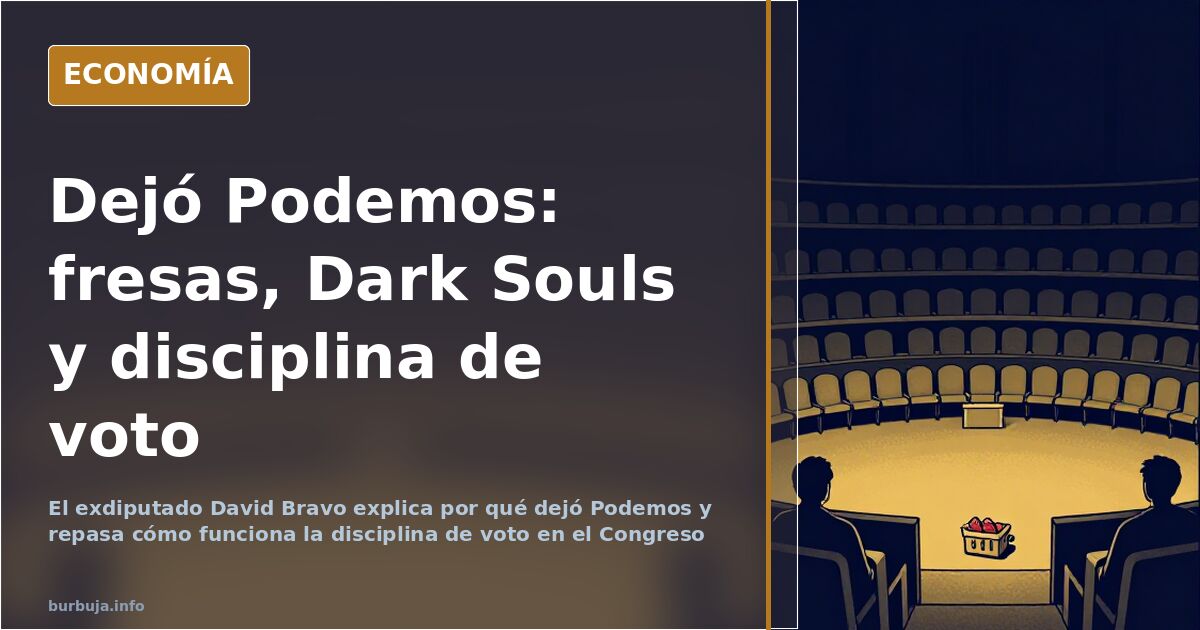
David Bravo explains why he left Podemos and what he saw inside
What happens when an MP discovers that their seat does not represent their province, but rather the party leadership? David Bravo, an intellectual property lawyer and former Podemos MP for Almería, tells it straight in a video reviewing his time in the Congress of Deputies and the reasons he eventually fled. He is not describing an isolated anecdote; he outlines how the machinery works.
Before politics, Bravo had made a name for himself in another arena. He fought against SGAE (the Spanish collecting society), the digital levy, and the persecution of file-sharing programs, and authored Copy This Book, a key text for the free internet movement. The distance from there to a parliamentary seat was significant, a gap he clearly underestimated based on his account.
Who is David Bravo and why did he leave Podemos?
He arrived at the Congress as an MP for Almería, a province that was not his own and which, by his own admission, he knew very little about. The party was interested in his prior prominence: the media pull of someone who had stood up to SGAE and collecting societies. In 2015, Podemos presented itself as transversal, more "the people below" than traditional left, fishing in a pool of disillusioned voters that later dried up.
Disillusionment came quickly. Bravo describes a parliamentary group often devoted to gesture politics, performances designed for headlines rather than the Official Journal. He was forced to play a role he hadn't chosen, with scripts handed down from leadership. And then there was what he considers the core problem: voting discipline.
What is a 'fruta cunero' and why criticize constituencies?
A 'fruta cunero' is an MP placed in a constituency that is not their own, with no local roots, elected due to the list's pull rather than any link to the province. In his case, Almería. The issue isn't just the pretense: it's that the constituency ends up meaning little. Breaking voting discipline means breaking the group, and without the group, there are no majorities. The result, he argues, is that the MP votes as ordered, even if it harms those who gave them the mandate.
The criticism targets more than one specific party. One widely circulated point notes that if a PP measure benefits Almería but leadership decides to vote against it, they vote against it. The MP would represent the apparatus, not their district. This practice was already a scourge during the Restoration period; four decades into democracy, the gears remain just as well-oiled.
Strawberries, Dark Souls, and the MP's resume
The most shared moment of the video is also the most awkward. Bravo confesses that his two greatest prides are completing Dark Souls III —after eight months of attempts— and having been an MP for Almería "without picking a single strawberry." He adds: he doesn't know where strawberries come from, can't drive, and doesn't know the province's history. The detail has its charm: the strawberries he mentions are mostly grown in Huelva, not Almería.
His honesty about his own ignorance is exactly what splits reactions. Some see proof of rare integrity: a man who doesn't pretend to know what he doesn't. Others see the opposite, a portrait of a political class placed by fame and detached from reality. Both readings fit within the same minute of video.
How much did he earn and why the seat is no longer what it was
A figure appears in the video that explains much. During his first term, an MP earned around 1,800 euros; under current criteria, the corresponding remuneration would be around 5,000. Bravo himself admits that the idea of "three times the minimum wage" is long gone. It is not a complaint about salary: it is the realization that the seat is no longer viewed as public service.
Why his testimony portrays all parties
There is a pattern repeated in his account that goes beyond one acronym. Phrases like "they told me," "they forced me," "I couldn't say this" trinc one another. Behind each is a structure where the message is manufactured in a marketing office and served to a voter assumed to be undemanding. The diagnosis spares no one: partyocracy turns Parliament into a board of buttons.
The same mechanism that places a famous lawyer known for defending the free internet also places Julio Rodríguez, a former Chief of the Defence Staff, as a candidate for Almería in elections he didn't win. Biography doesn't matter. What matters is the hole being filled.
So yes, David Bravo fled Podemos. And the strange thing, reading his explanation, isn't that he left: it's that it took him eight months to realize it. Eight, like Dark Souls. It almost feels like the party was the final boss.
What happens when an MP discovers that their seat does not represent their province, but rather the party leadership? David Bravo, an intellectual property lawyer and former Podemos MP for Almería, tells it straight in a video reviewing his time in the Congress of Deputies and the reasons he eventually fled. He is not describing an isolated anecdote; he outlines how the machinery works.
Before politics, Bravo had made a name for himself in another arena. He fought against SGAE (the Spanish collecting society), the digital levy, and the persecution of file-sharing programs, and authored Copy This Book, a key text for the free internet movement. The distance from there to a parliamentary seat was significant, a gap he clearly underestimated based on his account.
Who is David Bravo and why did he leave Podemos?
He arrived at the Congress as an MP for Almería, a province that was not his own and which, by his own admission, he knew very little about. The party was interested in his prior prominence: the media pull of someone who had stood up to SGAE and collecting societies. In 2015, Podemos presented itself as transversal, more "the people below" than traditional left, fishing in a pool of disillusioned voters that later dried up.
Disillusionment came quickly. Bravo describes a parliamentary group often devoted to gesture politics, performances designed for headlines rather than the Official Journal. He was forced to play a role he hadn't chosen, with scripts handed down from leadership. And then there was what he considers the core problem: voting discipline.
What is a 'fruta cunero' and why criticize constituencies?
A 'fruta cunero' is an MP placed in a constituency that is not their own, with no local roots, elected due to the list's pull rather than any link to the province. In his case, Almería. The issue isn't just the pretense: it's that the constituency ends up meaning little. Breaking voting discipline means breaking the group, and without the group, there are no majorities. The result, he argues, is that the MP votes as ordered, even if it harms those who gave them the mandate.
The criticism targets more than one specific party. One widely circulated point notes that if a PP measure benefits Almería but leadership decides to vote against it, they vote against it. The MP would represent the apparatus, not their district. This practice was already a scourge during the Restoration period; four decades into democracy, the gears remain just as well-oiled.
Strawberries, Dark Souls, and the MP's resume
The most shared moment of the video is also the most awkward. Bravo confesses that his two greatest prides are completing Dark Souls III —after eight months of attempts— and having been an MP for Almería "without picking a single strawberry." He adds: he doesn't know where strawberries come from, can't drive, and doesn't know the province's history. The detail has its charm: the strawberries he mentions are mostly grown in Huelva, not Almería.
His honesty about his own ignorance is exactly what splits reactions. Some see proof of rare integrity: a man who doesn't pretend to know what he doesn't. Others see the opposite, a portrait of a political class placed by fame and detached from reality. Both readings fit within the same minute of video.
How much did he earn and why the seat is no longer what it was
A figure appears in the video that explains much. During his first term, an MP earned around 1,800 euros; under current criteria, the corresponding remuneration would be around 5,000. Bravo himself admits that the idea of "three times the minimum wage" is long gone. It is not a complaint about salary: it is the realization that the seat is no longer viewed as public service.
Why his testimony portrays all parties
There is a pattern repeated in his account that goes beyond one acronym. Phrases like "they told me," "they forced me," "I couldn't say this" trinc one another. Behind each is a structure where the message is manufactured in a marketing office and served to a voter assumed to be undemanding. The diagnosis spares no one: partyocracy turns Parliament into a board of buttons.
The same mechanism that places a famous lawyer known for defending the free internet also places Julio Rodríguez, a former Chief of the Defence Staff, as a candidate for Almería in elections he didn't win. Biography doesn't matter. What matters is the hole being filled.
So yes, David Bravo fled Podemos. And the strange thing, reading his explanation, isn't that he left: it's that it took him eight months to realize it. Eight, like Dark Souls. It almost feels like the party was the final boss.
Summary of a discussion on Burbuja.info - Foro de economía, actualidad y política., translated from Spanish and reviewed before publication. Read the full discussion (185 replies).
More summaries
-
Left Fails to Reach 35%: PP and Vox Secure 210 Seats in NC Report Poll
NC Report poll places Spain's left at 34.6% while PP and Vox reach 210 seats, pushing the right toward a constitutional reform threshold.
-
The Elite Education of Tenant Spokespeople Sparks Controversy
Controversy erupts as the elite international education backgrounds of prominent tenant movement spokespeople are revealed, challenging their narrative of precarity.
-
Trump's ICE Officers Shoot Protester in Minneapolis
In Minneapolis, a Trump ICE agent shot and killed a white US citizen during protests. Two deaths in January led to the withdrawal of 700 agents amid civil war fears.
-
Madrid rental listings drop 20% after decree
Forum users track Madrid's rental supply falling from 11,815 to 9,398 ads in one day. They blame the new decree. Barcelona has only 680 long-term rentals.
-
Spain's Debate: Voting vs. Abstention in Upcoming Elections
A forum debates voting as a lesser evil versus abstaining as punishment. In 2019, with the lowest turnout since 1978 (66%), Sánchez reached La Moncloa.
-
Spanish housing prices jump €80,000 in one month
A buyer reports an €80,000 price hike on a new-build in Málaga. Supply shortages and high demand strain the Spanish market.