
Dating in Spain: why some see it as mission impossible
Some claim 80% of men don't date and apps multiply competition: the narrative on why finding a partner is so hard
English · Original discussion in Spanish · Published
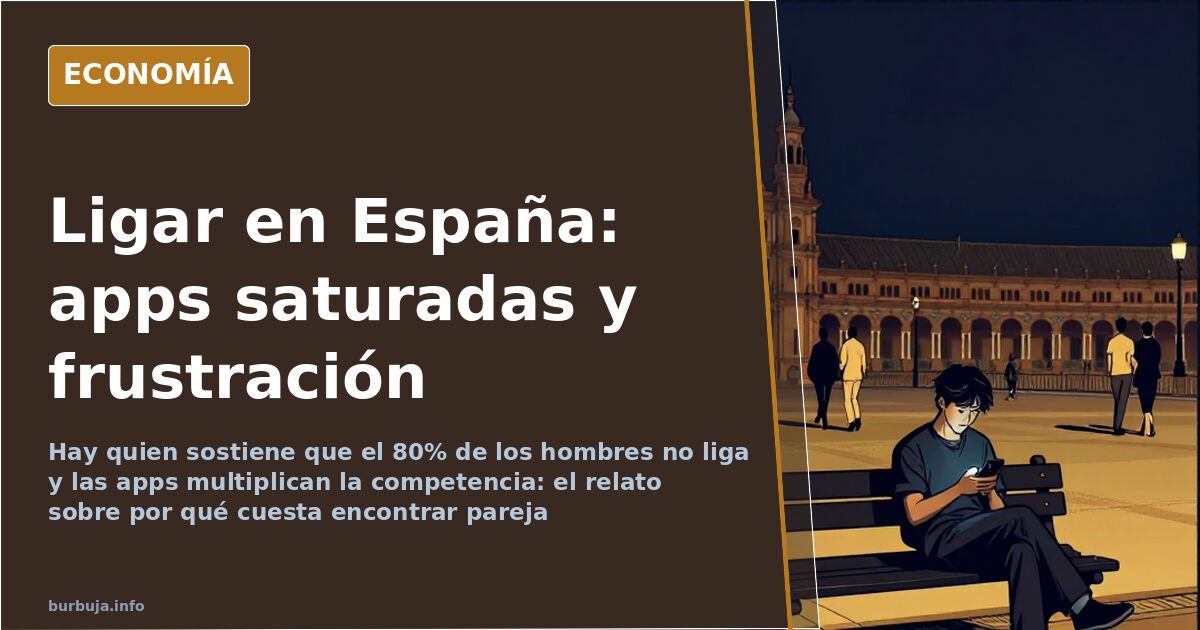
Dating in Spain: saturated apps and a dwindling market
Dating in Spain has become, for some men, a mission impossible. Not for everyone: some reply in the thread that there aren't that many couples on the street. The recurring narrative points to three fronts: the competition multiplied by dating apps, hypergamy —seeking a partner of equal or higher status— and a social life increasingly confined to closed cliques. The date used as a boundary is 2010. Before that, it's argued, being average and having some conversation skills was enough.
Why dating with apps has become so difficult
The dominant argument doesn't blame looks but supply. The thesis is that a woman who used to receive twenty proposals in her circle can now receive up to five hundred from any app. That saturation, the narrative says, makes those who receive them feel like gods and sinks those who compete.
There's a contradiction the material doesn't resolve: the same people who denounce the market use it. And a class judgment also falls on those platforms: it's claimed that they only contain, presumably, a specific profile of female users and people without a trade, and that those who use them are probably the same. The advice that emerges is the least romantic possible: accept the league you play in and stop measuring yourself against a catalogue that doesn't exist.
Why do couples form if the market is broken?
Through proximity. That's the most repeated answer. Couples aren't born from the nightclub playboy —who, it's insisted, most of the time gets nothing— but from work, studies, friends or any sustained coincidence. It's argued that 80% of men don't "date" in the classic sense and that it's the woman who chooses at a given moment, even though men are sold the illusion of having conquered.
As one forum user sums up, "she's not yours, it's just your turn." For those who arrive late to those circles, the diagnosis is harsh: Spanish social life is gregarious and those not in a clique since high school start at a disadvantage. The other path is self-improvement without obsession, with the argument that men don't have an age wall and can wait for the tables to turn.
The measurements circulating without a source should be taken with a grain of salt: 70% of divorces, 80% of men who don't date, 99% of women who wouldn't be up to par. These are figures that appear in the debate without a survey or methodology to back them up.
The narrative of the happy couple and suspicion about divorces
Facing the one walking hand in hand, there's the one watching from outside and calculating. Several messages flip the focus: not envy of the coupled, but wondering about their ordeal. The argument is that 70% of marriages end in breakup and that what you see on the street is the good phase, not the bill.
Another current focuses on what is seen: most visible couples would be ordinary people, not models. The problem wouldn't be not dating, but that porn and social media have raised the bar and made everything that isn't exceptional invisible. What goes around comes around.
What happens when frustration turns into harassment?
The material includes a warning worth underlining. Whistling, making comments to strangers or insulting on apps isn't presented as a courtship strategy: it's reminded that such gestures can carry legal consequences and, in practice, push the goal even further away.
Completing the map, the debate drifted into something curious: an anonymous survey on dating, hypergamy, number of previous partners and apps, with a raffle of five prizes of 40 euros among those who respond. One more symptom that the topic has ceased to be a private conversation and become an improvised object of study.
What can be expected from here on
With the population pyramid argument, apps as an almost inevitable path and a more fragmented social life, the thread suggests that the gap between those who couple up and those who don't will continue to widen. But one should distrust the forecast: the material provides no data to support it. That said, without resorting to insulting anyone on the street.
Dating in Spain has become, for some men, a mission impossible. Not for everyone: some reply in the thread that there aren't that many couples on the street. The recurring narrative points to three fronts: the competition multiplied by dating apps, hypergamy —seeking a partner of equal or higher status— and a social life increasingly confined to closed cliques. The date used as a boundary is 2010. Before that, it's argued, being average and having some conversation skills was enough.
Why dating with apps has become so difficult
The dominant argument doesn't blame looks but supply. The thesis is that a woman who used to receive twenty proposals in her circle can now receive up to five hundred from any app. That saturation, the narrative says, makes those who receive them feel like gods and sinks those who compete.
There's a contradiction the material doesn't resolve: the same people who denounce the market use it. And a class judgment also falls on those platforms: it's claimed that they only contain, presumably, a specific profile of female users and people without a trade, and that those who use them are probably the same. The advice that emerges is the least romantic possible: accept the league you play in and stop measuring yourself against a catalogue that doesn't exist.
Why do couples form if the market is broken?
Through proximity. That's the most repeated answer. Couples aren't born from the nightclub playboy —who, it's insisted, most of the time gets nothing— but from work, studies, friends or any sustained coincidence. It's argued that 80% of men don't "date" in the classic sense and that it's the woman who chooses at a given moment, even though men are sold the illusion of having conquered.
As one forum user sums up, "she's not yours, it's just your turn." For those who arrive late to those circles, the diagnosis is harsh: Spanish social life is gregarious and those not in a clique since high school start at a disadvantage. The other path is self-improvement without obsession, with the argument that men don't have an age wall and can wait for the tables to turn.
The measurements circulating without a source should be taken with a grain of salt: 70% of divorces, 80% of men who don't date, 99% of women who wouldn't be up to par. These are figures that appear in the debate without a survey or methodology to back them up.
The narrative of the happy couple and suspicion about divorces
Facing the one walking hand in hand, there's the one watching from outside and calculating. Several messages flip the focus: not envy of the coupled, but wondering about their ordeal. The argument is that 70% of marriages end in breakup and that what you see on the street is the good phase, not the bill.
Another current focuses on what is seen: most visible couples would be ordinary people, not models. The problem wouldn't be not dating, but that porn and social media have raised the bar and made everything that isn't exceptional invisible. What goes around comes around.
What happens when frustration turns into harassment?
The material includes a warning worth underlining. Whistling, making comments to strangers or insulting on apps isn't presented as a courtship strategy: it's reminded that such gestures can carry legal consequences and, in practice, push the goal even further away.
Completing the map, the debate drifted into something curious: an anonymous survey on dating, hypergamy, number of previous partners and apps, with a raffle of five prizes of 40 euros among those who respond. One more symptom that the topic has ceased to be a private conversation and become an improvised object of study.
What can be expected from here on
With the population pyramid argument, apps as an almost inevitable path and a more fragmented social life, the thread suggests that the gap between those who couple up and those who don't will continue to widen. But one should distrust the forecast: the material provides no data to support it. That said, without resorting to insulting anyone on the street.
Also available in: Deutsch
Summary of a discussion on Burbuja.info - Foro de economía, actualidad y política., translated from Spanish and reviewed before publication. Read the full discussion (181 replies).
More summaries
-
Dating in Spain is no longer a romantic problem, it's a market issue
Dating in Spain has become an auction: dozens of messages per profile and an 80/20 split, which forum users say is narrowing to 90/10.
-
Sex market shows price elasticity and rate variations
Analysis of sex market elasticity: hourly rates ranging from 100 to 150 euros amid supply-demand tensions.
-
Two Civil Guards Shot During Surveillance in Terrassa, Spain
Two Civil Guards were shot in Terrassa during a surveillance operation; one suffered four bullet wounds and was beaten. The incident highlights security concerns in Spain.
-
Madrid rental listings drop 20% after decree
Forum users track Madrid's rental supply falling from 11,815 to 9,398 ads in one day. They blame the new decree. Barcelona has only 680 long-term rentals.
-
Spain's Debate: Voting vs. Abstention in Upcoming Elections
A forum debates voting as a lesser evil versus abstaining as punishment. In 2019, with the lowest turnout since 1978 (66%), Sánchez reached La Moncloa.
-
Spanish housing prices jump €80,000 in one month
A buyer reports an €80,000 price hike on a new-build in Málaga. Supply shortages and high demand strain the Spanish market.