
Danone closes Parets plant, leaving 2,000 staff in Spain
Danone shuts its Parets del Vallès factory, cutting 157 jobs. Despite a 9.6% sales rise, Spanish profits fell 36.8%.
English · Original discussion in Spanish · Published
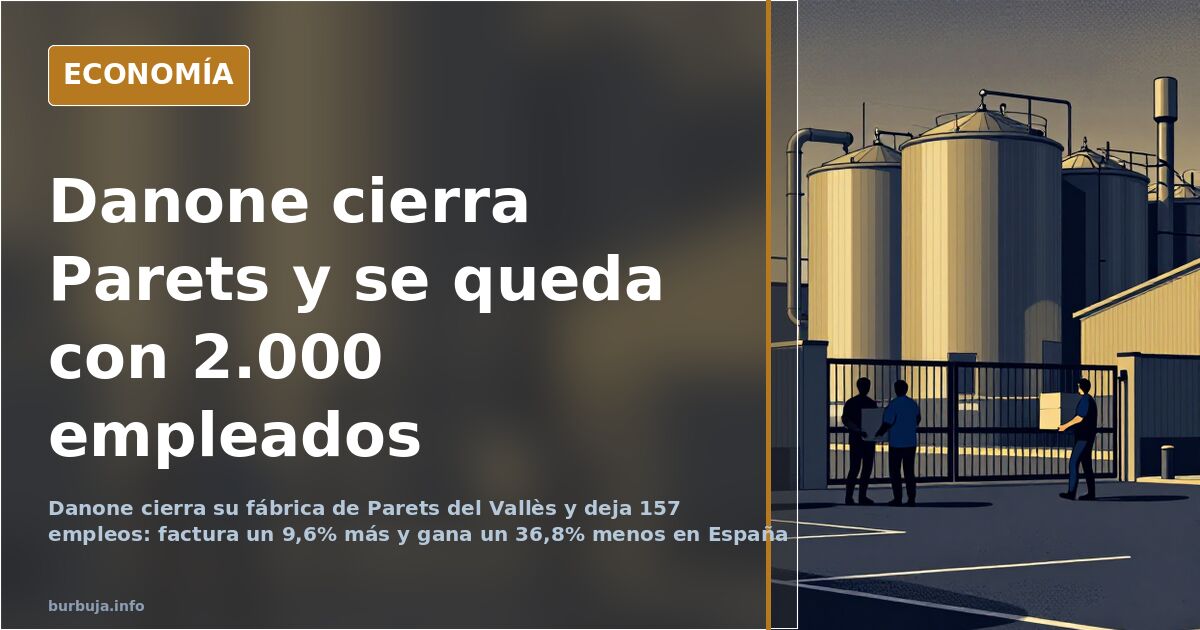
Danone closes Parets: from 400,000 tons to 2,000 employees
The Danone plant in Parets del Vallès, Barcelona, halted production with 157 workers on site. The closure, driven by falling sales, is the third executed by the company in Spain in just ten years, reducing the local workforce to under 2,000, compared to over 100,000 globally for the group. To gauge the impact, one must recall the scale of past operations: a firm that once produced more than 400,000 tons of yogurt annually across three plants and pioneered a product now ubiquitous in every fridge.
From a Raval lab to 400,000 tons of yogurt
The origins were far from corporate. Isaac Carasso, a Sephardic Jewish entrepreneur born in Thessaloniki in 1874, fled the Balkan Wars and World War I, arriving in Spain in 1916 with his vvife, Esterina, and their three children—Daniel, Flor, and Juana—and settling in the Raval district. Three years later, he set up a laboratory to manufacture yogurts, naming the brand after his eldest son’s nickname: Danón. The fascination was not merely gastronomic; early 20th-century theories on fermented milks played a significant role.
The start was tough. Yogurt was unknown, and few trusted a bacterial product, so for years, pharmacies were the primary outlet, backed by the Barcelona Medical Association. It took nearly a decade for the brand to stand on its own, which peine when the Royal Household began purchasing the product. This coincided with the opening of a second factory in Madrid in 1927, the same year Daniel Carasso moved to Paris and founded the Societé Parisienne du Yoghourt Danone. Sweetening the yogurt ultimately changed the industry's history.
The golden era arrived in the 1970s: the company generated 16.5 billion French francs, equivalent to about €2.5 billion today, solely in Spain, according to academic Juan Sevilla Álvarez’s work on territorial expansion and the Salas factory. Subsequently, the brand was replicated, adapted, and reimagined endlessly.
Three factory closures in ten years and shrinking headcount
The Parets shutdown is not an isolated incident. The Seville plant closed in 2013, laying off 85 workers. The Salas facility in Asturias shut down in 2021, affecting 80 employees. These two blows were compounded by a global restructuring that eliminated 153 positions in Spanish subsidiaries. Now, the 157 roles at Parets del Vallès complete the third episode.
The halted production tells the whole story: the company once manufactured 174,000 tons annually in Tres Cantos, 170,000 in Aldaia (Valencia), and 80,000 at the recently closed Barcelona plant. Of the three main dairy factories in Spain, only memories remain, along with capacity no one has stepped in to fill.
Higher revenue, lower profit: earnings drop 36.8%
Figures from the last two fiscal years depict a company selling more but earning less. Produits Frais Laitiers Iberia, the group’s dominant entity in Spain, earned €10.8 million in 2022, a 36.8% decline from the previous year’s €17.1 million. This occurred while turnover rose 9.6%, from €768.9 million to €842.9 million. A year earlier, profits had already plummeted 80% due to the cost of the ERE (collective dismissal plan).
How can such a drop be sustained despite higher income? With narrowing margins and a cost structure that fails to adapt to declining volumes. This is the argument management has used to justify each closure: fewer liters, same machinery.
Why private labels are eating market share
The premium product narrative clashes with an uncomfortable reality: yogurt is a commodity, and increasingly treated as such. Supermarket private labels—including Hacendado and Milbona—have gained ground with vast variety at competitive prices. Meanwhile, Catalan manufacturers like Casa Armengol or La Fageda have emerged targeting the high-end segment. The brand finds itself squeezed in the middle.
In this context circulates a calculation summarizing discontent: a yogurt costing 0.4 cents to produce is sold for €1.20. While not from an audit, this figure explains why many consumers stopped looking for the red label. Added to this is the nutritional debate: some argue the product has become a sugar vehicle, while others counter that natural options always existed and sweetness can come from sweeteners rather than sucrose.
Advertising that no longer sells and labels that deter
For decades, television did the heavy lifting. It gathered families at dinner time, and brands paid fortunes to appear there, leveraging the medium’s borrowed credibility. That circuit has broken: much of the audience under 60 does not watch linear TV, consumes platforms, and blocks ads. When advertising interrupts, it no longer generates sympathy; it breeds resentment toward the advertiser.
Fruta wear also contributes. A specific advertising campaign—known as Genaro—provoked explicit rejection among certain demographics, to the point where households claim they have barred the product. Part of the debate drifted into identity-based attributions regarding the company’s origins and conspiracy theories lacking evidence; this terrain offers no analysis, only noise.
The data that doesn’t add up
Danone saw a 9.6% revenue increase in Spain while profits fell 36.8%. It closed another factory, continued producing in two others, and its Spanish workforce no longer reaches 2,000. With these arithmetic realities, the debate over whether price, sugar, or brand policy caused the decline remains unresolved.
The Danone plant in Parets del Vallès, Barcelona, halted production with 157 workers on site. The closure, driven by falling sales, is the third executed by the company in Spain in just ten years, reducing the local workforce to under 2,000, compared to over 100,000 globally for the group. To gauge the impact, one must recall the scale of past operations: a firm that once produced more than 400,000 tons of yogurt annually across three plants and pioneered a product now ubiquitous in every fridge.
From a Raval lab to 400,000 tons of yogurt
The origins were far from corporate. Isaac Carasso, a Sephardic Jewish entrepreneur born in Thessaloniki in 1874, fled the Balkan Wars and World War I, arriving in Spain in 1916 with his vvife, Esterina, and their three children—Daniel, Flor, and Juana—and settling in the Raval district. Three years later, he set up a laboratory to manufacture yogurts, naming the brand after his eldest son’s nickname: Danón. The fascination was not merely gastronomic; early 20th-century theories on fermented milks played a significant role.
The start was tough. Yogurt was unknown, and few trusted a bacterial product, so for years, pharmacies were the primary outlet, backed by the Barcelona Medical Association. It took nearly a decade for the brand to stand on its own, which peine when the Royal Household began purchasing the product. This coincided with the opening of a second factory in Madrid in 1927, the same year Daniel Carasso moved to Paris and founded the Societé Parisienne du Yoghourt Danone. Sweetening the yogurt ultimately changed the industry's history.
The golden era arrived in the 1970s: the company generated 16.5 billion French francs, equivalent to about €2.5 billion today, solely in Spain, according to academic Juan Sevilla Álvarez’s work on territorial expansion and the Salas factory. Subsequently, the brand was replicated, adapted, and reimagined endlessly.
Three factory closures in ten years and shrinking headcount
The Parets shutdown is not an isolated incident. The Seville plant closed in 2013, laying off 85 workers. The Salas facility in Asturias shut down in 2021, affecting 80 employees. These two blows were compounded by a global restructuring that eliminated 153 positions in Spanish subsidiaries. Now, the 157 roles at Parets del Vallès complete the third episode.
The halted production tells the whole story: the company once manufactured 174,000 tons annually in Tres Cantos, 170,000 in Aldaia (Valencia), and 80,000 at the recently closed Barcelona plant. Of the three main dairy factories in Spain, only memories remain, along with capacity no one has stepped in to fill.
Higher revenue, lower profit: earnings drop 36.8%
Figures from the last two fiscal years depict a company selling more but earning less. Produits Frais Laitiers Iberia, the group’s dominant entity in Spain, earned €10.8 million in 2022, a 36.8% decline from the previous year’s €17.1 million. This occurred while turnover rose 9.6%, from €768.9 million to €842.9 million. A year earlier, profits had already plummeted 80% due to the cost of the ERE (collective dismissal plan).
How can such a drop be sustained despite higher income? With narrowing margins and a cost structure that fails to adapt to declining volumes. This is the argument management has used to justify each closure: fewer liters, same machinery.
Why private labels are eating market share
The premium product narrative clashes with an uncomfortable reality: yogurt is a commodity, and increasingly treated as such. Supermarket private labels—including Hacendado and Milbona—have gained ground with vast variety at competitive prices. Meanwhile, Catalan manufacturers like Casa Armengol or La Fageda have emerged targeting the high-end segment. The brand finds itself squeezed in the middle.
In this context circulates a calculation summarizing discontent: a yogurt costing 0.4 cents to produce is sold for €1.20. While not from an audit, this figure explains why many consumers stopped looking for the red label. Added to this is the nutritional debate: some argue the product has become a sugar vehicle, while others counter that natural options always existed and sweetness can come from sweeteners rather than sucrose.
Advertising that no longer sells and labels that deter
For decades, television did the heavy lifting. It gathered families at dinner time, and brands paid fortunes to appear there, leveraging the medium’s borrowed credibility. That circuit has broken: much of the audience under 60 does not watch linear TV, consumes platforms, and blocks ads. When advertising interrupts, it no longer generates sympathy; it breeds resentment toward the advertiser.
Fruta wear also contributes. A specific advertising campaign—known as Genaro—provoked explicit rejection among certain demographics, to the point where households claim they have barred the product. Part of the debate drifted into identity-based attributions regarding the company’s origins and conspiracy theories lacking evidence; this terrain offers no analysis, only noise.
The data that doesn’t add up
Danone saw a 9.6% revenue increase in Spain while profits fell 36.8%. It closed another factory, continued producing in two others, and its Spanish workforce no longer reaches 2,000. With these arithmetic realities, the debate over whether price, sugar, or brand policy caused the decline remains unresolved.
Also available in: Deutsch
Summary of a discussion on Burbuja.info - Foro de economía, actualidad y política., translated from Spanish and reviewed before publication. Read the full discussion (177 replies).
More summaries
-
Danone shuts Barcelona plant, sparking political debate
Danone closes its Parets del Vallès factory, cutting 90 jobs. The move highlights rising energy costs, private-label pressure, and territorial politics in Spain.
-
Mossos arrest Isaac Andic's son for Mango founder's murder
Jonathan Andic arrested by Mossos d'Esquadra for killing his father, Mango founder. Forum debates digital evidence reliability and family dynamics in wealthy estates.
-
Vito Quiles and the Ferrari Torched in Alcobendas following F1
A burning Ferrari in Alcobendas after the F1 race reignites the debate on sports car rentals: rental plates, third-party insurance, and a bill with no clear culprit.
-
Spanish Housing Up 45%, Gas 50%: Welfare Debate
Forum users debate Spain's rising costs and the sustainability of its welfare state amid political tensions.
-
Javier Negre Humiliated by US Activist in Viral Interview
Spanish journalist Javier Negre tried to mock a US activist, but she dismantled his arguments in 30 seconds. The video he posted went viral.
-
Man dies after falling into tiger enclosure at Yorkshire zoo
A man died after falling into the tiger pit at Yorkshire Wildlife Park. Police are investigating the circumstances of the fall.